

Share & more
Lesvos has all but faded from the headlines, this island of pebble beaches, olive groves, and rugged mountains in the northeastern Aegean Sea. Not that long ago, it was constantly in the news – first as the main gateway in 2015 for people forced to flee their countries who were searching for safety and stability in Europe, and then as a potent symbol of the inhumanity of European policies aimed at stopping that migration.
I visited Lesvos four times on reporting trips between early 2016 and the end of 2019. In May this year – after more than six years – I went back. I wanted to see how the situation on the island has changed, and what that says about Europe’s ongoing efforts to try to stop migration.
My first visit to Lesvos was at the tail end of the great migration that saw over one million people – most of them escaping the Syrian civil war – cross the Aegean from Türkiye to Greece in the span of 2015 and early 2016. The island was the first arrival point in the European Union for nearly 60% of those who made the journey.
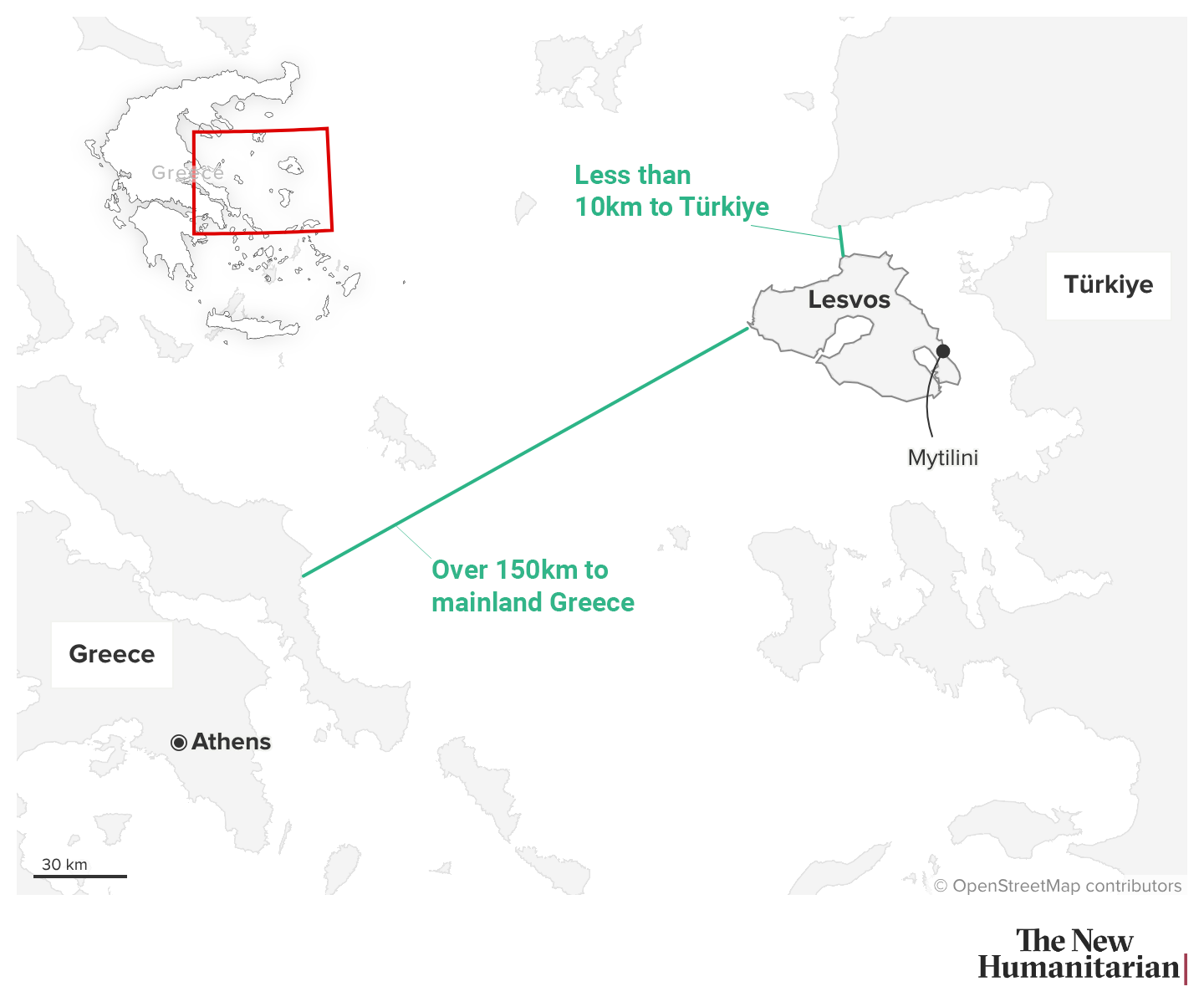
In March 2016, Greece, supported by the EU, drew a border around Lesvos and the other Aegean islands that only applied to people seeking protection. This policy, known as containment, trapped people for indefinite periods of time where they landed. It was coupled with the EU-Turkey deal, signed the same month. After that, the movement across the Aegean drastically reduced, although it never entirely stopped.
When I visited in 2019, rather than the thousands of people who arrived per day in 2015, the average was several hundred per week. But they couldn’t move off the island. Moria, the refugee camp on Lesvos, which had capacity to house fewer than 3,000 people, was hosting 13,500. Not for the first time, it had spilled out of its barbed-wire fences, filling the surrounding olive grove with tents and uncollected garbage. In September 2020, the camp – perhaps the most visible manifestation of the cruelty of European migration policies – burned to the ground.

(Left) Moria Refugee Camp in October 2019, when there were around 13,500 people in the facility. In September 2020, the camp burned to the ground. (Right) The site of the camp in May 2026.
When I went back in May this year, at first glance, it seemed that a mundane sense of normalcy had returned to Lesvos. The number of asylum seekers crossing the Aegean has dropped further as the main maritime migration route to Greece has shifted south to the island of Crete. There were only about 600 asylum seekers in the camp that has replaced Moria – mostly from Afghanistan, Sudan, Eritrea, Yemen, Palestine, and a smaller number from West African countries.
The immediate visual signs of the island’s role as a holding pen for people seeking safety were much less apparent. A few Turkish tour groups strolled through narrow lanes past the ruins of an Ottoman-era mosque and bathhouse. The cafes and restaurants were full, but the crowds of summer tourist season were still just around the corner. Moored fishing boats bobbed lazily in the surf.
Watching the sun sparkle off the turquoise Aegean, it was tempting to believe that this was all there was to see. But just beneath the surface was a darker reality, one that consisted of deadly violence, prison-like camps, punitive policies, and a hidden graveyard – the final resting place on the island for refugees who perish while seeking a better life.
More than anything, what returning to Lesvos revealed was the architecture of deterrence that Greece and the EU have constructed since 2015, its deadly consequences, and how both have been normalised and are increasingly being made invisible.
As a stark and tragic illustration of the point, two nights before I arrived, the Hellenic Coast Guard violently pushed a boat carrying 45 people out of Greek waters south of Lesvos, killing one person. It barely made the news.
Border violence
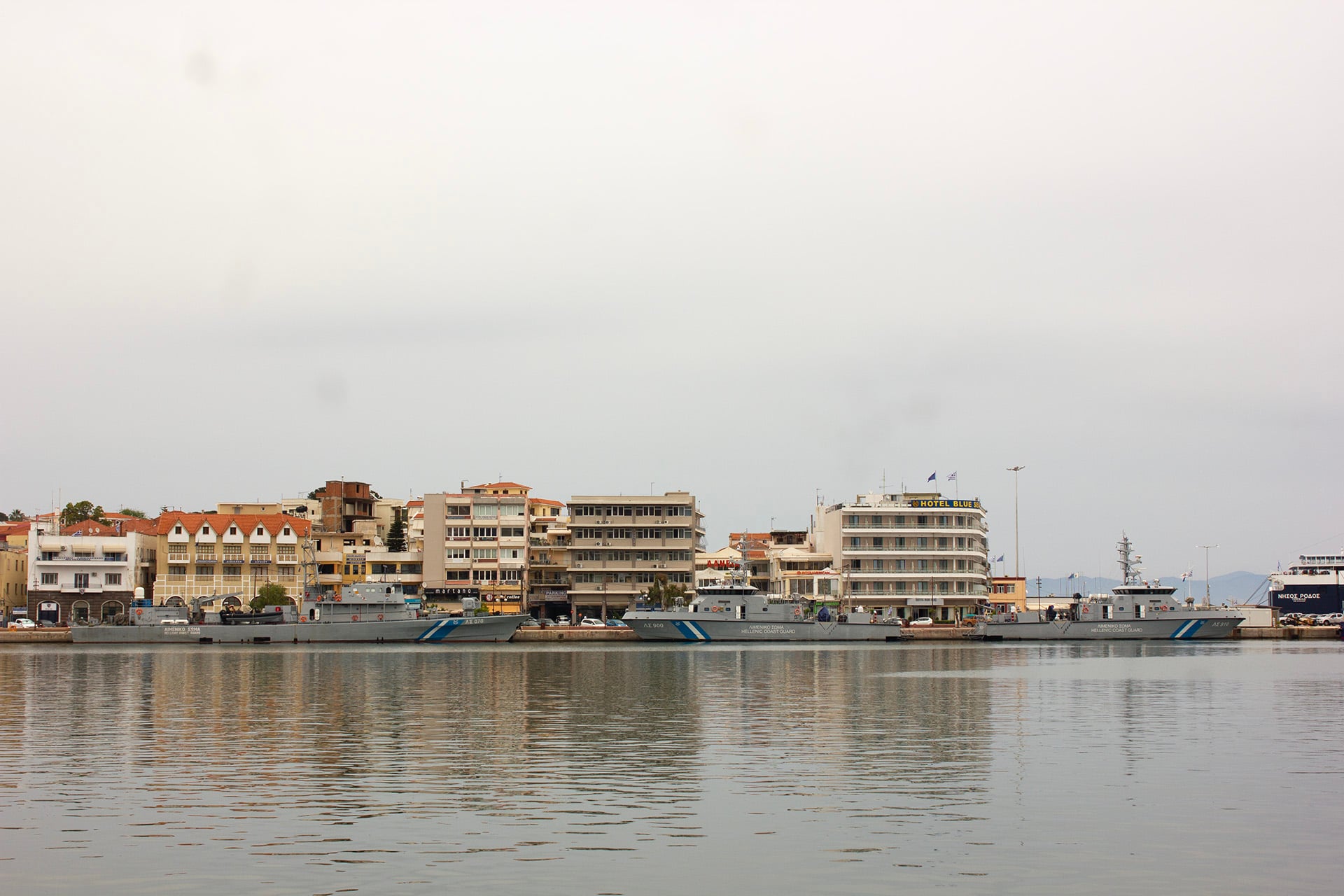
My first stop on the island was the offices of Legal Centre Lesvos, an NGO providing free legal services to refugees. The building they are in is one block from the port in Mytilini, Lesvos’ main city, where three grey Greek Coast Guard ships sat moored in the placid waters.
“The most urgent issue still is the systemic border violence,” Lorraine Leete, coordinator of Legal Centre Lesvos, told me. “I mean, you can see in the port the number of coast guard vessels that are here, and you can see that they go out at night.”
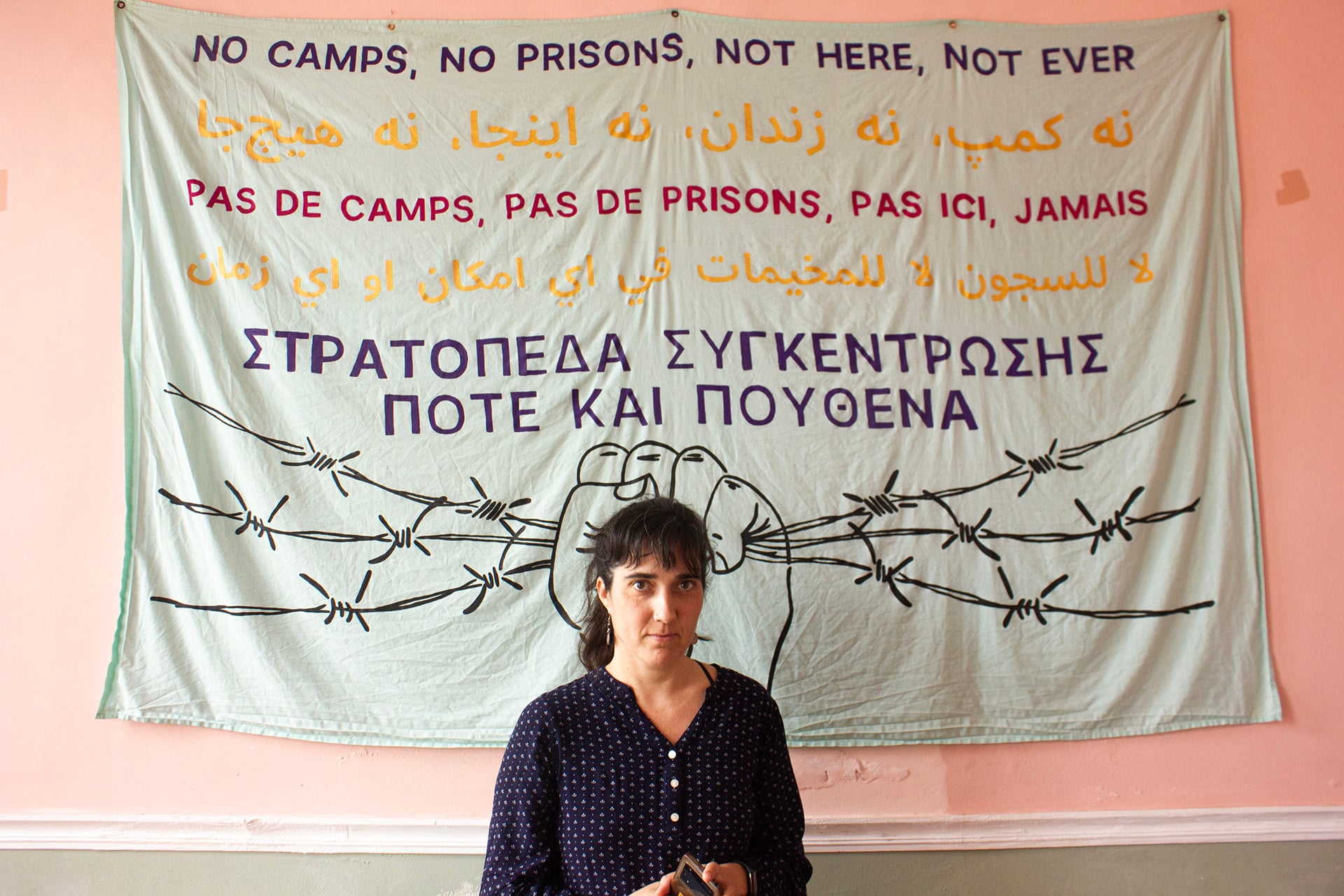
Leete is an American lawyer with a background in migration and international human rights law. She moved to Lesvos in 2016. The deadly pushback before I arrived was just one incident that happened to be reported. “It’s an invisible situation because, for the most part, it’s happening at sea, at night, where people aren’t able to document what’s happening and where people can’t really see the violence that’s taking place,” she explained.
Pushbacks – the practice of a state expelling asylum seekers from its territory to prevent them from applying for protection – are illegal under international law. But they have been Greece’s de facto border policy since March 2020.
In May 2023, The New York Times published a video investigation from Lesvos documenting Greek security forces and the Coast Guard bundling a group of asylum seekers – including women and children – into a van, taking them out to sea, and abandoning them on a raft. Condemnation rolled in, but Greek Prime Minister Kyriakos Mitsotakis defended the country’s migration policies as “tough but fair”.
A month later, the Greek Coast Guard intercepted a boat carrying around 750 asylum seekers off the coast of mainland Greece on the Ionian Sea and attempted to tow it out of Greek waters. It capsized, killing up to 650 people. Only 104 survived.
Last year, a Greek court finally pressed criminal charges against members of the Coast Guard – including the current and former heads of the agency – over the deaths. But pushbacks have once again slipped from sight.
Greece has cracked down on the aid workers and human rights activists monitoring what is happening. First, it was a case in 2016 against volunteers conducting search and rescue activities at sea. Then, charges were brought in 2018 against an NGO providing aid to people on the shoreline when they arrived. Just this year, Greece attempted to extradite a Norwegian activist facing charges for monitoring border violence from afar – although Norway rejected the request.
“The frontline is getting pushed further and further back,” Leete said.
There used to be humanitarians at sea or on the coastline observing what was taking place, in addition to providing help. Now, most of the evidence about ongoing border violence comes from the testimonies of people who manage to make it to the islands – although many are understandably afraid to talk about what they experienced.
Walking past the Coast Guard vessels in the port after interviewing Leete, I could see a few sailors moving about on their decks, their presence seemingly ordinary and unremarkable. Had one of these boats, and its crew, carried out the pushback that killed someone a few days before? How many other similar incidents had they been involved in over the years, and did anyone else milling around or sipping afternoon coffee nearby even know?
The road to Kara Tepe
The following day, I set out to see the current camp on Lesvos – officially called a Closed Controlled Access Centre (CCAC). Known as Kara Tepe camp, it was set up to be a temporary solution after Moria burned down in 2020.
The Greek government has built another facility on Lesvos to hold refugees – one of five supposedly model camps on the Aegean islands constructed with EU funds. It is 30 kilometres from Mytilini, in the middle of nowhere. The project has cost €76 million (around $87 million), but the camp has yet to open due to a series of legal challenges, planning blunders, and opposition from the local community.
The current Kara Tepe camp is a little over four kilometres outside of Mytilini along the main coastal road – close enough to walk, although it takes around an hour. Many of the people staying there have no other choice because Greece has not provided regular cash assistance to asylum seekers since April 2024 (despite receiving money from the EU to do so), which means even the cost of public transportation can be prohibitive.
Walking along the road was the first time the presence of asylum seekers on the island became apparent. A few rode past on bicycles, while others were making their way to or from the camp on foot, outside of the facility’s curfew hours. One I approached to talk to was Alvin, who was from Sierra Leone and about to turn 22.
Alvin, who asked to be referred to by only his first name, had lived in Freetown, Sierra Leone’s capital, his whole life, until what he said were security reasons forced him to leave in November 2024. He declined to elaborate on what exactly pushed him to begin his journey, but what he experienced along the way before reaching Lesvos in February this year was a reminder of all that people seeking asylum go through before they even set foot on European soil.
Alvin was never planning on coming to Europe, let alone Greece. Like many, his main thought when leaving his home was getting away from whatever it was that caused him to flee. His first stop was neighbouring Guinea, but the connections between there and his home were too close, and it didn’t feel safe. Someone suggested Türkiye as a country that he could get to and where he could find work. But once he arrived, there was no way for him to seek asylum or get residency. His only choice was to live undocumented.
After about a year in Istanbul, Turkish police caught Alvin and threw him in a detention centre. “The condition in the prison was very hard, and some people even lost their life because [the prison authorities] don’t want to cater for your basic needs,” Alvin said.
He was held there for about six months. When he was released, Turkish authorities gave Alvin 15 days to leave the country or risk being detained again. It was while he was in the detention centre that he shared his story with Afghan and Sudanese friends he made. They suggested he go to Greece and seek asylum.
Alvin’s first attempt to cross the sea did not go well. After about 30 minutes, “they caught me,” he said. “Actually, I saw people dying in the sea.”
Whoever “they” were was ambiguous – either the Greek or Turkish coast guards. Alvin said he couldn’t tell, but he ended up back in Türkiye. On shore, he saw the bodies of people who had drowned being put into body bags. “I actually saw that. That was not behind my back. It was in front of me,” he said.
On his second attempt, Alvin made it to Lesvos. His asylum case was still pending when we spoke, but he was relieved not to be in Türkiye. “This is much better because at least here I have the opportunity to seek asylum… So I have hope,” he said. “Back in Türkiye they did not give me the opportunity.”
Camp conditions
Hope can be relative. It is also fragile, and the Kara Tepe camp where Alvin was staying while waiting for a decision – as with Moria before it, and other camps throughout Greece – is a place where hope has often been eroded and, sometimes, entirely snuffed out.
Several weeks before I arrived, I wrote to the camp’s management asking to arrange a visit. My request was turned down, citing “an emergency internal inspection” that was “currently underway” and that I was told would not be completed until June – well after I left. So the only view I got was from outside the barbed-wire fences marking its perimeter.
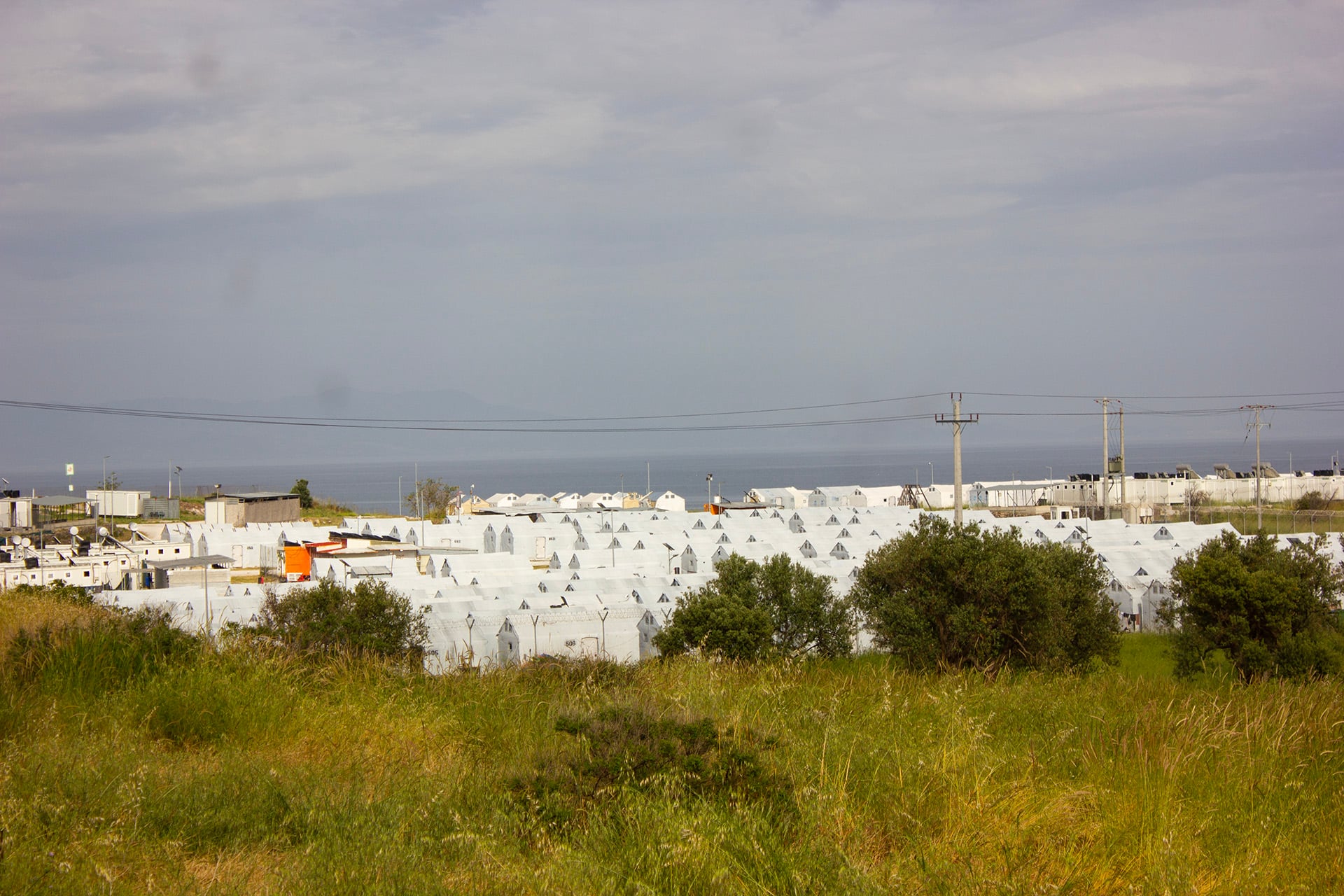
The EU-funded camp is huge, with capacity for around 4,000 people. Its white tents and prefab housing containers spread across the low-lying areas of a peninsula divided by a tall hill. A guard from a private security company paced in front of the main gate wearing a neon vest. Greek and EU flags flew from separate poles, both beginning to fray.
The camp has never met the EU’s own reception standards, according to Christos Nikolaides, Area Manager for an NGO called Boat Refugee Foundation (BRF), who I spoke to over coffee before going to see the facility.
It was hastily built in 2020 at the sight of a military firing range, raising concerns about dangerous levels of lead toxicity in the soil. There were reports of asylum seekers finding unexploded mortar shells and unspent ammunition after it opened. The low-lying location also meant that it has repeatedly flooded during winter rains. Everything from food to the showers to medical care has been a perennial problem.
BRF runs a nighttime medical clinic inside the camp when doctors from an EU-funded, Greece- and IOM-run primary healthcare programme are off duty. The quality of treatment provided by the Greece-IOM programme is severely lacking, according to multiple NGO workers I spoke to. As a result, the BRF clinic sees 20 to 25 people per night, according to Nikolaides. “We get a lot of suicidal ideation, a lot of stressors, a lot of things that come to the clinic,” he said.
Over a decade after 2015, and with far lower numbers of people and plenty of funding, Greece and the EU have had an ample amount of time to build facilities and develop a refugee reception system that should provide for a basic level of dignity. It doesn’t make sense for conditions to be so persistently poor that they are contributing to suicidal levels of despair – unless providing a decent place for people to stay during their asylum procedures is not the goal.
“It’s not that it would be difficult to provide people with better services,” said Sophie Baylac, country coordinator for Médecins Sans Frontières (MSF) in Greece, who I spoke to in Athens after leaving Lesvos. “It’s as if the system is designed to put more harm on the people.”
The cultivation of despair is also part of deterrence.
Out of sight
It is in this context that the new camp, known as Vastria, after the area where it was built, begins to make sense. The day after I walked to Kara Tepe, I rented a car to go see it for myself.
The drive from Mytilini takes about 45 minutes, but I was coming from the north of the Island. Turning off the coastal road, I wound through hills toward the island’s interior. Eventually, I passed a garbage dump, with crows circling overhead.
Just on the other side, a pristine, newly paved road appeared out of nowhere. The pavement descended into a valley blanketed by scrubby pine trees, until suddenly, around a bend, the camp materialised in front of me: sterile white, massive, and eerie in its emptiness behind imposing fences.
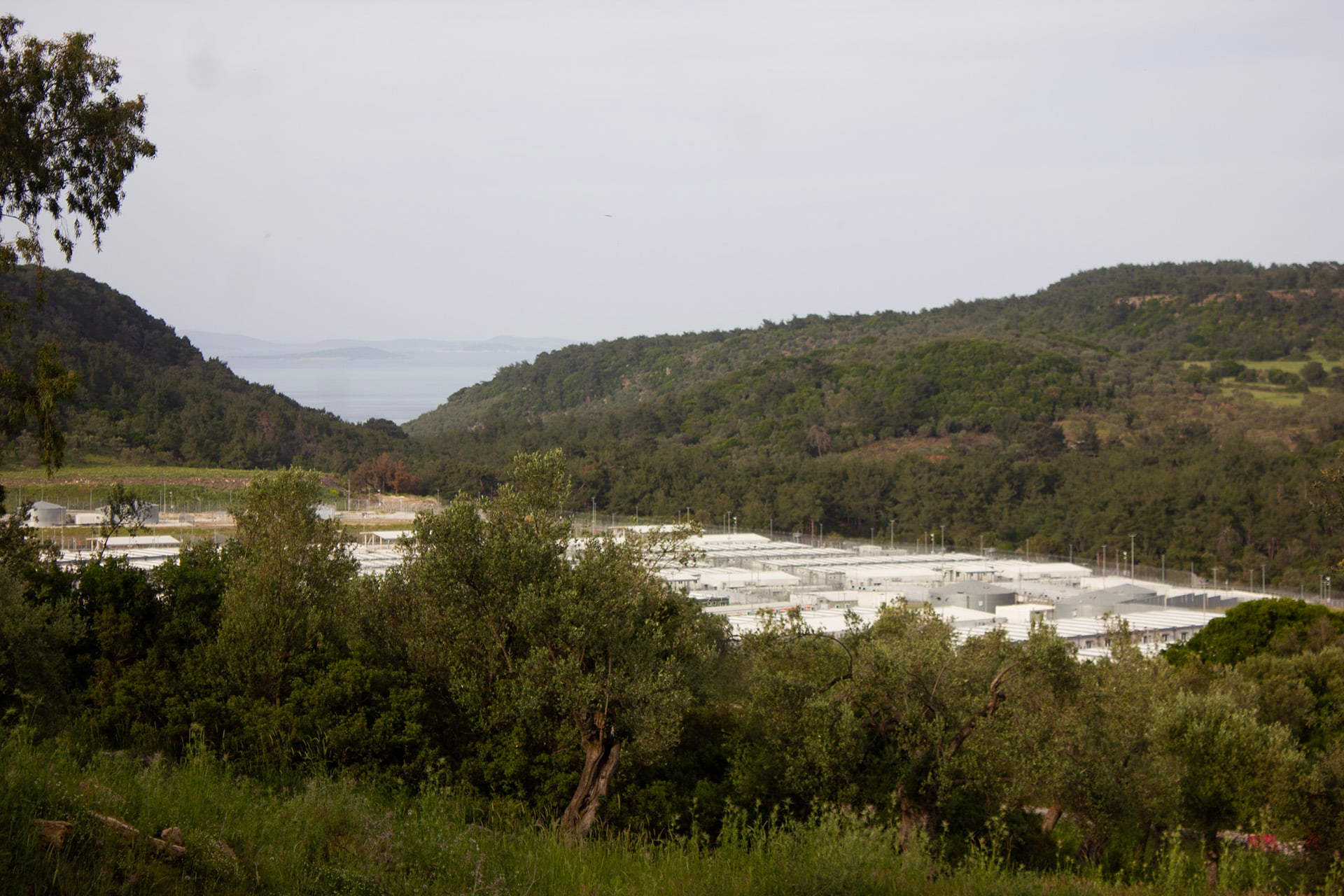
Before I could get my bearings, or even get out of the car, a lone guard, visibly irritated by my presence, emerged from the gate. The only words of English he apparently spoke were “problem”, “leave now”, and “go”. As I retreated along the flawless asphalt, I spotted an access road, out of sight, that went up a hill behind the camp. I parked and followed it to its highest point, and then climbed a rock to snap a few photos over the tops of the trees – the best I could manage given the circumstances.
Around me, the wind whistled through the valley, which opened up to a breathtaking view of the Aegean with the shadow of the Turkish coastline on the hazy horizon. As I walked back to the car, the air filled with a soft cacophony of bells clanking around the necks of goats, only interrupted by the occasional bleat.
This desolate facility – below a garbage dump, in an area prone to wildfires, and completely hidden from view – will be the new accommodation for asylum seekers on Lesvos once it opens, which, despite the delays, everyone I spoke to said is likely just a matter of time.
Regardless of EU rhetoric about dignified and safe living conditions, Vastria and the other camps in Greece have been, and continue to be, an instrument of deterrence. The locations chosen for them, what they look like, and the conditions within their fences are a message to would-be asylum seekers about what awaits them if they come.
The problem, however, is that people who are escaping war, persecution, genocide, and societies collapsed by protracted crises (in which the West almost always plays a role) are first and foremost concerned with reaching relative safety, and so some continue to come.
Continuum of violence
Everyone in the current camp – like those who passed through Lesvos before them, and who will continue to pass through after they leave – have had their lives upended by some kind of trauma. They have also experienced precarity, deprivation, abuse, and violence on their journeys, including at Greece’s borders by the same authorities whose care they are now under.
The waiting period for a decision on their asylum claim, which can last anywhere from a few months to a year or longer, is full of anxiety. Will their claim get rejected? Will they be deported? How can they imagine or plan for a future that seems entirely uncertain?
“In the past, Lesvos was still a transit place. People had hopes and dreams and plans, even, to go to Germany, to go meet their family in Sweden or wherever. You had an end goal there. Now, you don’t really,” Nikolaides said.
The rise of anti-migrant politics across the EU since 2015 has resulted in a cascade of policies in member states that have made it more difficult for people to find stability throughout the bloc – with Greece having introduced some of the harshest measures.
Last September, the centre-right government, in office since 2019, passed a law that gives people whose asylum claims are rejected 14 days to leave the country or face prison sentences of two to five years. The law also introduces a €10,000 fine for people found guilty of entering the country illegally and raises the amount of time people can be detained for arriving without paperwork from 18 to 24 months. Leete and others I spoke to said they are seeing an increasing number of people detained and imprisoned under its provisions.
The Greek government also recently announced that it will provide cash bonuses of €250 to state-appointed lawyers who convince their asylum seeker clients to withdraw their claims and leave.
Both of these measures come amid an EU-wide push to increase deportations, which critics have said mirrors the immigration policies of US President Donald Trump. It’s not a coincidence, then, that almost 40% of Vastria’s 5,000-person housing capacity has been constructed as a detention centre for people awaiting removal.
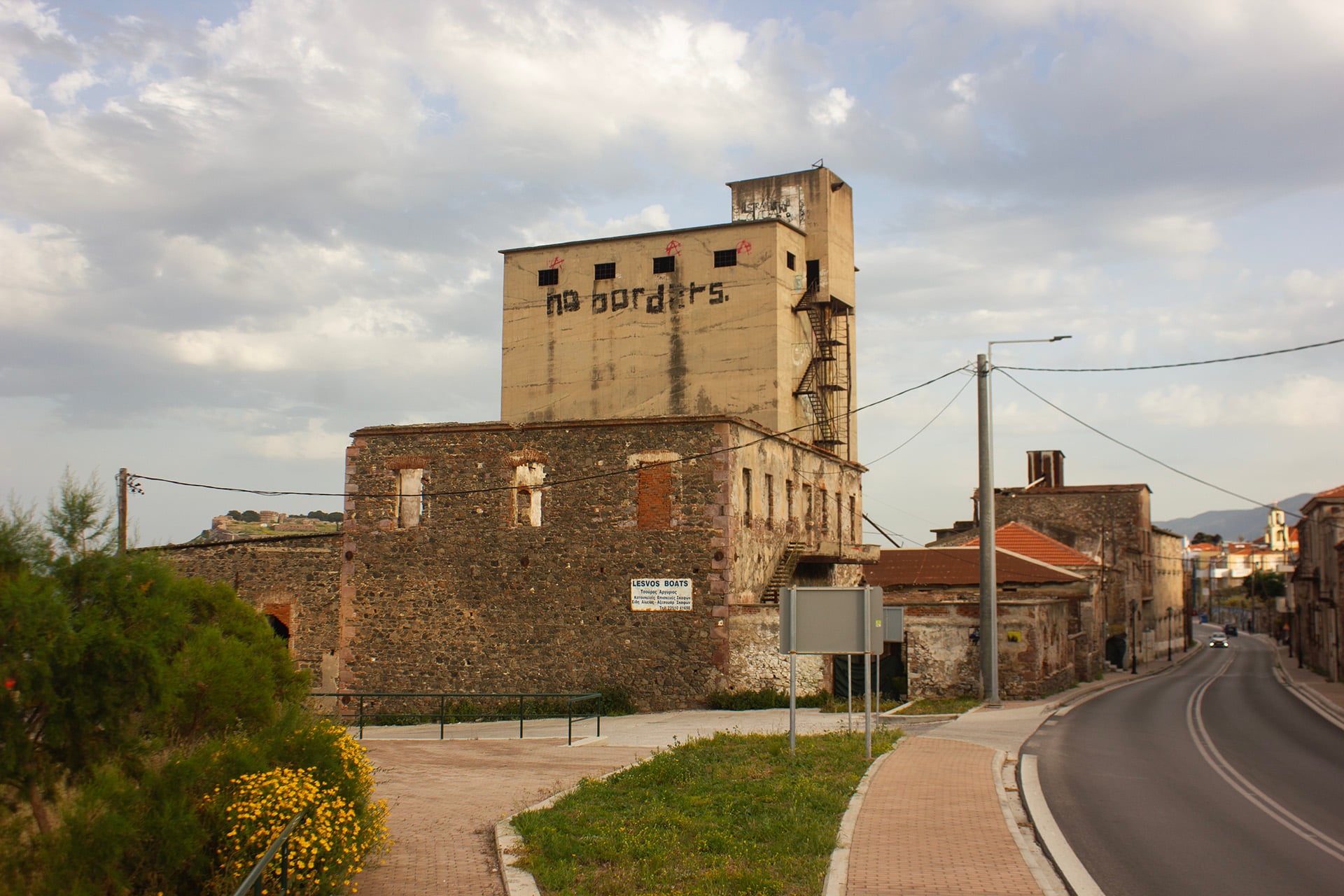
Before this, existing policies had already made it more difficult for asylum seekers to access protection and had stripped away support. The result is a situation where people who are granted asylum have little hope of building a life in Greece, according to Leete. Many travel to other EU countries, but an increasing number are being deported back to Greece, or are returning on their own, because EU rules prevent them from getting legal residency elsewhere, she added.
As for those who are rejected, they can either leave on their own or potentially spend years cycling through prison and detention: Many can’t be deported because Greece and the EU don’t have readmission agreements with the countries they come from.
MSF refers to what asylum seekers experience in Greece – from pushbacks at the border and conditions in the camp to the policies that make establishing a stable life nearly impossible – as a continuum of violence. “It’s a vicious circle,” said Mitsos Papanikolaou, MSF’s humanitarian affairs manager, who I also spoke to in Athens. “No matter which stage of migration you are in, you experience it.”
It can also be deadly. In February this year, a 44-year-old Congolese asylum seeker named José Kiesse committed suicide on Lesvos after repeated rejections of his asylum application. He had been on the island for six years, first in Moria and later in Kara Tepe. His death was far from the first from suicide in Lesvos’ camps.
Made invisible
My last stop on Lesvos was a graveyard, established in 2015, for refugees whose bodies were retrieved from the sea after shipwrecks or who died once they reached the island from various causes – disease, fires or carbonmonoxide poisoning in the camps, car accidents, suicide.
There’s no way I would have found it if someone hadn’t sent me a pin of the location – like the new camp, it was entirely hidden from view. I turned off a road running along the edge of one of the island’s natural gulfs and followed a narrow lane that ran between olive groves until I came across a blue gate. Inside, nestled in a small field of scrubby grass, I counted over 220 graves, many in varying states of disrepair.
One of the graves was for Zaynab Mansrai, a baby girl who was born on 29 January 2022 and who died on 9 December the same year, before she even reached her first birthday. Another was for Netbakht Nazari, born 1 January 1934 and died 4 June 2021, at the age of 87. It had an inscription that read: “My kind mother, your soul is happy”. Most of the graves, however, were simply marked “unknown”.
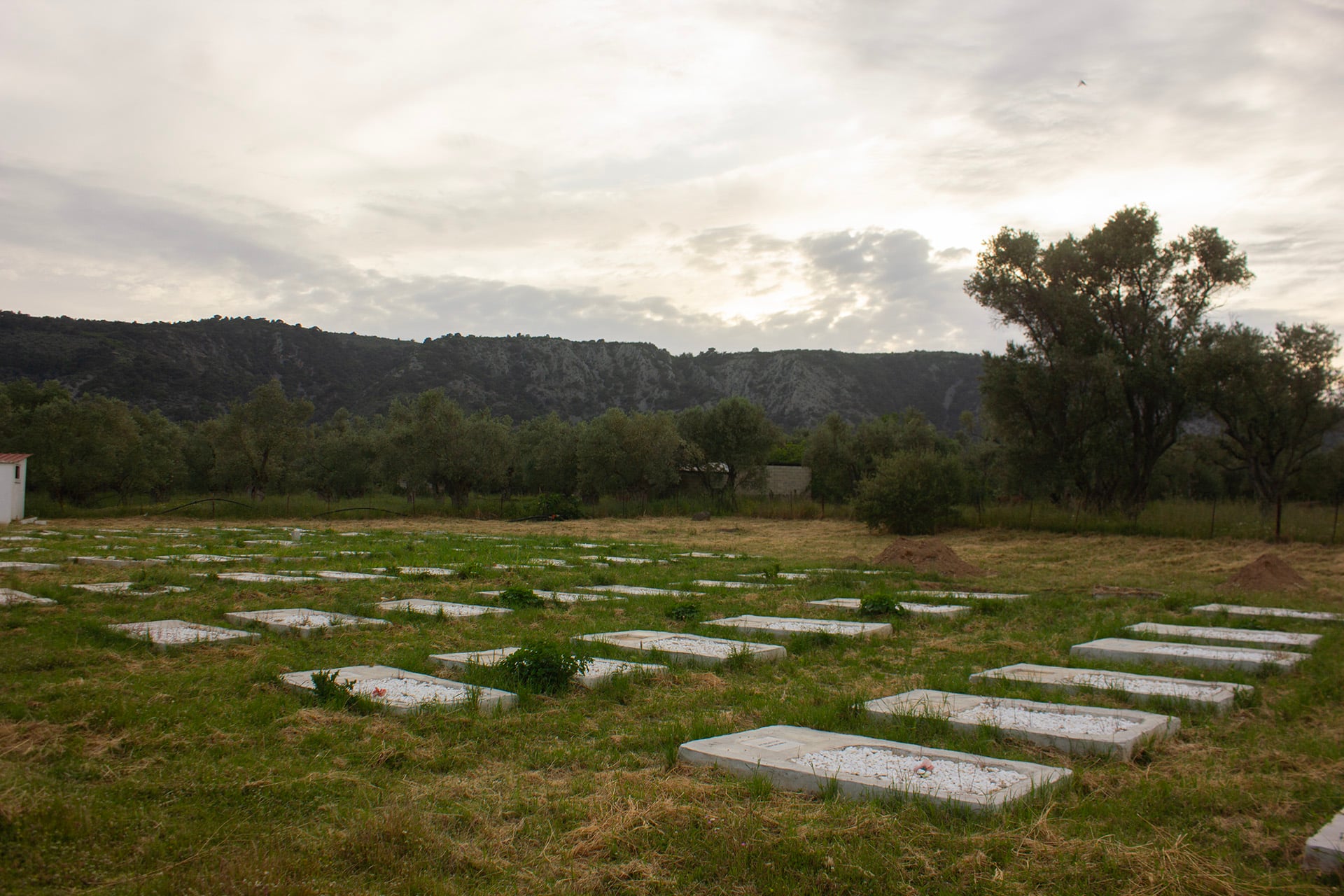
As I left the cemetery, the sun was setting over the mountains, sending shocks of orange, pink, and red across the sky. I thought about all that I had seen and heard about since returning to Lesvos, and felt incredulous.
The number of asylum seekers on the island was significantly lower than my past visits, but to focus on the number alone misses the bigger picture. The web of practices, infrastructure, and policies put in place to dissuade people from coming by enacting various forms of violence on those who arrive – the architecture of deterrence – should be a scandal. But it hardly registers on the global radar anymore.
Since my last visit, the world has passed through a period of mass death during the COVID-19 pandemic, witnessed Russia’s invasion and ongoing war in Ukraine, and watched Israel carry out a genocidal war in Gaza – to name just a few of the seismic events of recent years.
Along the way, it is hard to shake the feeling that something has hardened, that our collective tolerance for death and cruelty has increased. What is the significance of the plight of several hundred people in a camp at the EU’s outer border, and a few hundred deaths per year in the Aegean, in the grand scheme of things – especially when weighed against what Western societies have evidently decided is the greater good of stopping migration?
Perhaps our standards have also slipped as we’ve watched countries that espouse the importance of human rights and the rule of law selectively apply, or readily violate, both – time and time again. How can those who continue to care appeal to higher values, when those values have been exposed as self-serving and disposable? What leverage for change actually exists?
The risk is that what should be intolerable becomes normalised, whether through indifference, numbness, cynicism, or despair.
When I spoke to Leete, she reflected on the extent to which this is the case on Lesvos. “I remember when I arrived here, the fact that people were trapped on the island and couldn’t continue their journeys to Athens, this was the main point of struggle – that an artificial border had been created where there is no border,” she said. “This is now taken as a given… there’s no border between here and Athens, but it’s somehow accepted.”
Edited by Irwin Loy.


