


Share & more
Almost three years after the beginning of the Gaza genocide, I am publishing a book of poetry about a house that no longer exists, in a language my mother cannot read, in a country where my family cannot follow.
The first two poems I wrote in my life were called Lemon Tree and Hope. I wrote them two or three months after the genocide began in a purple notebook that my sister gave me as a gift, in my now destroyed childhood home, about a tree I will not see again.
The book is named for that house, and it will be published in French on 9 September. When the collection comes out, I will be asked to sign copies of it in a city where nothing that belonged to me has ever been demolished.
The book is called This is My House – in French, Ceci est ma maison. The title has a double meaning. It refers to the house in the north of Gaza where my brothers were married, where my older sisters gave birth, and where their children learned to walk on a rooftop that I could describe to you tile by tile. It also refers to Gaza, my home and the home of more than two million other people. Both have been reduced to rubble.
I want to tell you how I learned that my childhood home had been destroyed because the shape of that experience is the shape of exile: It was at the end of September or early October last year when our neighbours saw the destruction. They told my family, and my family told me. That was the order. The people standing in the street knew before its owners, and I – writing a book about it – was the last to be told.
Distance is not a feeling. It is a delay measurable in hours, and I have been at the far end of that delay since I crossed the border and left Gaza in July 2025. Perhaps I will be at the far end of it for the rest of my life.
I was the last to find out about the destruction of my own house, where I lived since I was five. I was in my room studying when I found out, the French daylight filtering through the window in a country where the electricity does not go off, from a voice on a phone that had already said it out loud to someone else first.
◇◇◇
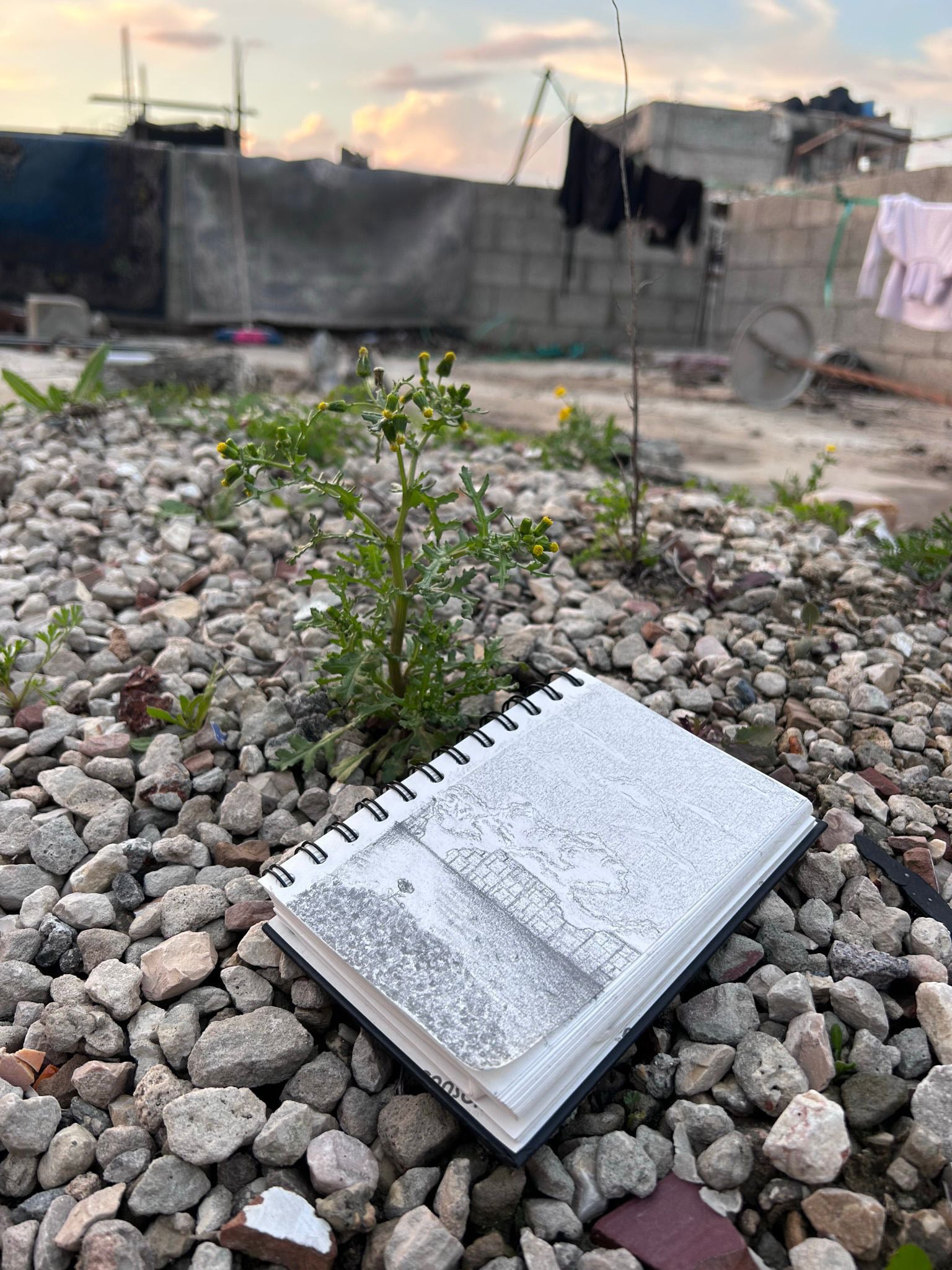
Everything that was in the house was lost. The oil paintings I had made and never showed to anyone – some of them finished, some still works in progress. My books in three languages, Arabic, English, and French. The room I wrote in. The walls that held space for weddings and births. The rooftop. The particular way the afternoon light came into the kitchen.
A house is not just a structure. It is a set of instructions for where the light falls in space, and those instructions have been deleted from the world. There is no copy. Except one. It is not a good copy, but it is what remains, consisting of over 50 poems in a language I was not born into.
The poems are not gentle memories. I have not been able to write about anything except this: the house; the yearning for what no longer exists; what has been done to the people who called it home; the children killed in numbers that stopped being numbers; massacres that have names in Arabic and no names at all in the papers here; a boy who is now alone in the world because everyone who knew his name was killed on the same afternoon and who is expected to keep waking up.
I did not choose these subjects. There was nothing else in the room.
I wrote the poems for myself and for my family. That was the readership I imagined. I did not intend to create a manuscript. The poems were phrases in notebooks I already owned and that I was already using for something else. There are French verb tables in those notebooks and lecture notes.
I was not making a book. I was catching sentences before they disappeared like everything else.
When I started writing the poems I was a student of English and French literature. My university’s campus was destroyed, like virtually all the university campuses in Gaza. The university continued teaching online throughout the genocide, and I continued attending – which sounds absurd. So was scrawling half a line of a poem about a dead child at the top of a page about the subjunctive. I was not making a book. I was catching sentences before they disappeared like everything else.
I wrote the poems in English even though Arabic is my first language. I’ve never been able to fully account for that. Maybe writing in a foreign language allows for more emotional distance. The words land with less force. The pictures they summon are dimmer.
English was not a literary choice. It was a pane of glass. In Arabic, everything would have been too close and loud.
Dimmer is what I needed. English was not a literary choice. It was a pane of glass. In Arabic, everything would have been too close and loud. In English, I could stand on the other side and look in.
Every poem in this book was written through that pane of glass by a woman who could not have written a word of it without that separation. But that pane of glass also disappears, even in a second language, when I write about my mother or my younger sister. I can write in English about a child I never met, but I cannot say my own address out loud.
◇◇◇
The poems left me before any publisher was interested. I started reciting them on Instagram while I was still in Gaza. People responded, and I liked that they responded.
Some of the notebooks I wrote the poems in were destroyed with the house. Some stayed behind with my sister. What is being published is what escaped from a fire and across the borders. My first book is the surviving portion of something that was never assembled.
There is a moment in every one of these conversations where the interviewer asks a perfectly reasonable question and I cannot answer.
Then it was translated, and the translation is extraordinary. Lisa Ducasse did what I would have told you could not be done. Writers I know and trust, Karim Kattan among them, have said so too, and they are right. I want to state my admiration without a single qualifier attached to it. And still, reading it, I meet a stranger who knows everything about me.
Now, I sit down for interviews to talk about the book. There is a moment in every one of these conversations where the interviewer asks a perfectly reasonable question and I cannot answer. I stop. The kind person across from me waits. The waiting becomes its own weather in the room because now I have made them uncomfortable, and I find myself apologising to someone for the destruction of my own street.
At the launch event in Paris, there will be a table with volumes of the book piled high. My name will be said into a microphone. People will be genuinely moved, and then they will go home, which is the correct thing for them to do and I hold it against nobody. There will be a picture of me smiling, and the smile will be real because this is the thing every writer is supposed to want, and there was a girl in that house who wanted it more than she wanted almost anything else.
At the same time, my mother will not be in the room, nor will my younger sister. Neither can read the language the book is printed in.
Both of these things are true at once, and neither cancels out the other: This is my dream, and it has been handed to me in exchange for everything I had. Nobody consulted me on the rate.
◇◇◇
There is one more thing – the worst of all – which I am going to set down rather than continue to carry: The book matters because Gaza is still happening. Its relevance is my family’s ongoing danger. I wrote the poems because I wanted people to look and see what was happening. That was always the whole of it. I didn’t want people to look away.
In Paris, when they look at me they might see a woman who evacuated from Gaza to continue her studies at one of the best universities in Europe. But it turns out that being looked at and being read are not the same thing. When people read, they might understand the pain and agony of what we have gone through.
The book matters because Gaza is still happening.
If you pick up the book, know that these poems were written by a student who still had French homework, in notebooks that mostly no longer exist, for an audience of her mother, her sister, and herself. And notice the tense of the title – This is My House. The house is gone, but the sentence is in the present tense.
A demolition takes an afternoon, but a house can be kept somewhere else, in a borrowed language, between two covers, as long as someone is still reading the words.
Edited by Eric Reidy.


