


Share & more
The conflict in Ethiopia’s northern region of Tigray moved a step closer to triggering a wider conflagration last week when Eritrean forces crossed the border, and Ethiopia hit back with two days of drone strikes on the troops and equipment.
Eritrea denied multiple reports of the incursion, and framed Addis Ababa’s condemnation as amounting to a “declaration of war” and a pretext for the landlocked country to grab the Red Sea port of Assab.
However, local sources told The New Humanitarian that Eritrean forces took part in clashes in multiple locations over the past few days, including at Adi Hageray, about 60 kilometres from the city of Shire, in northwestern Tigray.
It has been long-feared that Ethiopia’s internal political and security crises could merge with geopolitical rivalries and turn into an all-out regional war that would prove difficult to diplomatically contain.
The humanitarian fallout would also be immense, especially for Tigray. Four years after the last war ended in 2022, about a million people remain displaced, and close to four million – more than half of Tigray’s population – are in urgent need of aid.
There have already been warnings that this year’s drought – against a background of a still shattered local economy and ongoing difficulties in delivering humanitarian supplies – could result in pockets of famine.
Below we analyse the interlocking local and regional tensions, and present three scenarios – all grim – over how this conflict could develop over the next six months.
The new alliances
Although a turning point, the capture on 3 October of the Tigrayan regional capital of Mekelle by the federal army and a pro-government militia, the Tigray Peace Force (TPF), is unlikely to mark the end of the conflict.
The political and military leadership of Tigray’s ruling party, the Tigray People’s Liberation Front (TPLF), had already withdrawn before the city fell, heading into the northern countryside pledging to continue the fight. It’s in this context that the arrival of Eritrean forces – new-found allies of the TPLF – should be seen.
The return to conflict in Tigray is the death knell of the problematic ceasefire agreement that ended the 2020-22 Tigray war, but which failed to lay the groundwork for a sustainable peace.
Frictions had escalated over the years between Addis Ababa and the TPLF, but also internally in Tigray – as reflected in the formation of the TPF. More broadly still, an anti-government coalition, the Alliance for Survival, emerged last month involving seven armed opposition groups.
These included the TPLF, Fano, the Oromo Liberation Army (OLA), alongside smaller insurgent groups from Benishangul-Gumuz, the Somali region's ONLF, and Uguugumo – an Afar rebel group stationed in Eritrea.
The new alignment flips the coalition that was behind the last devastating war. Then, the Eritrean army and Amhara regional militia fought alongside federal forces. This time the militia-turned-insurgents, under the banner of Fano, are determined to overthrow the government of Prime Minister Abiy Ahmed.
However, the insurgent alliance exhibits the same ideological incoherence that ails Abiy’s ruling Prosperity Party, which has recently integrated splinter factions of the TPLF, Fano, and OLA. The political divergence spans key issues, including the constitution, interregional territory disputes, and the legitimacy of identity politics.
Militarily, the TPLF and Fano strategy appears aimed at linking southern Tigray with the northern Wollo zone of Amhara – creating a contiguous rebel corridor. While the federal army has managed to penetrate deep into Tigray, Fano has reported it has captured a series of towns in southern Wollo and northern Shewa zones of Amhara, close to Addis Ababa.
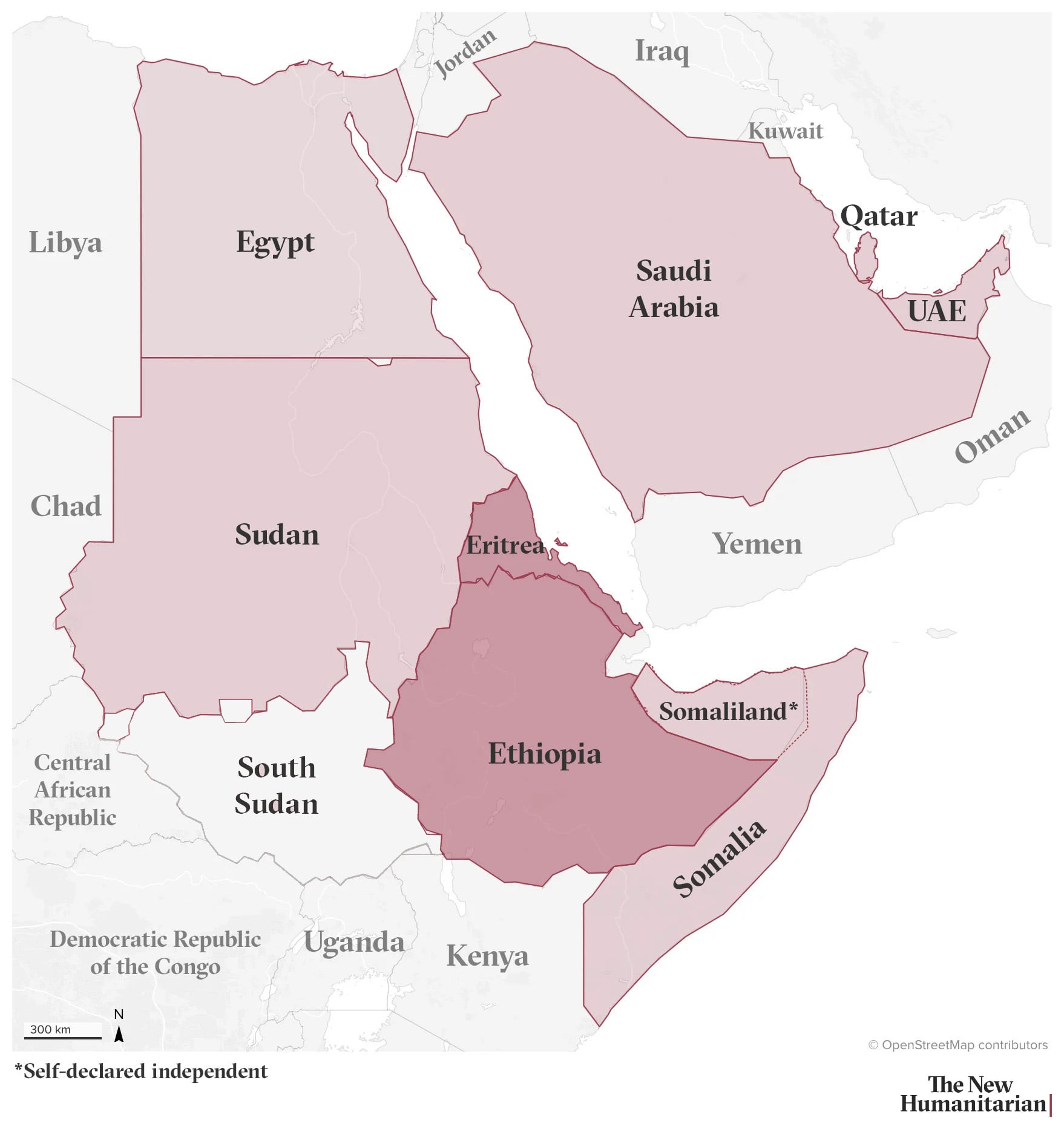
There is also a wider regional dimension to the hostilities. After accusing Eritrea, Egypt, and Sudan of supporting the alliance, Ethiopia this month closed the Eritrean embassy and PNGed an Egyptian diplomat. Denying the allegations, the three countries joined Somalia to issue a joint declaration that crystallises a shared containment approach to Addis Ababa’s perceived expansionist ambitions.
Seeds of conflict
When Abiy became prime minister eight years ago it was with sweeping regional goodwill. He helped broker a political transition in Sudan, forged a tripartite pact with Eritrea and Somalia, and even won a Nobel Peace Prize for his rapprochement with Eritrea’s President Isaias Afwerki. Egypt also joined the bandwagon and extended diplomatic niceties.
Domestically, Abiy used the Amhara and Oromo wings of the then-ruling EPRDF which brought him to power – alongside opposition groups returning from Eritrea and elsewhere. They rallied around him to sideline the TPLF, politically dominant in Ethiopia for almost three decades.
When war erupted in 2020, Eritrea – with mutual longstanding enmity toward the TPLF – joined the conflict alongside Amhara paramilitary forces it had been training with the blessing of the federal government. The UAE was another key ally, delivering combat drones that gave Addis Ababa a decisive military edge.
The military pressure, coupled with a devastating humanitarian siege, compelled the TPLF to accept the lopsided ceasefire deal with Addis Ababa in November 2022. Eritrea was not a signatory to that agreement and was reportedly opposed to it.
Eritrea’s Isaias also criticised Abiy’s attempt to scale back the wartime bloat of the Amhara paramilitary forces. That move – widely interpreted as an attempt to sideline the region while leaving the TPLF armed – triggered an amorphous insurgency under the banner of Fano.
While Eritrea has long regarded security ties with pro-Asmara forces in Amhara as a strategic goal, Addis Ababa has also looked in turn to undermine Eritrea. It has been courting opposition groups that hail from the country’s central and eastern regions such as the Blue Revolution movement and RSADO, respectively.
As the post-ceasefire peace process collapsed, Eritrea undertook a rapprochement with the TPLF. Addis Ababa countered by helping TPLF dissenters set up the pro-government TPF militia in the neighbouring Afar region.
When the chair of the recently consolidated Amhara Fano National Movement appeared on the Tigray government's TV station on 20 September to announce the formation of the Alliance for Survival it was a major surprise.
Behind the scenes, however, Fano leaders and commanders of the OLA – which has been fighting in Abiy's home region of Oromia since 2019 – had been travelling to Tigray for some time. They had also met in Sudan along with Eritrean officers to reportedly discuss joint military planning.
A hostile neighbourhood
Abiy has squandered the regional goodwill he once enjoyed. His most contentious move was demanding a port for Ethiopia, declaring in 2023 that it was the country’s historic right.
The most obvious candidate for that ambition was the Eritrean port of Assab, which had been part of Ethiopia until Eritrea's secession in 1993. When Abiy subsequently pivoted to the port of Berbera, signing an MOU with breakaway Somaliland for a naval base, Somalia joined the anti-Addis Ababa axis.
Egypt, a close ally of Eritrea, is also at loggerheads over the Renaissance Dam on the Nile, which Cairo fears gives Ethiopia leverage over the river’s vital downstream flow.
Sudan’s government has a grievance over Ethiopia’s alleged meddling. The paramilitary-turned-rebel Rapid Support Forces (RSF) has reportedly established a base in Ethiopia’s Benishangul-Gumuz region, about 30 kilometres from the Sudanese border. UAE-linked cargo flights have also been tracked transporting weapons to the RSF via Ethiopian air bases.
These new regional alignments have ripened at a time when a direct confrontation between Ethiopia and Eritrea seems imminent.
Strategic scenarios
Backed by intense drone strikes, the federal army and TPF have captured the major urban centres of Aksum and Adigrat vacated by the TPLF in Tigray. The TPLF has since announced a switch in tactics to “mobile warfare”, but its long-term success remains uncertain. However, the federal army faces a significant threat in central Ethiopia, where Fano's recent battlefield gains could sever vital federal supply lines.
Meanwhile, a diplomatic off-ramp seems unlikely. The strategic Red Sea zone and navigation through the Bab el-Mandeb has elevated the geopolitical value of Ethiopia and Eritrea – as evidenced by the lifting of US sanctions on both countries last month.
There is also the influence of the Gulf states. These so-called "middle powers" have effectively paralysed diplomacy in Sudan for years – with Saudi Arabia and the UAE on opposite sides of the conflict. Similar geopolitical competition is at play in the Ethiopia-Eritrea dispute.
With limited prospects for preventive diplomacy to work – at a time when the UN and African Union are at their weakest, and the US apparently disinterested – here are three potential trajectories for the conflict over the next six months.
Scenario 1: Armed groups proliferate
Eritrean troops stop their incursion but continue providing logistical support in particular to the TPLF and Fano. Addis Ababa steps up sponsoring proxies against Asmara and also looks to fragment the opposition at home – as indicated last week by the formation of the pro-government Amhara Peace Force.
That would result in the proliferation of armed groups, further civilian casualties, and complicate any political resolution.
Scenario 2: A grinding stalemate
The alliance’s rhetoric suggests a campaign reminiscent of the one that toppled Mobutu Sese Seko in then Zaire in 1997, when a rebel coalition – backed by neighbouring armies – swept through the countryside and on to Kinshasa.
That optimism doesn’t account for the UAE’s dedicated backing of Addis Ababa. Even assuming the insurgents manage to successfully field their own armed drones, their realistic short-term gains would be limited to the rugged highlands – locking the country’s north into a grinding stalemate that further devastates local economies and exacerbates civilian displacement.
Scenario 3: Interstate war
The escalation of tensions into a full-fledged interstate war could be only a few incidents away – if not already underway given the latest developments. Abiy’s recent framing of a sea outlet as a prerequisite to build a “new Ethiopian civilisation” was met by Eritrea calling on its citizens to prepare for war over the defence of the port of Assab.
Ethiopia and Eritrea fought a bitter 1998-2000 war. This time, an agreement by the newly minted Cairo-Mogadishu-Khartoum alliance to coordinate military and intelligence efforts should the conflict reach their borders, could transform a bilateral dispute into Horn-wide hostilities.
The stakes of these scenarios cannot be lost on the belligerents, but there is no indication that their zero-sum calculations will make way for compromise. A perilous period awaits the people of the region.
Edited by Obi Anyadike.


