


Share & more
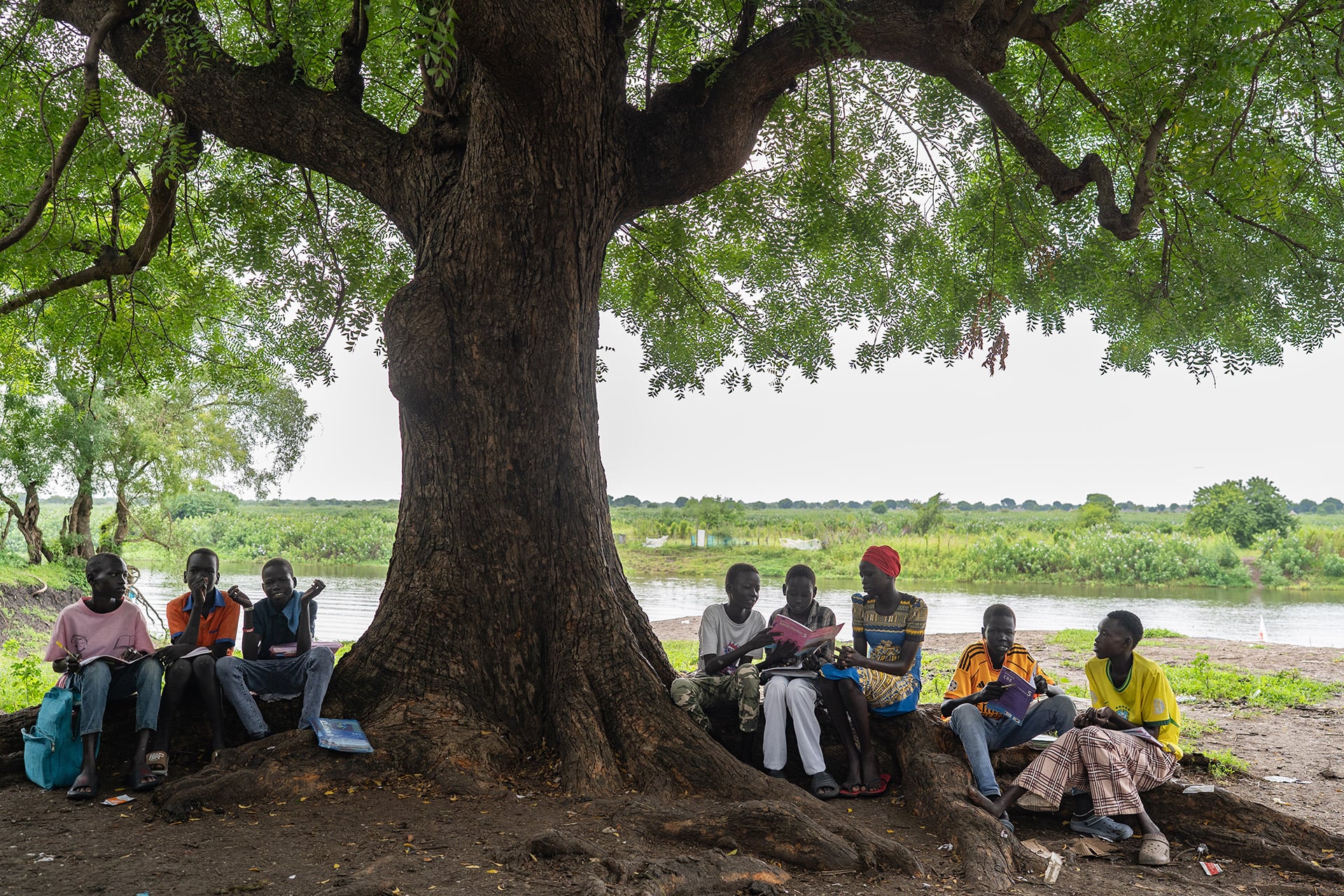
A looted school with scattered benches and children attending lessons beneath a tree.
A maternity ward, where a woman had collapsed outside and given birth in the grass.
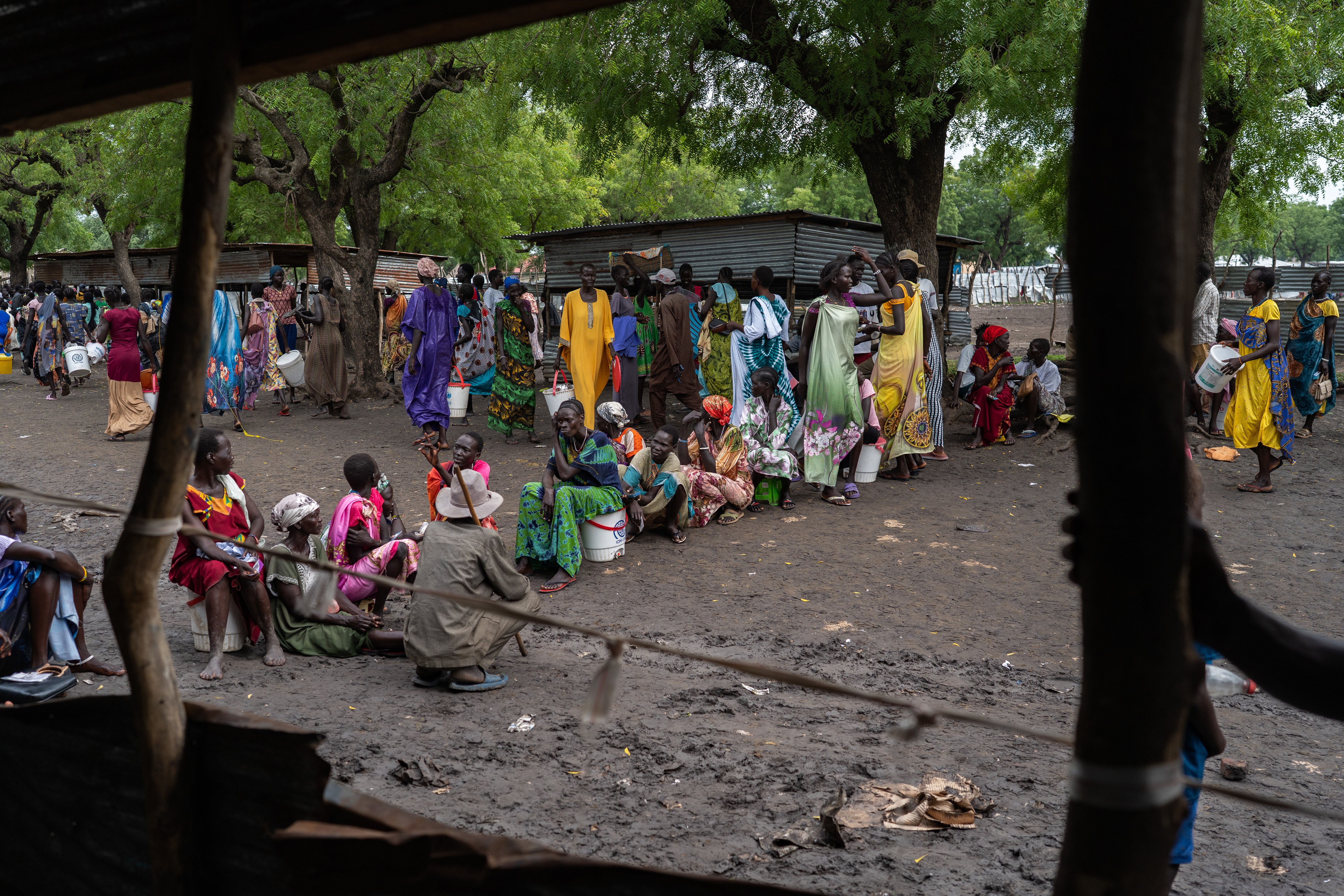
A food distribution site, where hundreds of people were waiting beneath the sun.
Since renewed fighting between government and opposition forces erupted across large parts of South Sudan last year, collapsing the country’s fragile peace agreement, Akobo, in the east, has been one of the flashpoints.
Now, thousands who fled the fighting are coming home, exposing the scale of the challenges facing the town and reflecting the wider humanitarian emergency impacting the country, which is supposed to be preparing for its first ever elections.
“People’s livelihoods have been destroyed,” said Mac Anyang Yuang, a team coordinator in Akobo for the UN’s World Food Programme (WFP). “They depend entirely on food assistance.”
The South Sudanese government, led by President Salva Kiir from the ruling SPLM party, formed a unity administration with the opposition SPLM/A-IO in 2020. It was part of a peace deal to resolve a 2013-2018 civil war that cost an estimated 400,000 lives.
But the peace deal was never properly implemented and SPLM/A-IO leader Riek Machar was placed under house arrest last year by Kiir, accused of supporting an armed militia attack against government forces. He now faces charges including treason.
Last year, the government launched major operations in opposition parts of Upper Nile state and Jonglei state, where Akobo is located. They were supported by allied militias and fought both SPLM/A-IO fighters and affiliated community defence groups known as the White Army.
Human rights groups have accused government forces, backed by the Ugandan military, of using incendiary bombs in airstrikes that killed civilians, while relief workers have accused the government of withholding aid from opposition-held areas. SPLM/A-IO fighters and other groups have also been accused of looting and abuse.
In Akobo, widespread pillage occurred after the town was taken by the South Sudanese army in March. Opposition forces retook it in April, though several months later schools are still barely functioning, health workers are overwhelmed, and food is in short supply.
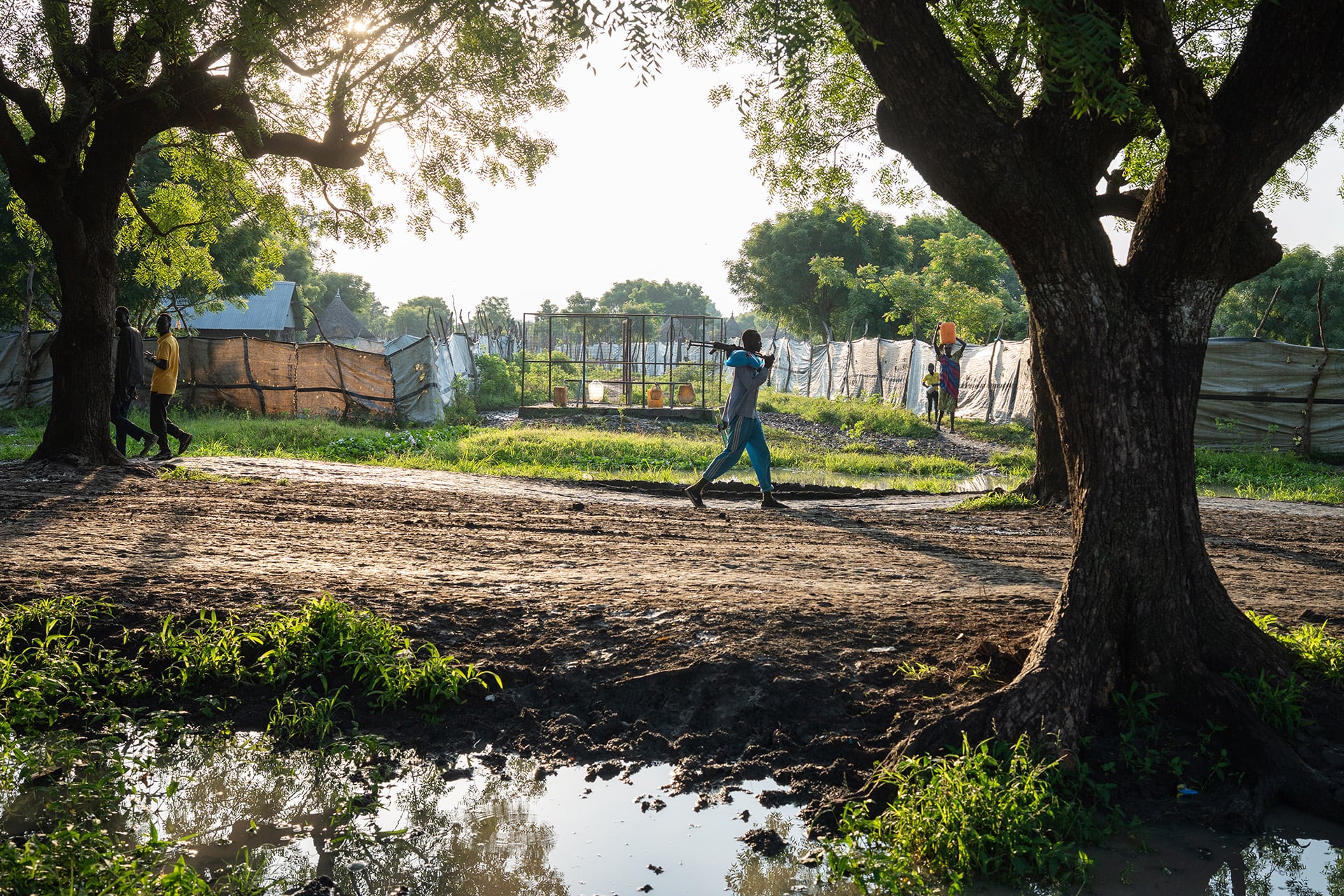
And while a relative calm has returned to the town, fighting has continued elsewhere. John Wiyual Lul, an opposition-appointed local commissioner in Akobo, said that “as long as Machar is detained, there will be no peace.”
Edmund Yakani, a human rights defender, agreed that no end to the conflict is in sight, and that conditions are therefore not right for elections. “They won’t be allowed to take place in opposition areas, and probably not even outside urban centres,” he said.
Dire conditions in Ethiopia
Akobo lies in the far east of South Sudan, close to the Ethiopian border. It is a key corridor between the two countries and a critical humanitarian hub marked by neem trees, cone-shaped houses, and a handful of colonial buildings falling into ruins.
In March, after losing several military positions in Jonglei, the South Sudanese army announced its offensive against the town, which was a significant SPLM/A-IO stronghold. Civilians, aid organisations, and UN personnel were given 72 hours to leave.
At the time, the UN estimated that Akobo and surrounding villages had a population of around 270,000 people. That included people displaced to the town from elsewhere, and the host community itself.
As the army moved in, over 100,000 people crossed the river into Ethiopia, seeking safety on the other side of the border, while others disappeared into rural areas. Conditions were incredibly difficult, according to those who were displaced.
“There was nothing to eat in Ethiopia. We slept under the trees. The children were sick,” said Nyariak Reath, 36, sitting outside a ward in Akobo’s main hospital, her young son in her arms.
“Shortly after arriving in Ethiopia, I assisted a woman in giving birth,” added Gatjiuk Kulang, a midwife at the hospital who was also displaced. “There was no medication, luckily it all went well.”
Nyanjang Puk said her husband was killed by unknown assailants when they fled to Ethiopia, and that she almost lost her two-year-old son, Buom, who is now recovering from severe malnutrition. “He couldn’t even open his eyes,” she said.
Puk said she now supports her family alone, collecting firewood to sell at the market, on paths that are still unsafe. She leaves just after sunrise and returns hours later with a bundle that only sometimes earns enough for all her children to eat full meals.
Aid restrictions
Displaced people said they began returning back to Akobo around June, after fighting in Akobo County, the broader administrative area in which Akobo is located, had largely subsided.
The current number of returnees is unclear. The International Organization for Migration recorded 79,000 returnees in Akobo by the end of August. However, current estimates range from government figures of 270,000 to 119,000, according to the UN.
Lul, the opposition-appointed commissioner of Akobo County, said the current population includes thousands who fled villages in the west of the region and arrived in Akobo with “no shelter, no food, no clothes”. The host community, he added, is “not better off”.
Many families said they returned to Akobo empty-handed. They then searched through the remains of their homes for anything that might still be useful, but often came away with nothing.
“We sleep without blankets or mosquito nets. My brother’s hut was burned down. It’s very difficult,” said a man who was busy fixing the metal door of his compound that had been forced open. His name is not being used to prevent reprisals against family members in government-held areas.
At a local market in town, food is available but is being sold in quantities small enough for people to afford: a little cooking oil, a few pinches of salt, one onion, a handful of grain.
Lul, the commissioner, alleged that badly needed humanitarian funds intended for vulnerable households have been held up by the government in Juba. In recent months, the government has repeatedly denied humanitarian access to opposition areas.
In July, the UN’s emergency aid coordination agency, OCHA, said restrictions on the movement of cash, fuel, and communications equipment into opposition territories were affecting the delivery of “essential assistance”.
At a food distribution site, Nyawech Malueth said she only received half a sack of sorghum, not enough for her family of six children. She remembers when her family could grow its own food. “We used to farm, [but] today we are here, and we wait.”
The residents of Akobo are not alone in their struggle with food shortages. According to the World Food Programme, an estimated 7.8 million South Sudanese are facing high levels of acute food insecurity, which is more than half the population.
A looted hospital
The New Humanitarian also visited Akobo hospital, finding it badly damaged and looted, though it was unclear who was responsible. Beds, medicine, and basic equipment were in short supply, and health workers were not receiving regular salaries.
At the maternity ward, Priscilla Wangare Wambugu, a midwife for Médecins Sans Frontières (MSF) – which supports the facility – said staff currently don’t have the means to perform a caesarean. “I can only pray that it won’t be necessary,” she said.
MSF was forced to temporarily leave Akobo after the government’s evacuation order. When they resumed activities in May, “enormous numbers of children were malnourished,” said Kulang Wal, an MSF medical assistant in the paediatric ward.
Inside the ward, The New Humanitarian spoke with Nyapuok Chuol, the mother of five-year-old Mana, who was suffering from tuberculosis with a fever and a persistent cough.
Chuol said her family had once been self-sufficient before the fighting, feeding themselves by farming sorghum, maize, and beans around Lankien, a small town located about 150 kilometres northwest of Akobo.
“Then our village was burned and the cattle were stolen,” Chuol said, referring to events that occurred during fighting between the South Sudanese army and the SPLM/A-IO in February.
The New Humanitarian could not independently verify who carried out the destruction, though residents of Lankien accused government forces of being responsible, as have eyewitnesses who spoke to other media organisations.
The violence in and around Akobo has had a major impact on children, according to Tot Tang, a local teacher. He described them as “traumatised” and struggling to catch up after long periods of displacement.
“The kids have missed several months of school – they are behind on the curriculum,” he said from a school that had 450 pupils. It was looted after it was abandoned by the population in March.
Cattle raiding
Several Akobo residents said that in addition to the fighting, they have also faced attacks and looting by militias from nearby Murle communities. The Murle are an agro-pastoral group often involved in communal conflict, yet frequently stigmatised.
Several people said that while they were fleeing to Ethiopia, they were attacked by these militias, rather than by government soldiers.
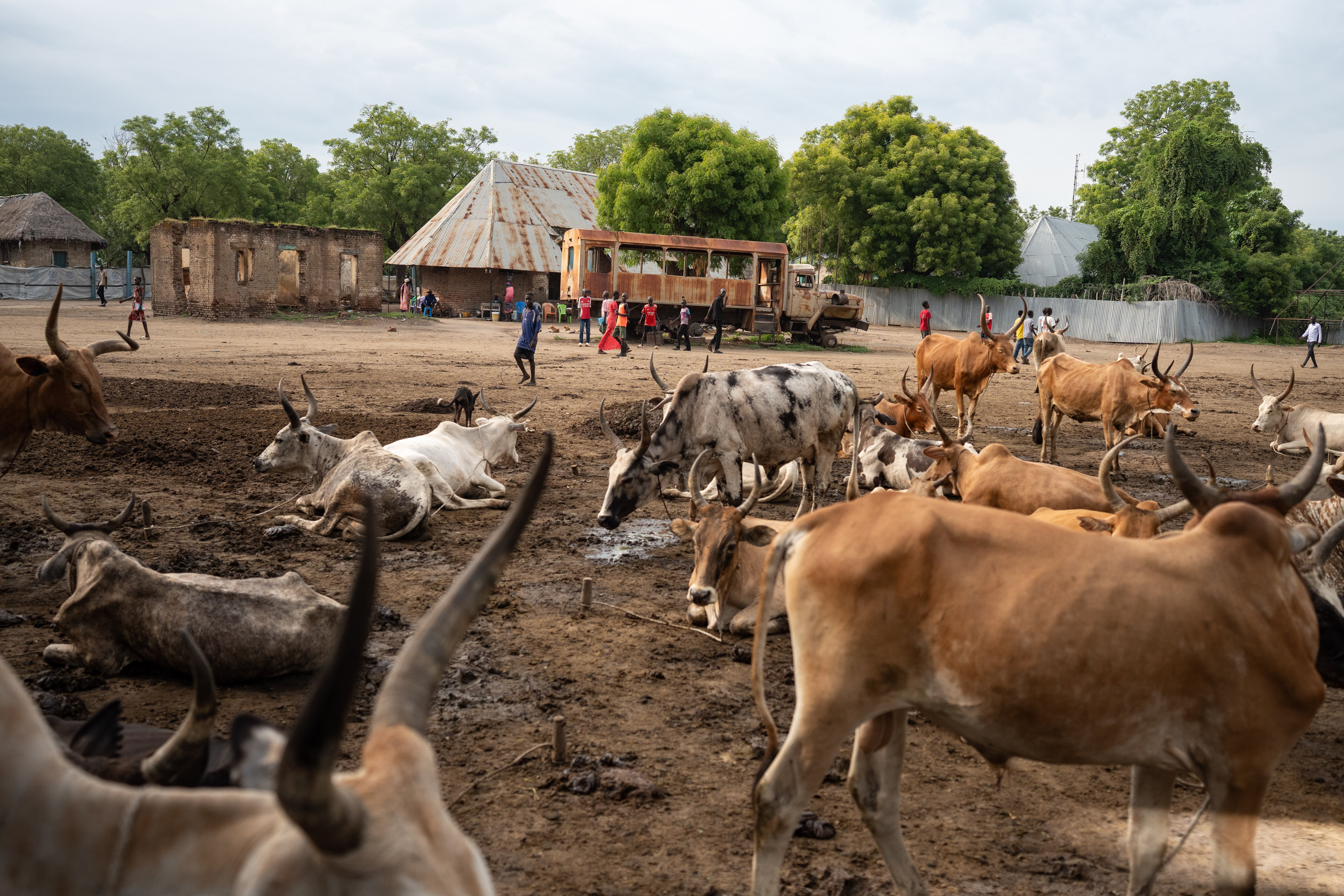
Others complained of Murle militias raiding their cattle, depriving them of an essential source of income and stored wealth.
Kong Tut, a 26-year-old in a T-shirt bearing the South Sudanese flag, blamed Murle militias for taking 30 of his cattle last year. He said each cow was worth at least $250, and that some of them could have reached $700.
Another man, who asked not to be named, said several dozen cattle belonging to him and his friends were stolen from under their watch in January, again by Murle armed militias.
However, he suspected that others may have been acting behind the militias, given documented cases of South Sudan’s security forces providing support to armed groups, and the way cattle raiding has become entangled with national politics and conflict.
“I don’t understand why the government is targeting us,” said the man, who had a wounded leg and sat on a low wall, his crutches resting beside him. “Being Nuer means being treated as an enemy,” he added.
The Nuer are South Sudan’s second-largest ethnic community and have historically provided a grassroots base for the predominantly Nuer SPLM/A-IO, as well as for the White Army.
Election fears
As fighting and insecurity continues across Jonglei, Upper Nile, and other states, the impact on South Sudan’s long-postponed elections remains uncertain. But observers say the conditions needed for a free, fair, and credible vote are absent.
With only months remaining before the scheduled vote – intended to be the country’s first since independence in 2011 – there is no voter registration database, no census has been conducted, and the opposition continues to be suppressed.
“We’ve never had capable leaders who could translate people’s struggle into meaningful action,” said Yakani, the human rights defender. “In fact, the population faces the same difficulties as before independence: war, famine, and the absence of public services.”
Despite everything her family has been through, Chuol, whose son has tuberculosis, said she still holds on to hope. Around her right wrist, she wore a beaded bracelet in the colours of the South Sudanese flag.
“I love my country,” Chuol told The New Humanitarian. “We are still hoping for peace – that is what gives us the strength to keep on.”
Nyagun Tuot, an elderly woman queuing for food aid, had a different view. She said the fighting in March was the first time she had escaped to Ethiopia, despite having lived through several past conflicts.
“We have lost everything,” she said. “I don’t think I’ll ever see peace.”
Reporting for this story was supported by the Pulitzer Center. Edited by Philip Kleinfeld.


