

Share & more
Mario Torres was only 18 years old in 2018 when he left his native city of Valencia, in central Venezuela, due to his country’s economic crisis and repressive government. A brilliant student, he had finished high school at 15, won a scholarship, and was studying business administration at a university technical institute.
“I had one semester left, but there was a lot of pressure, a lot of problems in the country, and my family was also going through a tough time because of the situation there. So I decided to leave and help my mom, my dad, and my siblings,” he said.
Eight years later, he has lived in several Latin American countries, and last year saw his attempt to seek protection in the US rebuffed. His story is both unique and also indicative of the trials and tribulations faced by hundreds of thousands of other Venezuelans over the past decade.
Now, Torres is one of tens of thousands of displaced people searching for some semblance of stability between US President Donald Trump’s hardline migration policies and a growing cadre of right-wing Latin American leaders who are cracking down on migration in their own right.
After a short period in Colombia and Peru, Torres established himself in Chile, where he lived for four years. He started working as a street vendor – selling medicine, cigarettes, whatever he could get his hands on – in different markets. Eventually, he earned enough to buy a car and work as an Uber driver.
“I don’t get desperate anymore. When I was younger and first left Venezuela, I did. I would get very nervous and scared, my hands would shake. But everything I have lived has made me more determined.”
In 2024, however, worried about the risks of working in the streets, and as life became more expensive in Chile, he decided to seek new opportunities in the United States.
“I thought that in the US I would have a normal job with a salary, because in the work I did in Chile there are many gangs that control some areas,” he said.
During his overland journey northbound, Torres started a diary, writing down every town he went through and the cost of each ride, to share it with other Venezuelans he knew planned to follow his steps.
Torres arrived in Mexico at the end of 2025, but a series of hurdles kept him from reaching the US border before Trump returned to office and closed it, dashing his dreams of a better life. Like tens of thousands of other migrants in Mexico, he was forced to turn back south.
Over several phone conversations and WhatsApp exchanges, Torres shared his diary and experiences of the past 20 months with The New Humanitarian. This story retraces his steps across the region – a journey filled with challenges, dangers, and precarity, but also of persistence and solidarity.
Fear and loneliness have been constants on his journey, but Torres explained how he has learned to cope. “I don’t get desperate anymore. When I was younger and first left Venezuela, I did. I would get very nervous and scared, my hands would shake. But everything I have lived has made me more determined,” he said.
“I have always believed that I was born to do something great with my life,” he added. “That motivates me to keep going.”
This text was edited for length and clarity.
South America - September 2024
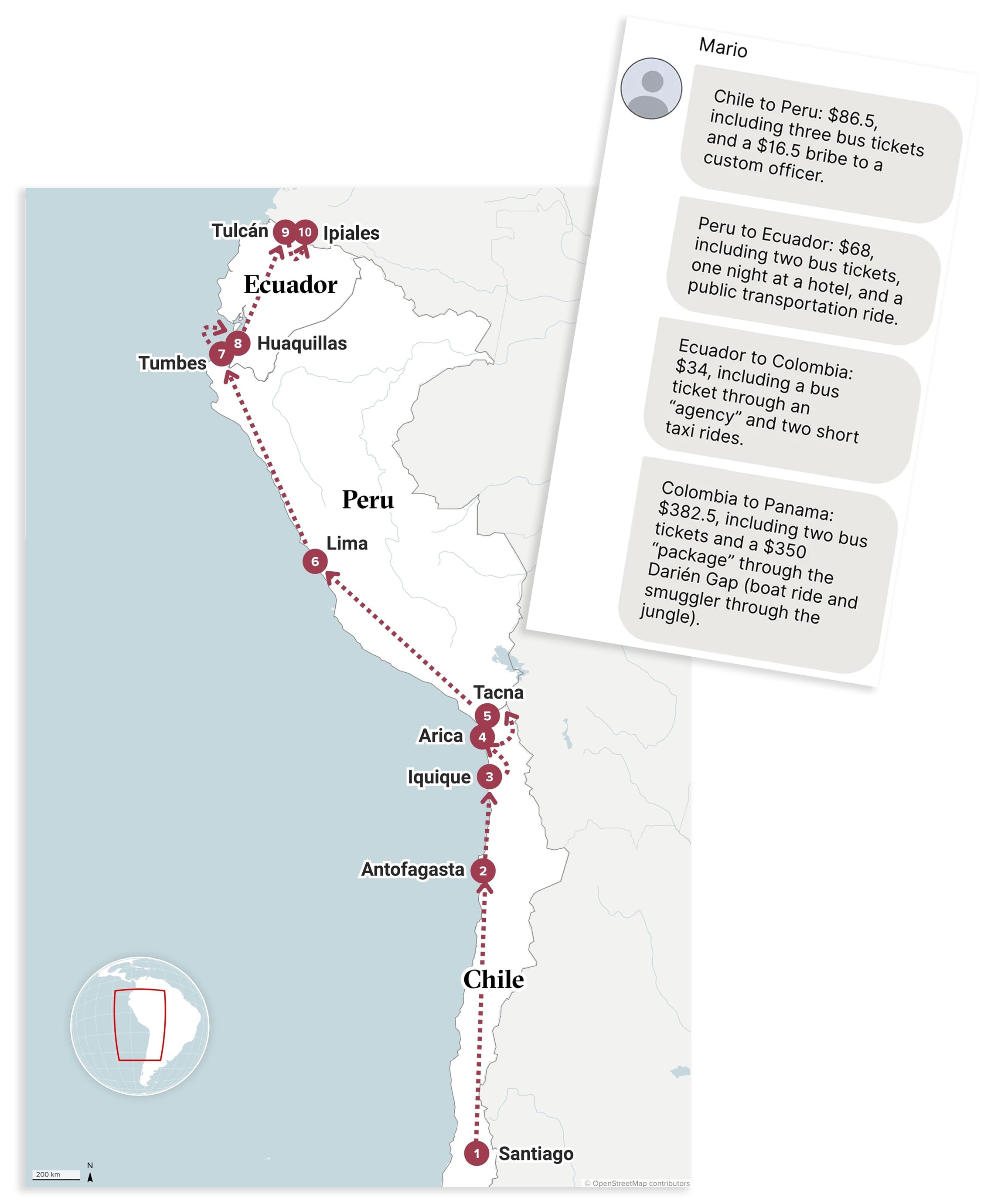
South America - September 2024
I set off from Santiago on my own in September 2024. After travelling by bus all along Chile to the north, I reached the Peruvian border. To cross, I had to pay some customs officers to let me go through and cross the desert, literally crawling to avoid being seen until I reached Peruvian territory… When I took the bus from Lima to [the northwestern city of] Tumbes, I was ripped off: They charged me more because I didn’t have a passport.
I firmly believe that you’re better off travelling in a group when it comes to situations like that. That’s why when I met a Venezuelan family on the bus, I decided to join them. They knew how to get through Peru and Ecuador without spending too much. I thought: “This is good for me.”
South America - September 2024
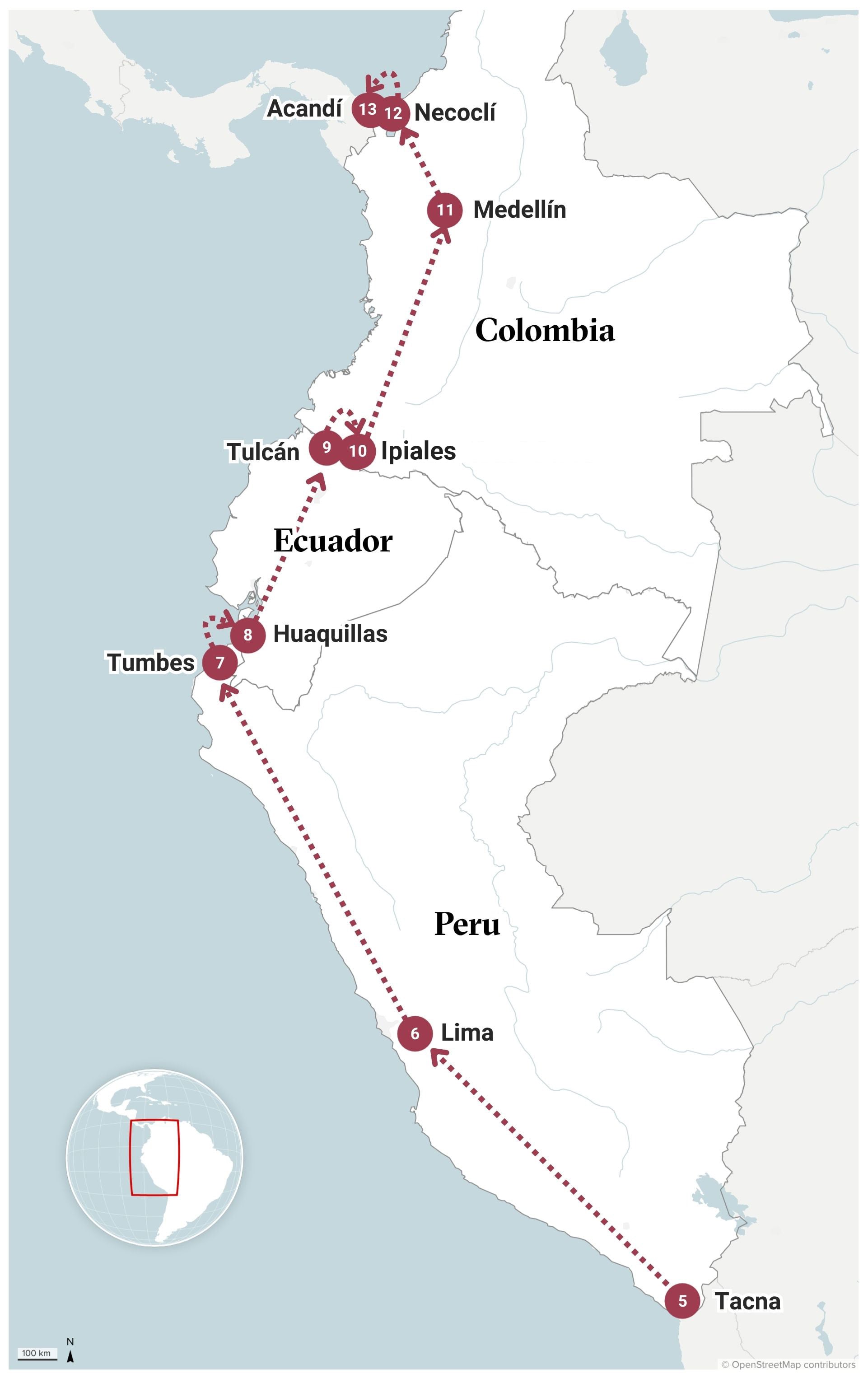
We crossed Peru and Ecuador by bus. I continued all the way through Colombia to Necoclí, a small town in the Chocó department of Colombia that received hundreds of thousands of migrants seeking to reach the US through the perilous Darién Gap in 2023 and 2024. I had to pay a $350 package to smugglers that included a boat to Acandí, where the path starts, and “guides” that led us through the Darién Gap.
It took us five days walking through the jungle to reach Panama. You see all kinds of things there: animals, dead bodies, armed Indigenous people. I almost drowned trying to save a woman in a river. There was a man who was about 30 and travelled with his wife, two children, and his mother, who must have been 70. There were two paths: a hill with a large, slippery rock, or the river. In the river, there were lots of sheets and blankets tied up to be used as ropes. She tried to hold on to them, but she was drowning. I took off my bag, jumped into the river, and swam out to her. I tried to tell her not to jump in because I had to get a firm grip first, but in her desperation she jumped in anyway, and we both went under. If I hadn’t known how to swim, we would have died.
We eventually reached Lajas Blancas, a migration reception centre where different aid organisations provided help [before closing last year].”
Central America - End of September to October 2025
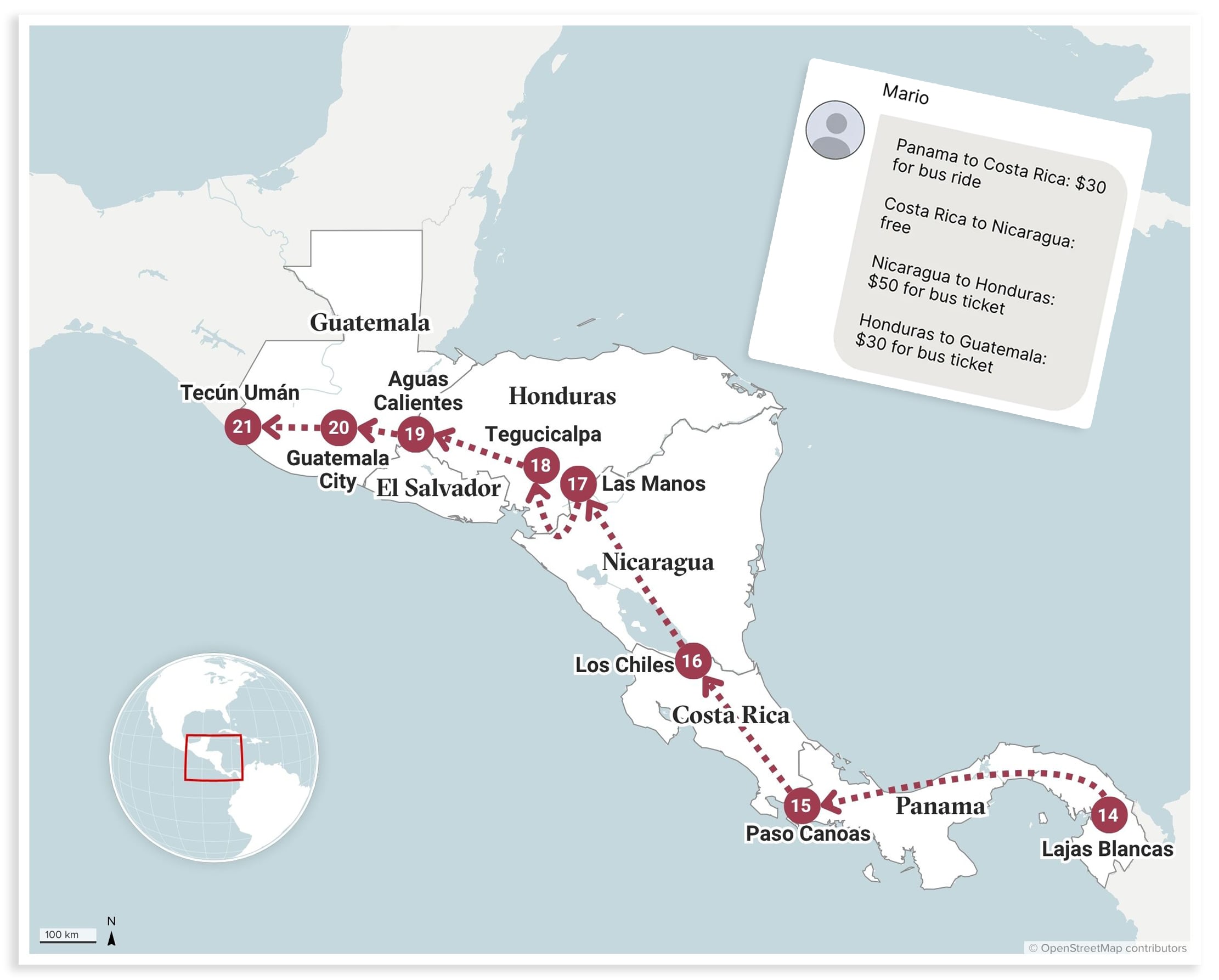
Central America - End of September to October 2025
At the camp, every person exiting the Darién was controlled; it was militarised and there were buses that took us to Costa Rica for $30. At the Costa Rican border [in Paso Canoas], other government buses took us for free all the way to Nicaragua… I then crossed Nicaragua, Honduras, Guatemala. That trip took me longer because I was travelling with other people and that slowed me down. Sometimes I stayed in some places to work and gather what I needed for tickets… In Danlí, in the south of Honduras, the UN gave us 600 lempiras (about $25), and a truck took us to Tegucigalpa. That helped.
Because I was told in Central America there are high crime rates, I was actually dressed up like a total weirdo: I had long hair and a long beard. I was carrying a big backpack, but the criminals would see me and obviously think, “He doesn’t have anything – what are we going to steal from him?”
In Honduras, selling candy went really well for me, because Hondurans are generous and supportive. I stood at a traffic light, selling, and people in cars and trucks on the highway would throw money at me; it’s the kind of story you tell and nobody believes. Thanks to all that, in Honduras I was able to pay for a hotel while I was there and save a little to keep going.
With the group of people I travelled with, we always stayed together, waiting for each other when one ran out of money. We crossed the border to Guatemala walking. It was 10 kilometres to the town of Esquipulas. In Guatemala, I worked in construction for a week. People were supportive too. They help you whenever they can, with a glass of water, a plate of food, even money. In those countries I encountered no problem.
In Tecún Umán near the border with Mexico, I also worked in construction and selling candies. Then we walked to Suchiate, the river bordering Mexico, to take a raftboat to Tapachula.
Mexico - October 2024 to March 2025
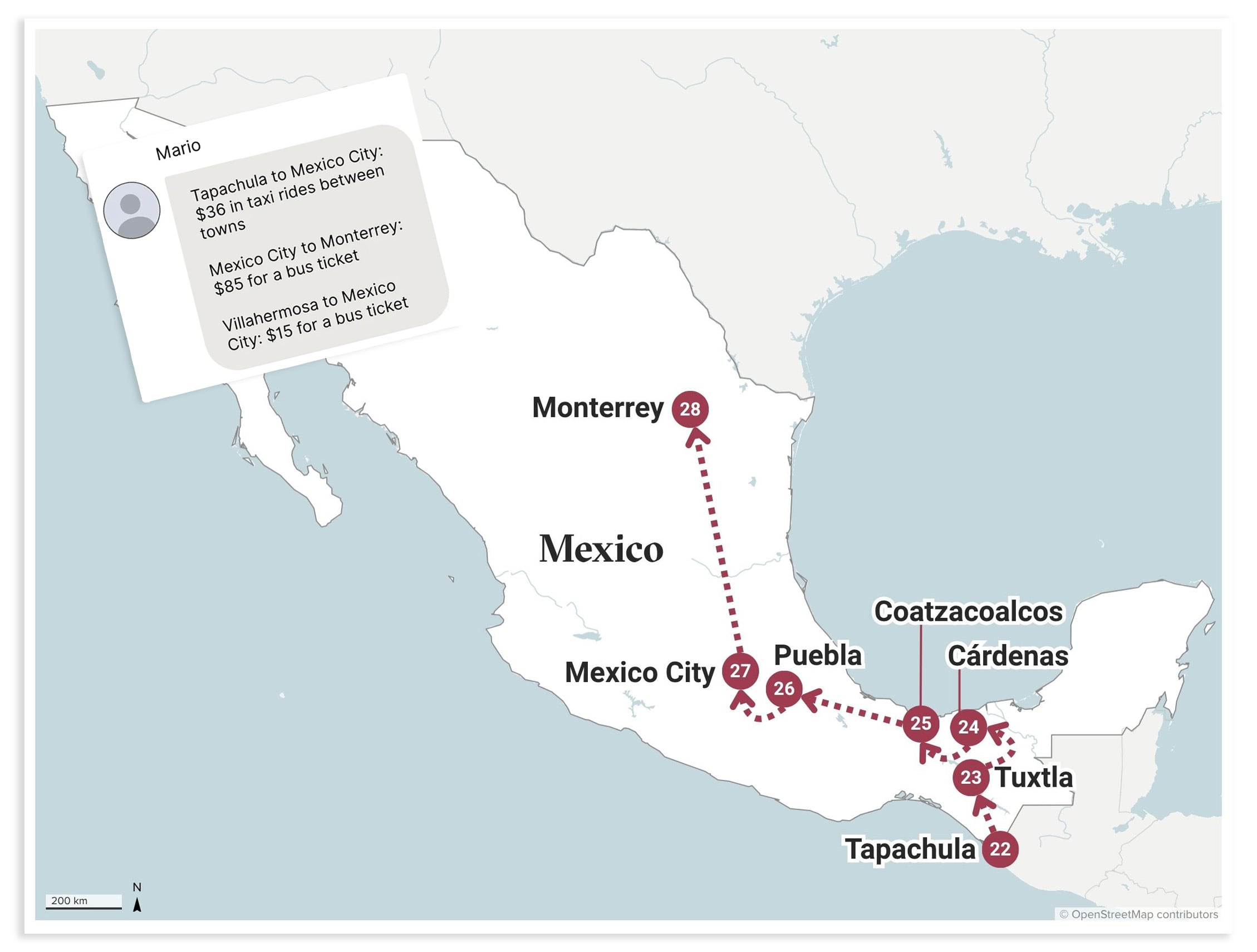
Mexico - October 2024 to March 2025
In Guatemala our group had grown bigger, a couple of people had joined us. As soon as we got off the raft, some people told us “you have to pay us $200 to be able to move freely through Tapachula”. They said that if we didn’t pay them, someone from their group would catch us somewhere else and charge us more. Luckily, there was a migration checkpoint just 50 metres away and they told us: “Ignore these people. Ignore everyone and leave quickly because it's dangerous here!”
I only stayed half a day in Tapachula. The sun was very strong. It was about 40 degrees celsius and there are a lot of bad people. There is a sort of mafia of Mexicans and Guatemalans. I don’t even want to give details, because it’s complicated. From there, I walked and walked, and then managed to take a bus provided by migration authorities to Tuxtla Gutiérrez, a city nearly 400 kilometres north of Tapachula. At that point, we had run out of money and we all stayed under a huge bridge. There were about 2,000 Venezuelans there and a few people from other countries. We looked on a map which road to take to continue to Mexico City avoiding immigration authorities… In all the countries I went though migration officers were very xenophonic, but in Mexico they were the worst.
I made it to Mexico City and stayed three months there to gather money. I worked as a salesperson, as a valet parking [assistant], and selling food. I lived in a five-storey building where you could rent bunk beds for about 70 pesos ($4) per day. Every room had 20 bunk beds and on each floor there were 4 to 5 rooms, so we were about 500. Living with so many people was difficult, and it was impossible to cook there so I had to eat out.
In early January, I left for Monterrey, further north. I was supposed to get off the bus before the immigration checkpoint to go round it, but I got distracted and didn’t. They arrested me. They locked me up for three days in Monterrey, incommunicado. I could only make one phone call per day. Then they bussed me down again to Villahermosa in the state of Tabasco. I was alone at that point. I only had about $300, so instead of buying a ticket directly to Mexico City I decided to look for cheaper routes. I talked to drivers to hop on their trucks and went all the way to Cárdenas and then Coatzacoalcos to get on the train known as “La Bestia”.
The first time I went up we had to pay 500 pesos (about $28) per person to be able to go through a beach to enter the state of Veracruz. It was 12 hours walking, there was quicksand; a friend almost sank completely, but thank goodness we managed to pull him out. The second time, since I was alone, I didn’t want to go through something like that, so I decided to take a more direct route. I paid only 60 pesos (about $3) to cross a farm that was on sale and go round a migration point.
At that point, I was with about 20 other people. We walked, and walked, and walked. It was tense in Mexico, because people said all the time “the cartels will kidnap you” or “they did this to my son, or my brother”. Everyone had stories to tell. I was listening to music on my phone, trying to think about something else, when, about 30 kilometres before reaching Coatzacoalcos, on a two-lane road, I heard something. It was already getting dark, so I put everything away and soon enough three hooded men came out of a farmhouse and pointed a gun at us. There were only four of us, I didn't know where the rest of the group was. When the guy with the gun pointed at someone else, I started running, and he shot me. I touched my leg and there was blood running down.
I managed to run another 100 metres to reach a gas station where we had planned to rest and wait until the sun came up, because it was about 12-1 am when this happened… Three of us managed to escape; they caught the other guy, who was Venezuelan, and took him to the farm where they were. That’s when I realised that everyone who was initially with us was there at the farm. They had caught every single one of them.
At the gas station, there were soldiers, police, everyone. I went up to them and told them what had happened, and they held me there. They checked my wound, an ambulance arrived, and they took me to the hospital in Coatzacoalcos, which was actually where I wanted to go. At the hospital, they examined me and wanted to release me right away because I only had a small gunshot wound. The bullet went in and came out. It didn’t damage any bones or muscles. All I had was pain. I asked them to let me stay until morning and they told me, “you have to leave at 6am”. I settled in there in the hospital hallway and charged my phone because it was out of battery. I left at 6am and headed near the train station to wait for it. I had to wait by the train tracks until 8am. “La Bestia”, the freight train I hopped on, was free. Well, it had a cost: the risk of dying.
I literally had to tie myself with a blanket to part of the wagon structure and be careful not to step in the void or it would have been a sad story.
When the train comes, you have to make a quick decision and jump on a wagon or you miss it. Once I had hopped on it, I realised that most of the wagon had almost no floor. There was half a square meter where I could sit but the rest was open and I could see the wheels. I literally had to tie myself with a blanket to part of the wagon structure and be careful not to step in the void or it would have been a sad story.
I went all the way to Mexico City again. On the way, I didn't pay for any accommodations. I slept in gas stations or wherever night fell. And I did a longer ride on the train. It was hard. I even had to sleep on the sidewalk, and you can’t trust anybody… And then, with what happened with Trump closing the border and all that, I had to turn back.
Reverse trip from Mexico to Panama - March 2025 to April 2025
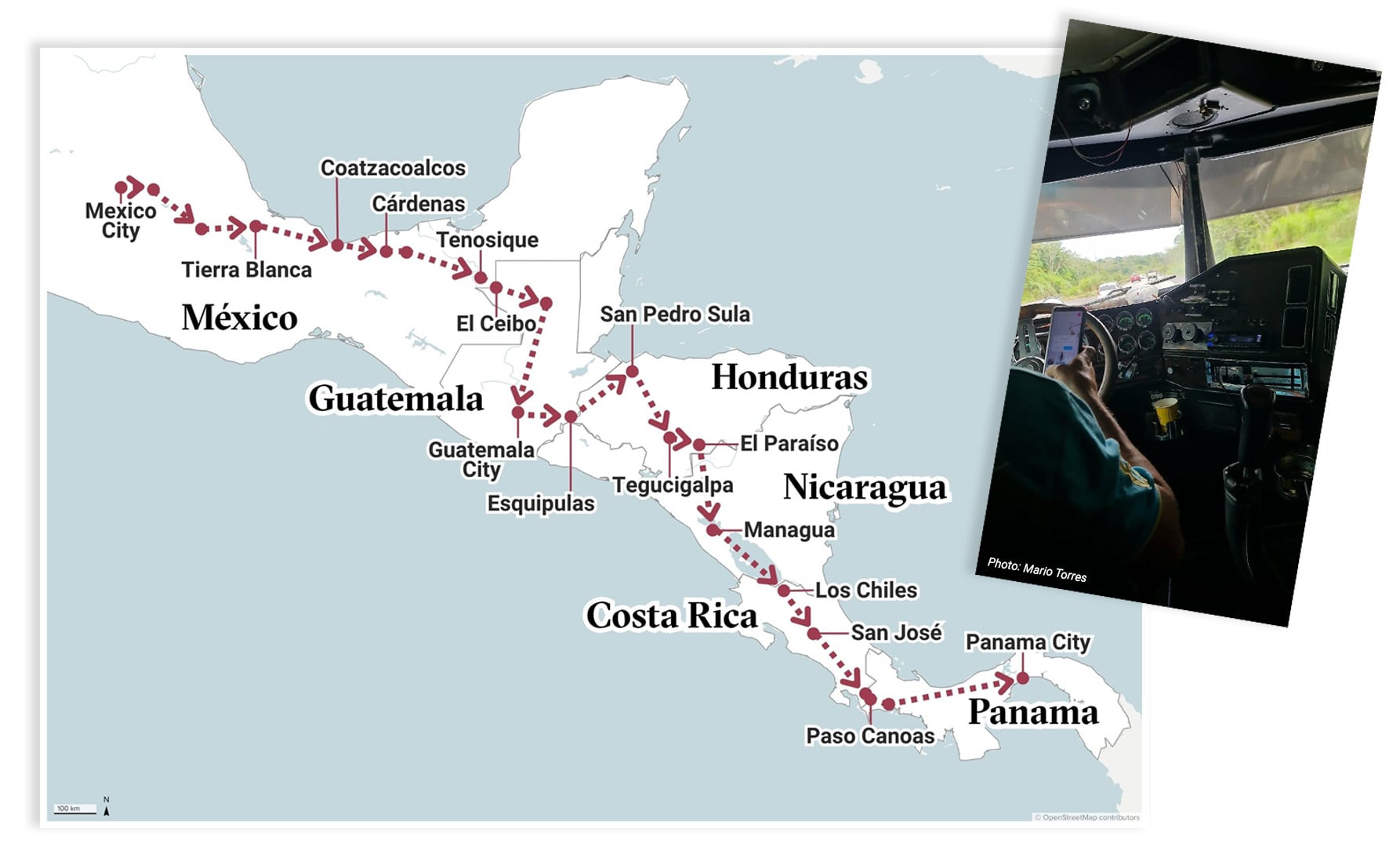
Reverse trip from Mexico to Panama - March 2025 to April 2025
The trip back was easier because I already knew the way; I felt more confident. The hardest part was the money. But I’m someone who adapts to anything, and I surround myself with people who adapt to anything, who find ways out of bad situations.
From Tenosique in Mexico to El Ceibo on the border with Guatemala, I crossed on foot without any problems and without paying taxes, nothing. From Guatemala to Honduras, same thing.
In Tegucigalpa, Honduras’ capital, I stayed for five days and worked selling candies on the street. In Honduras, people were very helpful again; I was able to make good money, and that allowed me to travel down back to Panama without any trouble.
When I crossed the Nicaraguan border, I did it at night and ended up camping at the Costa Rican border, which was five kilometres further on. I walked the whole way. Costa Rican customs are very corrupt; they work with the same people who rob you. I was with a friend, and we saw a couple who had just been robbed, so we decided to camp out until 4am when you can cross normally without paying anyone. Then I came to Panama in a cargo truck to avoid immigration.
Panama - April 2025-currently
My plan was to go back to Chile, but I ended up staying in Panama because on the way back I was travelling with a friend, and we didn’t have enough money for both of us to continue the journey. There are people who have boats that cross from Colón, a city on the Caribbean coast, to Colombia, but they’re expensive. We said, “Let’s stay here for a while and see if we can find a job.”
I remember I had $1.10 in my pocket. I drafted a resume on my phone and went to print 10 copies in a shop. I was left with only 10 cents. But at the seafood market, which is very touristic, they had told me I could work even if I didn’t have papers, and I can speak some English – I took a course in Chile – my grandparents were Italian, I have uncles in Portugal so I understand a bit of these languages. And I have worked in sales and know how to manage a business.
I was hired but some days were complicated. Since I'm alone, I had to put up with mistreatment that I don't deserve… There were comments, attitudes towards me that wouldn't have been there if I were Panamanian. They gave me all the hard work and, when I complained, they fired me. Now I work in a good place, thank God. I work as a waiter; here they call it “salonero”. I work solely for tips, but they are enough for me to live on. Maybe one day they will pay me a salary. At least the people are educated, they understand you, they speak to you politely, it’s a team effort, and there’s no mistreatment.
Now, with everything that’s happened in the world, in Venezuela, and all that, we’ll have to see if the situation in my country improves, and save whatever we can. I want to get my papers in order here. I recently got my passport and I am about to obtain a residency permit… I’d love to start my own business, I've always liked to manage my own money. It could be something with seafood, as there is a lot here, or anything related with food. Or maybe a clothing brand. Something cool.
Recently, migration authorities came to my workplace asking for everyone’s papers, trying to intimidate us. They took my passport, and even though I had the immigration registration stamp, they tried to make me believe they could detain me. They were rude. It wasn't until I called the lawyer who is helping me with my paperwork that they calmed down. I had to stand my ground and not let them terrorise me, saying they would deport me. They gave me my passport back, but they don't care about protocols and detain a lot of people without proof of anything.
It’s sad that the United States and countries in Latin America aren’t capable of having policies that promote safe migration. I know 10 countries in the region and none has them. So far it’s been nothing but a disaster, and nobody seems to care.
Reporting for this article was supported by the Fund for Investigative Journalism.


