


Share & more
President Donald Trump’s hardline deterrence policies are forcing many asylum seekers and migrants to establish themselves in Mexico rather than the United States, even as the suspension of US aid is making it harder for them to obtain the protections and support they need to integrate into Mexican society.
According to official Mexican data, only 119,183 migrants entered the country irregularly in the first six months of this year – 83% less than during the same period of 2024. And yet the number of asylum requests was similar in both years, indicating that more people are seeking to stay longer-term in Mexico.
Three out of four migrants surveyed by the UN’s migration agency (IOM) in Mexico in April-May 2025 said they were not considering returning to their home country or of previous residence. The share naming the United States as their final destination fell from 73% in October-December 2024 to 46% in April-May 2025, while those planning to stay in Mexico nearly doubled from 24% to 46%.
Several aid groups in Mexico also told The New Humanitarian they have seen migrant dynamics in the country change since Trump took office in January, largely out of fear of his brutal deportation campaign.
“Before, we didn’t see children enrolling in school,” said Joanna Williams, executive director at Kino Border Initiative, a humanitarian aid organisation that helps people on both sides of the US-Mexico border. “There is more permanence now.”
About 270,000 people were left stranded in Mexico when Trump – on the day he took office – shut down the US Customs and Border Protection’s CBP One cellphone application used to apply for asylum. While thousands are now returning home in a reverse flow, others cannot – either because their lives would be in danger in their home countries, or because they lack the means, or because they are unable to leave Mexico legally having lost or been robbed of their identity papers.
“There are no legal pathways left [for seeking asylum in the United States],” Elizabeth Ferris, director of the Institute for the Study of International Migration at Georgetown University, said, adding that Mexico, by contrast, has fairly generous asylum policies. Mexico, she said, approves 72% of claims on average and allows refugees to become citizens after just two years as residents.
A landmark integration programme
An integration programme led by the UN’s refugee agency (UNHCR) in collaboration with the government and local partners is credited with playing a key role in fuelling asylum seekers’ interest in staying in Mexico.
Since 2016, UNHCR has worked with the Mexican Commission for Refugee Assistance (COMAR), which processes asylum claims, to help integrate refugees through the so-called Local Integration Programme (PIL) – the only initiative of its kind in the country and considered a poster child for best practice in the region.
The PIL has resettled more than 50,000 refugees to industrial cities in the centre-north of Mexico and has provided other kinds of assistance to asylum seekers and refugees in their offices across the country: job training, support for family reunification, and administrative guidance. So far, it has supported a total of about 160,000 people.
Mexican wages are lower, but refugees are increasingly seeing that “not everything is about the US”, Silvia Garduño, a UNHCR communications officer in Mexico, told The New Humanitarian.
Arley Noel Fernández, 25, a Cuban refugee working at a security booth for Verpro, a private security firm in Monterrey, is one of the beneficiaries of the PIL. He arrived in Mexico a year and a half ago and originally planned to join relatives in the US but changed his mind after getting a job in Monterrey, the capital of the northeastern Mexican state of Nuevo León.
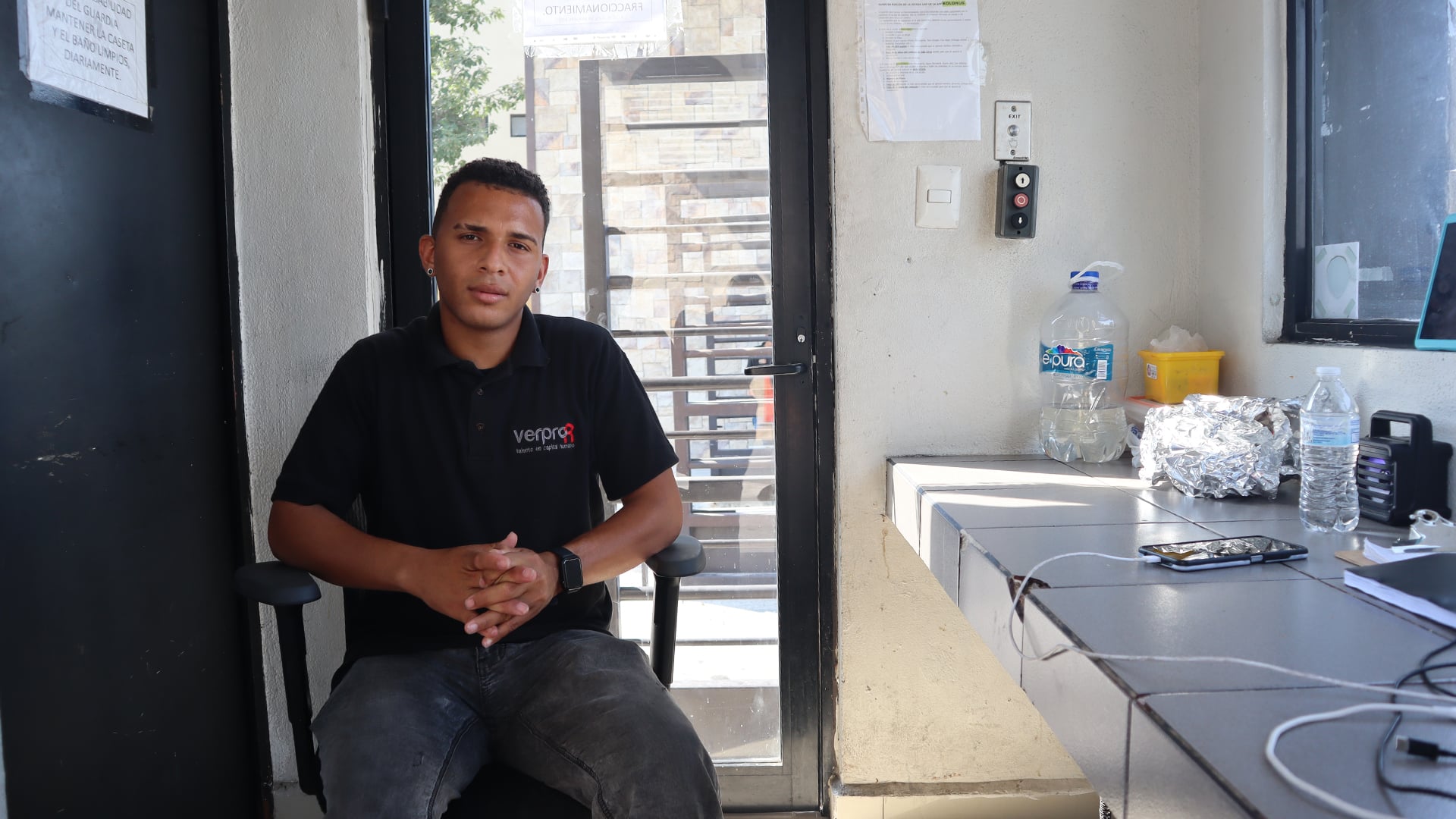
“My family in the United States says I’ll be better off in Mexico. [There] are more opportunities for me,” he said, explaining that in Mexico he can work legally without fearing deportation.
After first reaching Mexico, Fernández, a trained engineer, stayed six months in Tapachula in the southernmost state of Chiapas, where he applied for asylum while working informally for a private construction company. But the pay was poor, he had “no rights”, and he had to “live in the shadows”, he said.
During his asylum process, he heard of the PIL and decided to join once he had obtained refugee status, as required. Since he started working, he has been able to buy his own house in Monterrey.
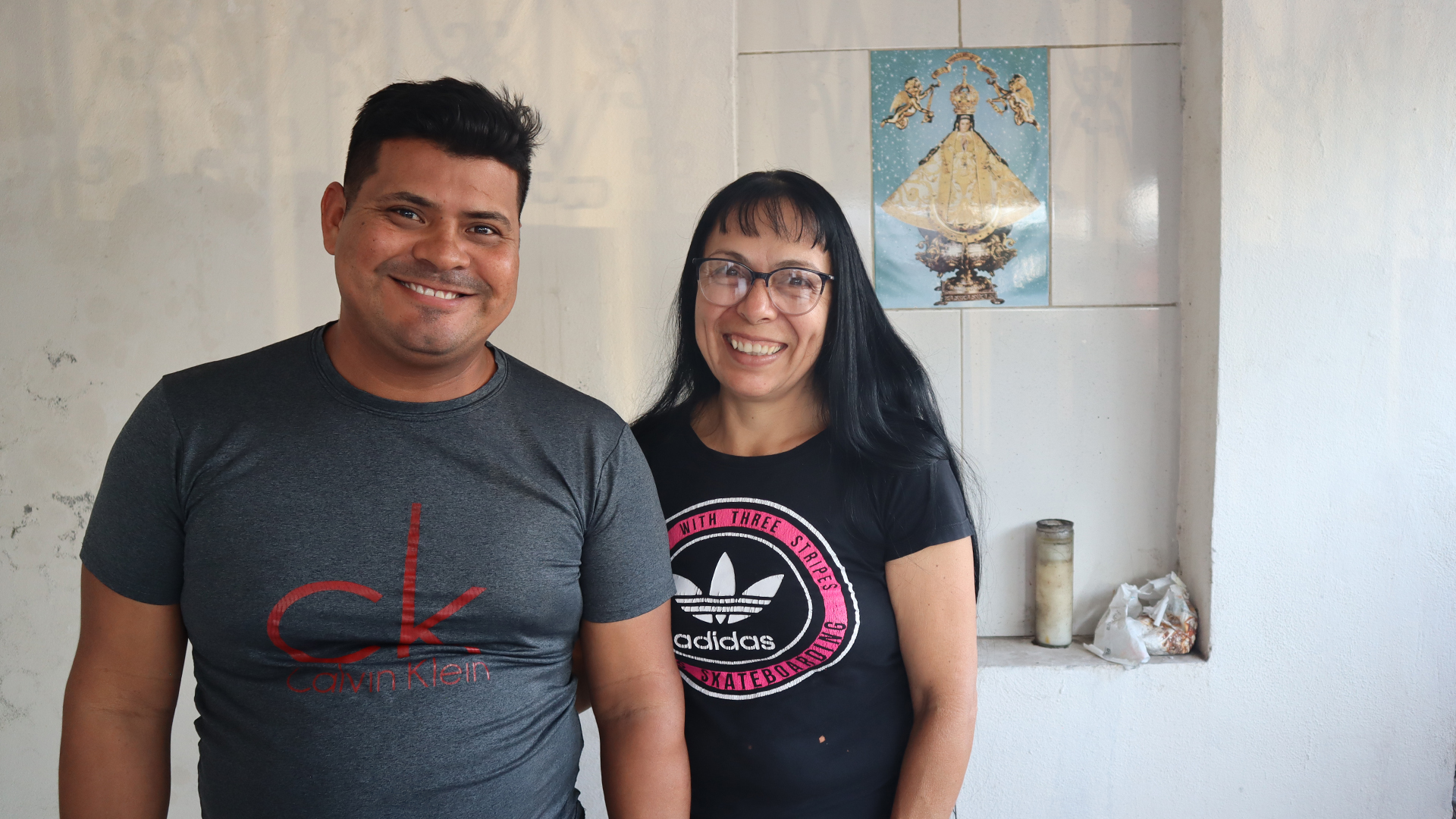
Yamilde González Ramírez, a 50-year-old Venezuelan refugee, has also given up on the idea of moving to the US. She too was relocated by the UNHCR in Monterrey, to work as a machine operator at a food company, Sigma Alimentos.
Ramírez said a smuggler offered to take her and her partner illegally to the United States shortly after they both started working there. They declined. “I want legal status,” she explained. “We’re okay here… the idea is to stay in Mexico.”
A win-win for all
The success of the PIL partly stems from the deep inequality between Mexico’s wealthier, industrialised north and its poor south – especially Chiapas, where most refugees arrive, over half of the population lives in multidimensional poverty, formal jobs are scarce, and criminal gangs terrorise communities.
Northern hubs like Monterrey and Saltillo, on the other hand, are filled with factories and job ads, and feel like another country. “The climate, the people, the safety, the pay – everything is different,” said 26-year-old Henry Murillo, who left Honduras in 2022 originally heading for the US.
It’s a two-way street. By obtaining proper employment, refugees are also helping companies to fill their vacancies and to strengthen Mexico’s local economies.
The state of Nuevo León has a labour shortage. In August 2023, 43% of its companies cited the lack of skilled workers as their top challenge.
“There is enough work for everyone. The challenge is to make sure [the refugees] stay rather than go to the United States.”
Reyes García, coordinator of talent acquisition at Grupo Senda, a Monterrey-based transport company, said a lack of workers had really been challenging the company and that the hiring of refugees through the UNHCR programme had “helped a lot”.
Nationally, refugees contribute $15 million fiscally per year – more than the Mexican government’s refugee protection budget, which explains why local authorities are eager for the PIL to continue.
“There is enough work for everyone” in Nuevo León, said Gabriela Muñoz Treviño, an undersecretary at the state’s Secretariat of Equality and Inclusion. “The challenge is to make sure [the refugees] stay rather than go to the United States.”
UNHCR currently works with 650 different companies to relocate refugees and find them jobs, mostly within just a week. It provides support accessing housing, transport, and social services, and also works with the government and civil society organisations on community engagement, psychological support, and educational programmes.
The NGO Vía Educación, for instance, runs recreational activities for children and workshops for adults – integrating care-taking with learning.
Jessika Juárez Rangel, a community facilitator there, explained that the activities help refugees build support networks while creating awareness in the local population.
“It can help do away with misperceptions,” she said. “Handing out school kits would be easier for us, but that is not the idea.”
Shrinking resources threaten support, and asylum
Despite these initiatives, integration remains challenging.
Some refugees and asylum seekers can’t find suitable jobs or, despite obtaining formal employment, still struggle with language barriers, housing issues, and childcare. Simple things such as enrolling a child in school or opening a bank account to get paid can be a hurdle as institutions sometimes demand documentation that refugees don’t have, even if they are not a legal requirement.
Additionally, the PIL only benefits a fraction of the total number of asylum seekers arriving each year and, according to Ferris, awareness of it is limited.
Migrants who are not granted asylum in Mexico face even more hurdles, as legal options to remain in the country are limited.
“There are very few pathways to regularise your status in Mexico,” said Dana Graber Ladek, chief of mission at IOM in Mexico. “Basically, one has to have married a Mexican citizen, have a child born in Mexico, or be recognised as a refugee. That’s it.”
As a result, many are pushed into Mexico’s already strained informal economy, exposed to exploitation and abuse.
Trump’s decision to suspend foreign aid, last January, is making things all the more difficult.
Giovanni Lepri, the UNHCR’s representative in Mexico, said funding to the agency’s operations in the country was cut by 60% between February and June 2025. They had to close four offices, lay off nearly 200 people, and terminate or reduce agreements with several partners. “There is no aspect of [UNHCR’s] operations that has not been critically affected by the cuts,” Lepri told The New Humanitarian.
The impact on COMAR, which receives two thirds of its funding from UNHCR, has also been significant even though Lepri said they have tried to limit any cuts to the Mexican agency because maintaining access to asylum and ensuring the process keeps running “are priorities”. Nevertheless, UNHCR had to reduce its funding to COMAR by 30% for the second half of 2025, further undermining its already overstretched capacity to process claims.
Several shelters and civil society organisations assisting migrants and asylum seekers in different states have complained that the processing of asylum requests – which could already take up to a year – is even slower now due to the reduction of staff and translators. They also said more applications are being rejected.
Edited by Daniela Mohor.


