


Share & more
The killing of more than 80 people and displacement of over 50,000 in a matter of weeks in the Catatumbo region earlier this year drew renewed but belated attention to the escalation of Colombia’s decades-long armed conflict, presumed wrongly by many to have been easing.
Indigenous and Afro-descendant groups in Colombia remain disproportionately affected, making up 66% of displaced people and 53% of those forcibly confined in 2024. They are also more vulnerable to land mines.
But despite this, in places like the western Chocó department, where 79% of the population is Afro-descendant and 16% Indigenous, communities’ calls for help from authorities remain largely unheard.
With the risks of displacement, confinement, or even being killed rising in Chocó, according to Colombia’s Ombudsman’s office, growing frustration over the lack of state support is pushing local groups to redouble their efforts to be heard and to help end the conflict.
“We are the ones who live the conflict day to day. That is why our voices must be central to the [peace] process,” Elizabeth Moreno, a prominent human rights leader from Chocó who coordinates the Interethnic Solidarity Forum, an Afro and Indigenous advocacy organisation, told The New Humanitarian. “We are not just victims, we are also agents of peace.”

Conflict statistics in Colombia are trending alarmingly in the wrong direction.
According to the International Committee of the Red Cross (ICRC), during the first five months of this year, 524 people were injured or killed by explosive devices (145% more than during the same period of 2024) and more than 85,700 people were confined (a 168% increase).
The same dynamics exist across the country: It is the Afro-descendant and Indigenous communities that most often bear the brunt of the humanitarian fallout.
Subjugated by criminals
While the 2016 peace deal brought momentary peace to Chocó with the demobilisation of the Revolutionary Armed Forces of Colombia (FARC), the largest guerrilla group at the time, other criminal organisations – notably the National Liberation Army (ELN) and the Gaitanist Army of Colombia (EGC or Gulf Clan) – soon filled the vacuum.
Chocó is Colombia’s poorest region and one of the most affected by the armed conflict. Its access to both Pacific and Atlantic coastlines, border with Panama, remote jungle terrain, and scarce state presence makes it ripe for illicit economies and armed groups’ proliferation.
“We practically aren’t in control of our own lives, our own actions,” said 36-year-old Yudi (her last name is being withheld for security reasons), an Afro-descendant mother of two and beauty product seller living in Condoto, a gold mining town of 10,000 people in the San Juan region.
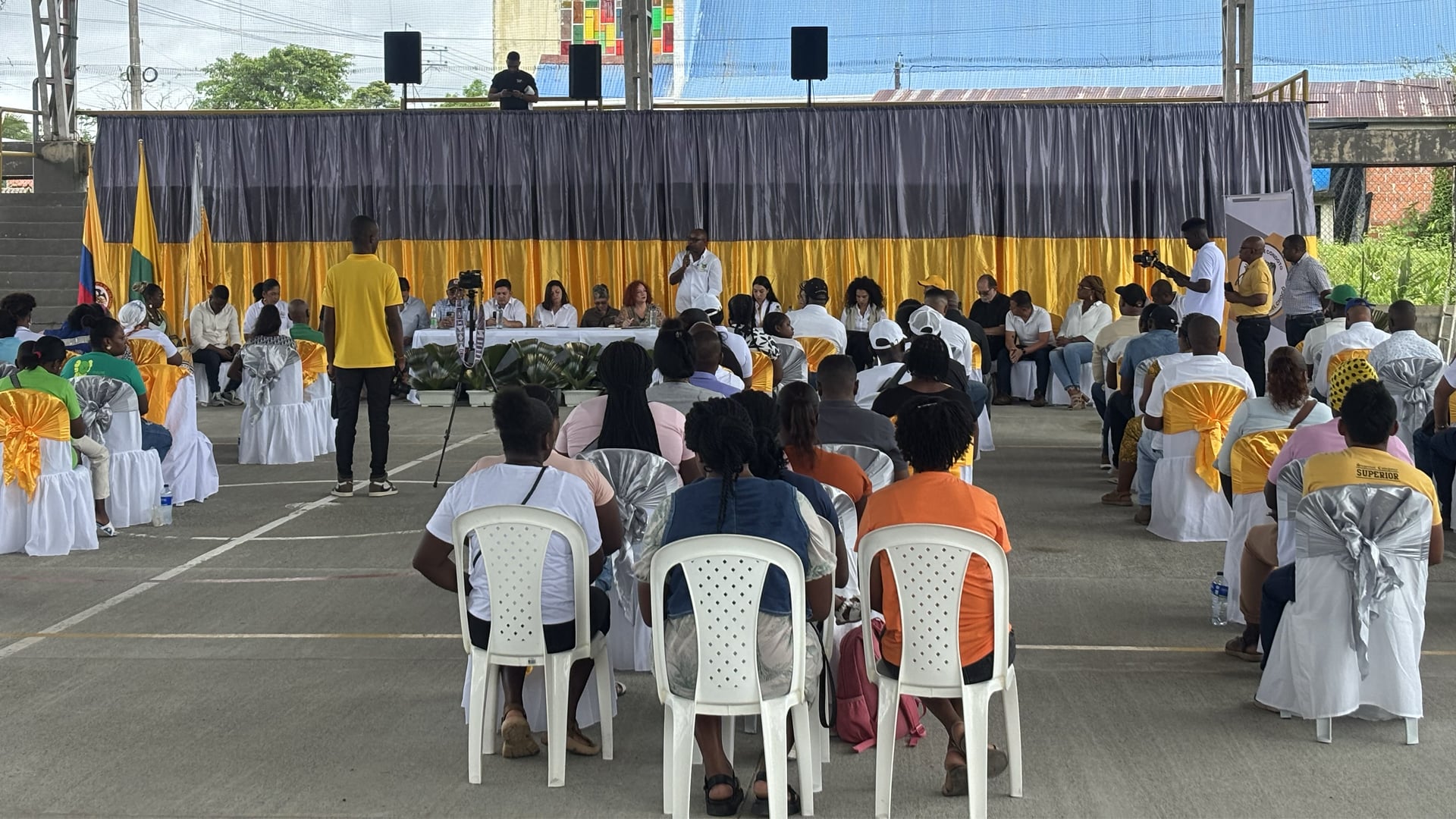
“The groups that have formed, the criminals, keep us subjugated,” she told The New Humanitarian during a meeting between victims of Colombia’s armed conflict and national government delegates in Condoto.
A day before the meeting, the town’s residents had been trapped in their homes for 72 hours under threat of violence by the ELN – deprived of access to healthcare, food, and education.
Conflict has also brought high rates of unemployment, Yudi said. “Now, young people feel forced to join groups, to attack the very communities they belong to, in order to somehow get by,” she said. “We are suffering the scourge of war.”
Like Yudi, Carmen, whose surname is also being withheld for security reasons, is one of the hundred-odd displaced people who attended the February meeting and one of nearly 1.8 million victims of Colombia’s armed conflict since 2016.
A seamstress forced to leave her rural home by rebel fighting two decades ago, she described her family’s struggle with discrimination, building a new house, and finding work in Condoto.
“There were many problems when our children went to study. They were bullied for being displaced,” she said, adding that her biggest fear is “that the war forces us to be displaced again”.
A new approach to peace
Despite Indigenous people being the most affected by Colombia’s cyclical violence, ethnic voices have historically been ignored in the political processes that have sought to bring about peace.
For example, the 2016 peace deal’s “Ethnic Perspectives Chapter” represents only four of the more than 300 pages in the document. It was also a last-minute addition pushed through by Indigenous and Afro-Colombian representatives, who were only invited to the negotiations in June 2016 – nearly four years after talks began and just two months before they concluded.
Though brief, the chapter included groundbreaking clauses, pledging to recognise ethnic groups’ autonomy and historical marginalisation, and to grant them new land rights. But it has been one of the least-implemented sections of the accord, with only 8% of its stipulations fully implemented as of May 2024 and 62% at a “minimum level of implementation”, according to a report by the Kroc Institute.
“The Colombian state... does not recognise Indigenous minorities and Afro groups,” Andrés Preciado, director of conflict and security at the Ideas for Peace Foundation, a Colombian think tank, told The New Humanitarian. “[They] have been excluded from peace negotiations.”
This is something Chocó’s ethnic community leaders are determined to change.
Moreno, the human rights leader, is one of many local voices clamouring for a regional approach to ending the conflict that would allow community representatives to participate in peace talks with armed groups – an option impossible under the current law that makes formally negotiating with criminal organisations illegal.
Ethnic leaders have experience mediating between armed groups and local communities. During confinement events, they often risk their lives to provide relief to civilians, negotiating with armed groups to establish humanitarian corridors for food and medical supplies. They have the community’s respect and understand the particularities of local politics, something Moreno says government delegates usually lack.
“While peace is being discussed at the national level, we are still in the crossfire.”
So far, the government has preferred to try and strike deals directly with groups at a national level, in line with President Gustavo Petro’s “Total Peace” plan. This strategy has enjoyed limited success: Just a few hundred fighters are estimated to have demobilised out of more than 16,000 nationwide.
“While peace is being discussed at the national level, we are still in the crossfire,” Moreno told The New Humanitarian. “Regional negotiations would allow us to advance more rapidly while the national process follows its own course.”
In 2017, Moreno helped negotiate a ceasefire between the AGC (the precursor to the EGC) and the ELN that brought peace to the San Juan River Basin for over three years. She said it is proof that a regional approach works.
Moreno is calling for a change in the law that would allow regional humanitarian negotiations to progress while conflict continues, reducing legal concerns for community leaders as they confront issues like child recruitment, access to food and medicine, and the killing of social leaders.
James Hermenegildo Mosquera, a congressman from Chocó who occupies a seat specially reserved for conflict victims, supports this legal change.
“The law… deepens distrust and turns the peace process into an asymmetrical relationship, where communities can only be heard if the state allows it,” he told The New Humanitarian, describing the government’s actions as “insufficient”.
In an email sent to The New Humanitarian, a spokesperson for the Office of the Peace Commissioner, responsible for government negotiations, justified the policy, saying that “guaranteeing the security and integrity of negotiators is fundamental for the National Government and this security guarantee may fail if the communities… carry out approaches or talks with armed groups without the knowledge of the National Government.”
“Women, victims, Afro and ethnic populations, among others, participate in dialogues or spaces parallel to the negotiation tables,” the spokesperson added.
Ethnic representation amid state neglect
While they still hope for ethnic voices to be included in peace processes, some Indigenous leaders are now concentrating more on trying to mitigate the root causes of the conflict, which they see as primarily a product of state neglect.
Harold Ismare, national representative for the Wounaan Indigenous People native to Chocó, is one of them – part of a national movement lobbying the government for greater recognition of ethnic authorities.
Their efforts have proven successful, putting Colombia at the forefront of Indigenous rights in Latin America, with the government in May granting communities self-governing authority, budgets, and administrative power.
“We believe issues of structural violence will be reduced because through Indigenous self-government there will be institutional assistance for the communities,” said Ismare.
The plans include funding for community-provided education, which he believes will expand opportunities for local youth and help deter them from joining armed groups.
The government has also recognised the ability of Indigenous authorities to provide health services and justice and agreed that state resources will increasingly go directly to ethnic authorities rather than through the municipal or departmental government.
“This gives us the legal capacity to administer, manage, operate, contract, and execute public resources of the Colombian state,” explained Ismare. “Peace cannot be built from above.”
Edited by Daniela Mohor.


