


Share & more
With violence on the rise and government-led negotiations with armed groups in a seemingly endless stalemate, Colombians are increasingly having to take matters into their own hands, developing grassroots initiatives to address the root causes of decades of internal conflict.
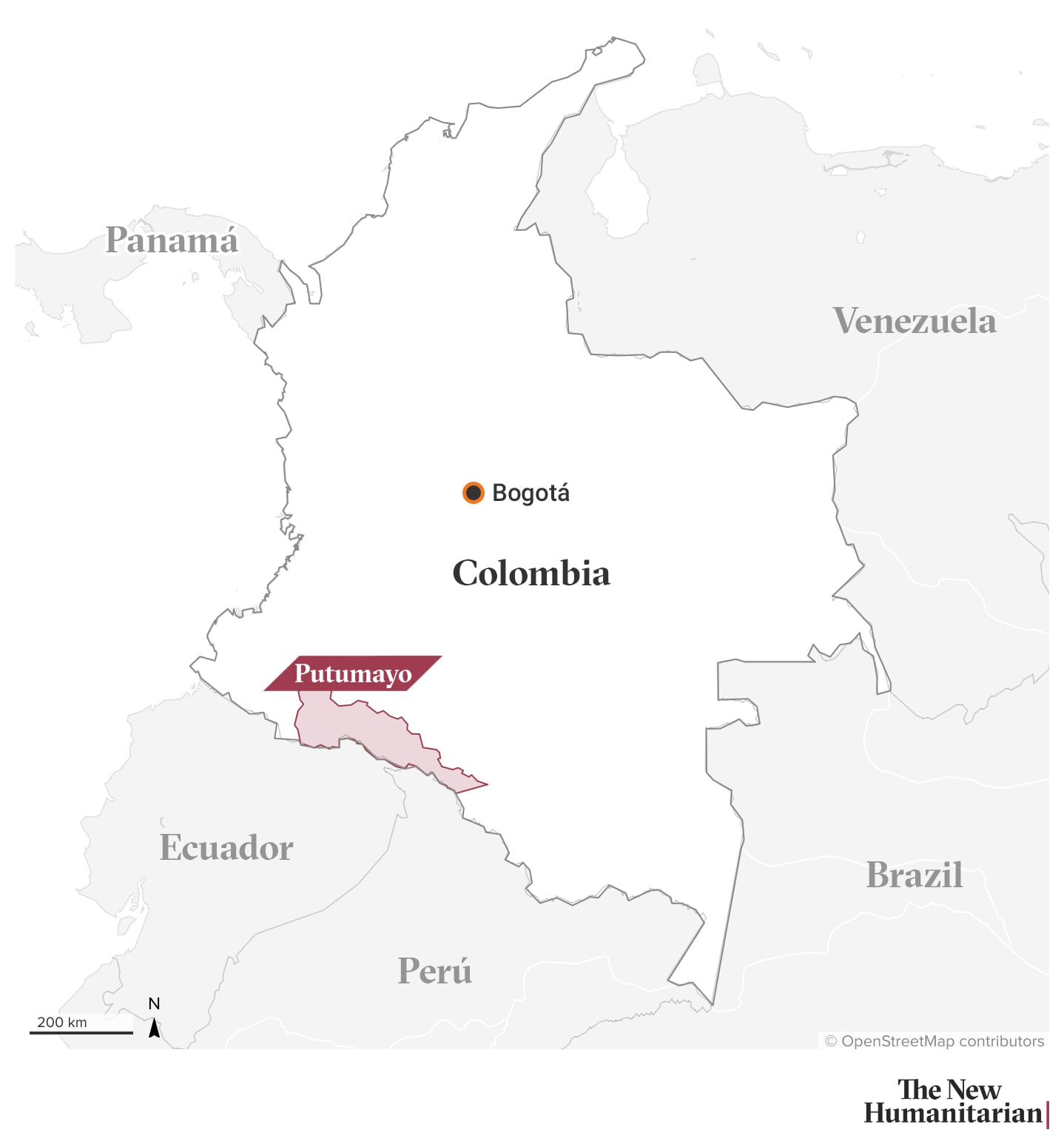
One such endeavour saw the Universidad de la Amazonia welcome its first 26 students in January in a new branch in Puerto Asís, a city in conflict-stricken Putumayo. The first public university to open its doors in the southern department’s biggest city, it seeks to revitalise the region by offering young people new opportunities through localised higher education.
In 2022, President Gustavo Petro’s flagship “Total Peace” plan – which aimed to strike deals with armed groups across Colombia – had brought hopes of a change. But three years after his election, most talks have stalled and many of the groups have fragmented, complicating conflict dynamics and leading to a new surge of violence across the country.
In Putumayo, clashes between three non-state armed groups (NSAG) have torn the region apart as they vie for control of smuggling routes and criminal economies, leaving youth with little to no opportunity to resist the pressure of illicit work or longer-term recruitment.
“Most of my schoolmates work in coca now. Others joined armed groups that offer a monthly salary,” one of the newly enrolled university students told The New Humanitarian. “This university is a great help for us – young people with few resources – to fulfill our dreams of studying,” added the student, whose name is being withheld as they are still a minor.
The university has already started an agroecology course and plans to launch veterinary science and law courses in 2026. Once those begin, a total of 135 students will be able to enrol in one of the five-year degree programmes twice a year.
Classes are currently held in a local high school, though the municipal government has donated land for a permanent campus. The Universidad de la Amazonia, whose main campus is in the neighbouring department of Caquetá, has drafted plans for a $10 million complex that could eventually serve 2,000 students.
Life under an armed groups’ control
The gateway to the Amazon and bordering Ecuador, Putumayo is one of the primary coca cultivation and cocaine production hubs in Colombia – a country responsible for most of the world’s supply. It is also home to two of Colombia’s eight internal conflicts and is one of the 12 hotspots in the country considered humanitarian emergencies.
The Revolutionary Armed Forces of Colombia (FARC) – then the country’s largest guerrilla group – signed a peace deal with the Colombian government in 2016 and demobilised in 2017, but several dissident groups remain active in the department, directly impacting the population.
In Putumayo, the number of people affected by severe movement restrictions known as confinement increased by 300% from 2023 to 2024, according to the International Committee of the Red Cross (ICRC), while the number of victims of humanitarian emergencies rose by more than 100%. Currently, 46% of the region’s population is affected by food insecurity.
The armed groups impose curfews and block access to food, healthcare, education, and livelihoods. They also target children: Between 2023 and 2024, they increased their recruitment of children by 20% nationally, according to the UN’s emergency aid coordination body, OCHA.
“When you live there, the presence of armed groups influences your behaviour. You know they are around and that you have to behave well.”
One particular armed group in Putumayo – known as the Border Command (Comandos de Frontera) – dominates coca production and trafficking routes. Composed of former FARC dissidents and drug traffickers, it controls illicit economies around Puerto Asís and also operates in neighbouring Ecuador, where it recently killed 11 soldiers.
The New Humanitarian interviewed four students from the first cohort, most of whom come from rural zones around the city where the Border Command’s presence is the strongest.
Some have families who own small farms, others’ parents are day labourers, taking whatever job is available. One student only recently returned to Putumayo after her family had been displaced by the conflict in 2002.
“When you live there, [the presence of armed groups] influences your behaviour. You know they are around and that you have to behave well,” said 23-year-old Jessica Álvarez.
Some students said they must inform the Border Command of their daily travel to Puerto Asís for classes. “They make the rules,” Álvarez explained.
Choosing education over coca
The Universidad de la Amazonia wants to bring changes. The choice to start with agroecology was strategic as the university hopes it will help the community find alternatives to coca cultivation.
“The programme teaches students how to develop agriculturally productive systems that work in harmony with the rainforest,” said Diana Patricia Vargas, an agroecology professor at the new university.
But the ongoing armed conflict – not to mention strained resources – makes Putumayo a challenging educational environment.
Decades of conflict have crippled primary and secondary schooling. Putumayo currently ranks at the bottom of Colombia’s education system.
Low pay and harsh living conditions deter teachers from working here, as do threats from armed groups.
“[Teachers] disrupt the status quo,” said an OCHA official who couldn't give their name due to organisational guidelines. “They mentor youth in ways that compete with armed groups’ control, and their teachings may contradict what the groups want.”
As a result, the quality of education suffers. So does access: Less than half of primary students move on to secondary school, and only about 19% pursue higher education.
“The few who do [study after school], go to bigger cities. Most do not come back,” said Jani Silva, a social leader from Putumayo who has been recognised internationally for her environmental and peace activism.
Many of the Putumayo students enrolled in the Universidad de la Amazonia would not have had access to higher education without the campus in Puerto Asís.
“For me, the opening of the university was fantastic, because I did not have the money to move to another city to study,” Jenny Riascos, one of the new students, told The New Humanitarian.
Costs are lower and the competition to get in is less fierce than for other public universities.
“[High school] students often go half a year without an English or Maths teacher. They can’t compete with urban students in standardised tests that determine university eligibility,” Silva said.
The new university’s ecological agriculture programme also aims to develop research that benefits the Amazon and locals.
“This is an under-researched region,” said Vargas. “When studies are conducted, universities from other parts of the country come, investigate, and take the results with them – usually without sharing findings with locals.”
A university’s gamble
The university, however, faces myriad challenges. Even with free tuition, costs remain prohibitive, which has led many to drop out.
According to Cristián Gelpud, the coordinator of the university’s new local branch, only 32 of the 45 inaugural spots were filled, and six students dropped out within weeks, most of them due to economic hardship.
The university also has to compete with the allure of illicit economies.
“Farm work pays little. Coca pays more. University gives you a future, but it takes time. It’s a hard decision,” said Riascos.
Some students fear that although armed groups have not impeded their attendance so far, this could change if graduates do start implementing alternative farming practices.
“People don’t believe until they see. So the first step is to change our own farms, then others might follow.” said Álvarez. “But I fear any progress might be cut short. Obviously, our work to shift mindsets goes against their interests.”
The risk that rival groups will challenge the Border Command's territorial dominance in Puerto Asís further complicates the situation. Elsewhere in the department, active fighting is already disrupting education.
“Last year, we saw several confinements — a week here, a week there, the longest one for two months. That means access to school is interrupted, which of course impacts its quality,” the OCHA representative said.
Funding hurdles also compound these challenges.
Though expanding higher education in conflict zones was part of Colombia’s peace deal with the FARC, the Universidad de la Amazonia received no extra resources for its new branch. Colombia’s Ministry of Education said in an email that additional funding from the national government may follow after an evaluation of the Puerto Asís project.
“No one is investing to boost higher education here,” Gelpud said. “The university is taking a financial risk, as it has to guarantee the continuity of the programme. But we decided that not starting would be worse.”
Edited by Daniela Mohor.


