


Share & more
Nearly six months on from a ceasefire between Lebanon and Israel, Israeli bombing hasn’t ended and there’s no clear timeline for hundreds of thousands of displaced people to return to south Lebanon for good, let alone rebuild their destroyed homes and neighbourhoods.
Israel and Lebanon have held several rounds of US-backed talks since an April ceasefire aimed at ending fighting between Israel and Hezbollah, which is not part of the negotiations. Since March, Israeli bombardment has killed more than 4,386 people and displaced more than one million in Lebanon, according to Lebanese government statistics.
A June deal renewed the truce – during which Israel continued to bomb Lebanon – and established a framework for “pilot zones” in southern Lebanon, where Israel would withdraw its troops from some occupied villages in exchange for Hezbollah disarming. But Hezbollah never agreed to disarm, Israel has continued to bomb and expand its presence in the south, and while more than 864,000 people have returned, according to the UN, many of them aren’t actually in their homes or in places where they can make a living or feel safe.
“We sit on the balcony and watch the airstrikes,” an elderly woman from Safad al-Batikh, a village around seven kilometres from the Lebanon-Israel border, told The New Humanitarian.
“We have nowhere else to go.”
The woman, who asked that her name not be published for security reasons, recently returned to her home, which was destroyed by Israeli bombing in 2024. Her family borrowed money to rebuild, and now have nothing left. They sleep on mattresses on the floor lent by the local government, and sit on plastic chairs. “We have nowhere else to go,” she explained.
More than 341,000 people remain displaced: some from border towns that have been levelled to the ground; others from parts of the country still under Israeli control.
While local and international aid groups are plugging the gaps where they can, displacement looks increasingly like a long-term problem. With more than 16,000 people still in collective shelters and new waves of displacement ongoing, it’s unclear what will happen if hundreds of thousands of people remain without homes, neighbourhoods, or jobs.
Life inside the yellow line
The Lebanese government says it has a plan to help displaced people, which is separate from the joint government-UN-NGO $1.62 billion humanitarian response plan for 2026, which has recently been updated given the escalated violence and displacement. But the government’s efforts – which have not been published – will depend on money that has not yet been raised, as well as on the US-backed Lebanon-Israel agreement that some Lebanese officials have described as non-binding.
“The government has drawn up a recovery plan to support displaced people returning home and is seeking around $1 billion to finance it,” Deputy Prime Minister Tarek Mitri told The New Humanitarian. “But its implementation depends in part on an Israeli withdrawal and on securing international funding.”
High rents, overcrowded shared apartments, and the difficult shelter conditions that some people – like the woman in Safad al-Batikh – have chosen to return to in the south despite the uncertainty and danger make the displacement situation particularly hard.
She was only able to go back because she doesn’t live inside the so-called “yellow line”, a term Israel first used to refer to a line on a map its military published in April showing what it called a “forward defensive line” inside Lebanon.
Inside that line, Israel now occupies around 68 towns and villages, and Israel’s Defense Minister Israel Katz said in August that 24 villages in the territory have been levelled to the ground.
For those back in the south, the Lebanese Army’s limited deployment and Israel’s ongoing incursions make movement in the area risky, and a return to normal life impossible.
Near the yellow line, smoke rises – Lebanese officials and firefighters have accused Israel of deliberately burning agricultural lands – and controlled detonations can be heard. And even if the demarcation itself were clear, Israel has been expanding further outside the line into a so-called “buffer zone”.
Haidar Koteish, 36, is from the village of Houla. It is occupied by Israel so he is now staying in Chakra, another village in the south. From Chakra, he was able to point out the fields where his family used to grow wheat. He said they were burned by the Israeli military. “We no longer have land to grow our crops,” he said, adding that he thought more and more Lebanese would become dependent on humanitarian aid because of the conflict. “Everyone is a farmer here, even the doctors, teachers, and mechanics,” he explained.
Youssef Cheaito, 64, left his occupied village of al-Tiri and later returned to the nearby village of Aita al-Jabal in order to be as close to home as possible. Since the age of 14, he has built his life and livelihood around beekeeping. “If a bee doesn’t sting me during the day, if I’m not planning which beehives I need to visit the next day, I can’t sleep.”
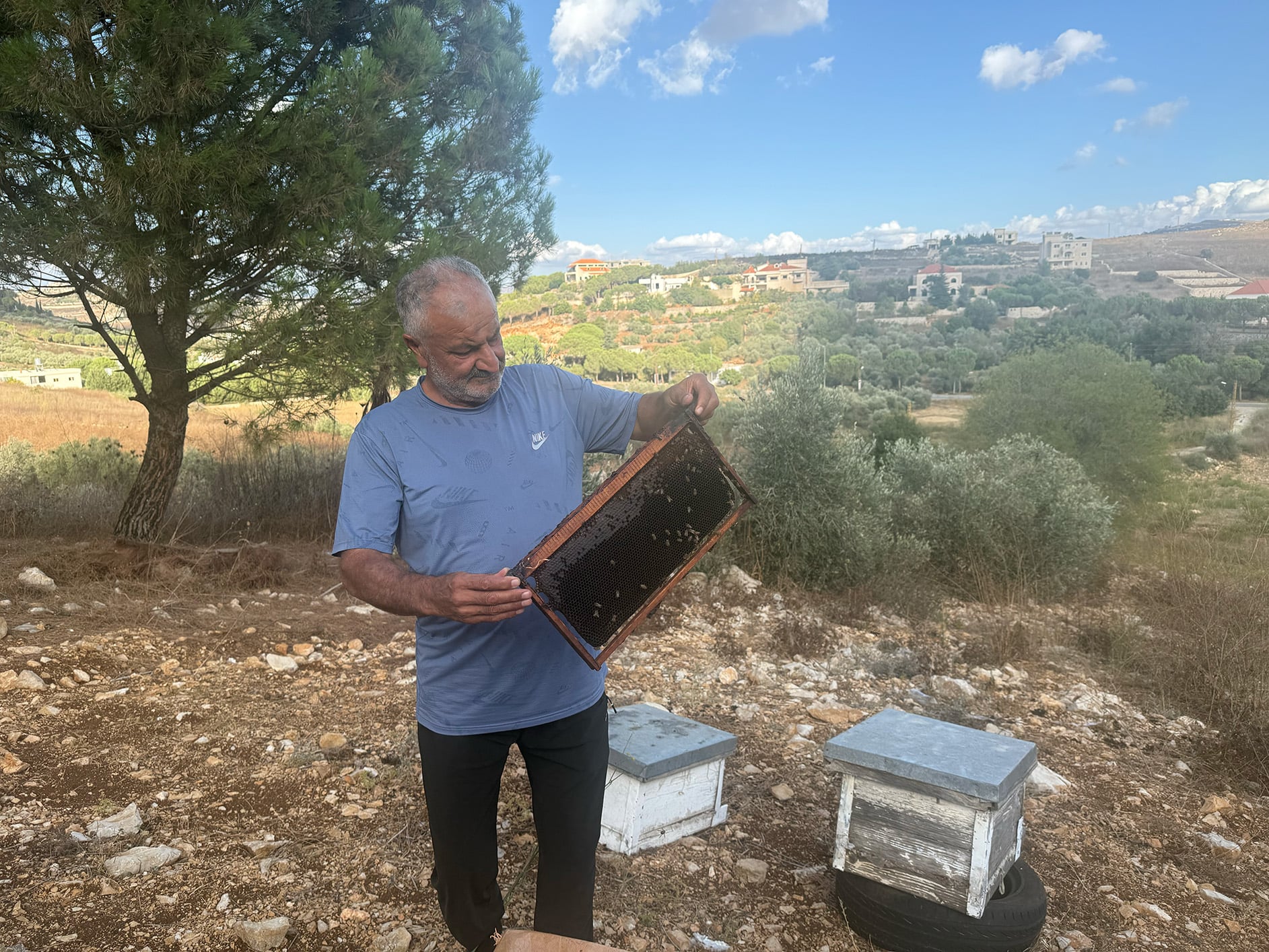
“I left everything I built and fled,” Cheaito said. He told The New Humanitarian he planned to stay nearby since returning, and he has bought some new beehives, because “being taken away from my land is like being cut down, like a tree. Even losing my house didn’t break my heart as much as losing my bees.”
Cheatio and Koteish both described the fear that Israel will advance towards their refuges as constant. Lebanese officials say Israel set fire to a government hospital in Marjayoun in the buffer zone earlier this month, and airstrikes killed 12 people in one day near Israeli-occupied areas on 7 September.
Some people were packed and ready to leave again if they had to, while others, like 35-year-old lawyer Najib Farhat, said they were coming to the south in case they didn't have the chance again.
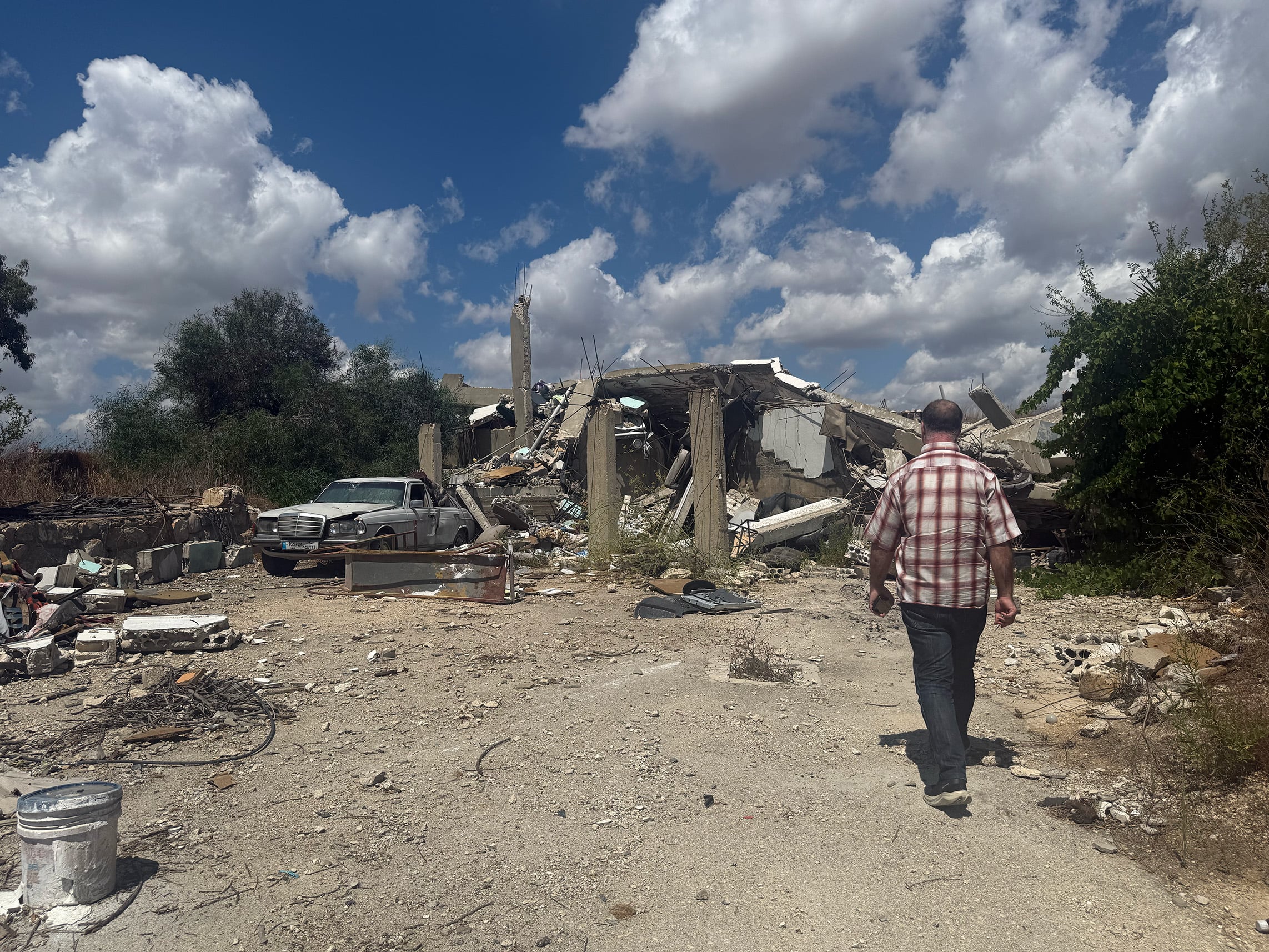
“We are seizing an opportunity to visit our land as Israeli forces advance further toward the village,” said Farhat, speaking by the tent his family has pitched near his destroyed home in Baraashit. The village is now partially occupied by Israel.
Aid and economics
It isn’t just those reliant on agriculture who are finding life hard.
Farhat said his entire family has struggled to keep going throughout the war. His father teaches at the village school. When their home was destroyed, he stayed with neighbours so he could continue going to work.
“My father finished paying off the house three years ago, and now he’s only months away from retirement,” Farhat said. “Is he supposed to start working all over again to rebuild it?”
As for Farhat, he began working as a lawyer 13 years ago. “The war has shut down six courts in the south, forcing me to rebuild my career somewhere else.
A spokesman for Lebanon’s Ministry of Social Affairs told The New Humanitarian it had provided “four rounds of cash assistance to around 250,000 war-affected families through the Shock Responsive Safety Net (SRSN)” – a donor-funded state programme – since March.
But residents want more permanent help, not simply repeated rounds of food parcels from aid groups and temporary cash assistance.
Koteish wondered what support there might be to build a new life in the village where he is staying: “If we cannot return to our villages, will we have options here?”
It’s not just about housing or jobs. Action Against Hunger has reported that around 150,000 people in the south have no access to running water. In Lebanon, water tankers have long compensated for the state’s unreliable public supply. But one tanker driver, who asked that his name not be published for security reasons, told The New Humanitarian that most wells are located on what are now Israeli-occupied lands.
He said the price of water has soared as Lebanon’s economic situation has worsened during the war and many customers can no longer pay. “One of my clients was crying because he could not afford to pay the full cost of a delivery,” he said, adding that many families now ration their water to make each delivery last longer.
Temporary shelters and pilot zones
Among those who haven’t returned are the more than 14,000 people living in collective shelters who are unable to pay for rent and who have no family members or friends who can share space with them.
Many schools were turned into shelters over the past month, but the academic year has now started and some displaced people are refusing to leave, arguing that the alternative shelters they have been offered are unsafe and too close to the bombing.
This feeds into a sense that there has been a lack of forward planning from the Lebanese government, especially if people can never go home or receive compensation for lost homes and lands.
Rights organisations have criticised parts of the framework deal between Lebanon and Israel as inconsistent with international law; under which displaced civilians have a right to return once the reasons justifying their displacement no longer exist.
The deal includes four “pilot zone” villages where residents are permitted to return following the withdrawal of Israeli forces and the assumption of control by the Lebanese army. But many argue that these villages were never actively occupied by Israel, although they were destroyed and are barely fit for habitation. “This runs counter to the original concept of successive pilot zones eventually leading to a withdrawal towards the international border,” Hassan Jouni, a retired brigadier general now working as a military expert, told The New Humanitarian.
Both Israel and Lebanon appear to be backing away from the pilot zone model, raising fears that Israel is digging into south Lebanon for the long haul.
“It isn’t clear who will return and when,” Mitri, the deputy prime minister, told The New Humanitarian. “Israel is saying publicly that there will be no withdrawal, except from some villages under the agreement of the pilot zones,” but at the same time “they are building infrastructure and establishing a permanent presence south of what they call the yellow line.”
Those who have gone back to the south don’t hold out much hope for the future. Many are keeping their bags packed for the next time they have to leave. Others, like Farhat, return regularly to visit and check on their family land. Close enough to survey his destroyed farm, Koteish put it simply: “There is no land to cultivate, no livelihood, and no stability.”
Edited by Annie Slemrod.


