


Share & more
It was 27 June. My family hadn’t tasted bread in a week. Not even a handful of flour was left in the tent we now call home. My little sister, Leen, 12 years old, stopped asking for food two days ago. She just sat quietly, her thin arms wrapped around her knees. The price of flour had climbed to 100 times what it used to be – too high for the poor, too cruel for the hungry. I couldn’t wait anymore.
I knew where the aid trucks would be. The northern end of the coastal road, al-Rasheed Street. We had heard some had been allowed to enter through the al-Siafa/Zakim crossing. But al-Rasheed Street has become a slaughterhouse.
Maybe you’ve heard of the hundreds of people who have been killed and thousands maimed while trying to get aid from the so-called Gaza Humanitarian Foundation. Nearly 200 people have also been killed by Israeli forces as they’ve tried to get aid from the few UN convoys that have been allowed into Gaza in recent weeks.
From a small hill at the northern end of al-Rasheed Street people watch the road with eyes full of hope, searching for trucks that might bring food, water, life. At night, a light appears. The people cheer, they whisper: “Aid is coming.” But the light is not mercy – it’s a tank. It does not bring bread. It brings shells and bullets. Joy turns to screams as people run back behind the hill. Above them is the constant hum of a drone.
I knew all this, but still, I made up my mind.
I was packing a small bag when my mother saw me. Her eyes welled up with a mixture of fear and pleading. “You won’t come back,” she said, voice cracking.
I didn’t reply. I couldn’t. I just folded my blanket, grabbed a bottle of water, and zipped my bag. Then she whispered something I didn’t expect: “Take a jacket. It’s cold by the sea.”
That’s when I realised she had let go: not because she wanted to, but because she knew she couldn’t stop me. I nodded and tucked the jacket into my bag, like it was a piece of her I could carry with me.
The road to the kill zone
The sun had just begun to fade when I saw my cousin Mohammed ahead of me, walking in the same direction. He is 25, three years older than me. We didn’t need to speak. One look between us was enough. Where are you going? To get bread. To die. To do both.
From where my family’s tent is in Tel al-Hawa, south of Gaza City, it was a two-and-a-half-hour walk north. People, some barefoot, others carrying empty plastic bags, walked in silence. We were all going to the same place. Pale faces stared straight ahead.
The areas we walked through were demolished and deserted. Buildings were either entirely destroyed or severely damaged. Gunfire echoed in the distance. The closer we got to al-Rasheed Street, the heavier it became. The ground was dry, cracked. Dust clung to our shoes like it knew we might not return.
And then we arrived. The place was a roundabout by the sea. There were no buildings around it, just berms built by the Israeli army.
A sniper was perched on the rooftop ahead, his scope sweeping over the crowd, like a farmer reaping wheat.
I’ll never forget the sound of that place – constant, mechanical violence. A sniper was perched on the rooftop ahead, his scope sweeping over the crowd, like a farmer reaping wheat. An Israeli tank blocked the street, its cannon twitching like a watchful eye. Drones buzzed above us, and a quadcopter hovered with a mounted gun, pointing not at soldiers – but at children, old men, starving mothers. From the sea, a warship opened fire.
We kept walking to find a place to hide from the bullets, but close enough to where the aid trucks would come. We walked not out of courage, but out of desperation. It was late in the evening, and there were thousands of people taking the same risk. Men. Women. Children. The elderly. Women carried infants in scarves. Boys held empty plastic bags that they hoped to fill with parcels of food. Some walked barefoot. Everywhere, the smell of dust and fear.
Waiting for the trucks
By midnight, the trucks still hadn’t come. My stomach was a hollow drum. The only thing I had eaten all day was air. We reached the old al-Furusiya equestrian club. The club has been destroyed, and the horses have been killed during the war. For us, it was the final point. The Israeli army didn’t allow anyone beyond it. But we were already too far from safety.
We gathered scattered pieces of wood from the ruins of resorts that used to stand nearby, where families would come to vacation by the beach. My cousin started a fire using a lighter from his pocket. I offered him my blanket. “This isn’t for warmth,” he said. “It’s for the mosquitoes.”
His voice was flat, tired. But I understood. In a place where bullets fall like rain, the only battles we can still win are the small ones.
I wore the jacket my mother had given me. It smelled faintly of home. That scent – fabric softener and olive soap – made my chest tighten.
Suddenly, gunfire.
It started out of nowhere and came from everywhere. The land, the sea, the sky. Why? I do not know.
I dropped to the ground. My hands dug into the sand. My cousin grabbed my arm and pulled me behind a berm. “Stick to the ground if you want to survive.”
My face pressed into the dirt. I thought of a poem by Mahmoud Darwish where a father tells his son to cling to the soil, because the soil doesn’t betray you.
When the gunfire stopped, the silence screamed. Three people were dead. One was a boy, maybe 10 years old. I watched his older brother cover his face with a torn shirt. I wanted to cry, but the tears wouldn't come. Not yet.
Scramble for aid
Around 3am, a shout pierced the silence: “The aid trucks have arrived!”
I jumped up, legs stiff, heart pounding. The crowd of thousands of people surged like a wave. I lost sight of my cousin in the flood of bodies.
I reached the first truck, but it was too crowded. At the second one, there was no space. At the third, people screamed as the flour was thrown out like candy. The dust kicked up by thousands of frantic feet made it difficult to see.
At the fourth, I saw a sack fall. I lunged. My fingers dug into the thick fabric. I pulled. It was mine.
I stood there, holding 25 kilos of flour. It could have been feathers. It could have been gold. I cried – not from sadness, but from something deeper. A mix of exhaustion, joy, and guilt. Why did I get it when others didn’t?
Minutes passed like hours. And then I saw my cousin also carrying a sack. I laughed. He laughed. We didn’t say anything. We didn’t need to.
I left the frantic crowd and walked to the Sudanese Roundabout, about five kilometres away. Mohammed and I had chosen it as an emergency meeting spot if we got separated. It was almost four o’clock in the morning. The sun had not yet risen. There were many people waiting there for their friends, children, or siblings to return.
Minutes passed like hours. And then I saw my cousin also carrying a sack. I laughed. He laughed. We didn’t say anything. We didn’t need to.
We walked around 20 kilometres back to the tent. My arms ached, but I didn’t care. I was alive. I had flour.
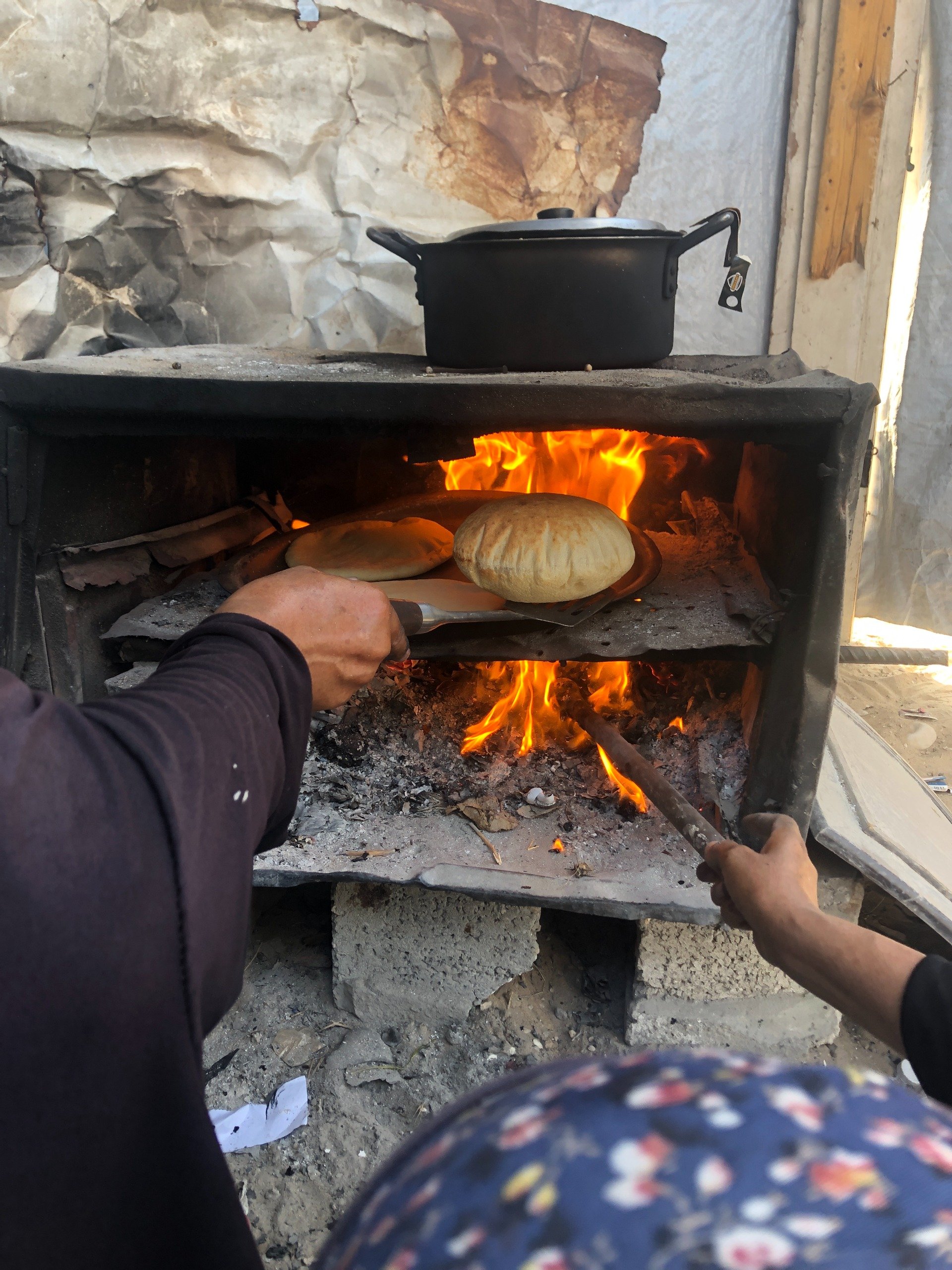
Bread and blood
When we reached the tent, I saw the flicker of light inside. My father’s silhouette was pacing. My mother was still praying. My four sisters – all younger than me – were waiting in silence. I stepped in.
“Allahu Akbar!” they shouted.
Leen ran to me. “Now bake for us!” she said. “We want to eat!”
That sack of flour wasn't just food. It was proof that I still existed. That I could still provide. That despite the bullets, the bombs, the hunger, I had won something that night.
But I didn’t forget the ones who didn’t return. Their mothers. Their blankets left behind in the sand. Their last prayers unfinished.
In Gaza, bread is not a right. It’s a battlefield. But we keep walking, keep hoping, keep returning home, even if only with flour. As Darwish wrote: “We suffer from an incurable disease called hope.”
Edited by Eric Reidy.


