


Share & more
On the morning of 26 June, my husband, Abdullah, woke up to a text message he couldn’t believe. “Dear Abdallah al-Turkmani, please proceed to Abu Zayed warehouse to collect a food parcel,” it read. The message said it was from the UN’s World Food Programme (WFP).
At first, Abdullah thought he was having a dream, but as he came to, he called out to me: “Rasha, come look! I received a message saying we’re getting a food parcel.” At the time, I was tidying the house where we are currently staying. I dropped everything and rushed to him with a shocked smile. “Are you serious, or is this one of your jokes?” I asked. He replied: “Look at the message... I’m not joking.”
The last time I wrote for The New Humanitarian, I recounted how my husband was nearly killed by Israeli gunfire trying to get aid from a site run by the US- and Israeli-backed Gaza Humanitarian Foundation (GHF). Seventeen people were gunned down around him while trying to get food for their families. He survived, but returned empty-handed after being robbed on the way back to northern Gaza by an armed gang.
That was in early June. Since then, the chaos and violence at the GHF’s four sites in Gaza – none of which are close to us in the north – have continued non-stop. People are being killed and wounded every single day; frequently dozens of them at a time. Médecins Sans Frontières, whose teams have been treating the wounded, called the GHF “slaughter masquerading as humanitarian aid”.
More than 766 Palestinians have been killed by Israeli forces – and thousands more wounded – while trying to obtain desperately needed food aid from the GHF’s sites since it began operating at the end of May, according to Gaza’s health authorities.
None of this is necessary. None of it is inevitable. It has been orchestrated by Israel. After deliberately starving Gaza’s population for months, and forcing the population into a state of utter desperation, it is now imposing a psuedo-aid system on us that only serves its interests: to see us displaced and killed.
The text message from WFP was a reminder for my family that this is not how things have to be. There is a readily available alternative that could bring an end to the starvation, chaos, and death – if only Israel would stop blocking supplies from entering Gaza and preventing long-established international aid organisations, like the WFP and the UN’s agency of Palestine refugees (UNRWA) from doing their jobs.
Effects of famine
After receiving the text message, my husband rushed to the WFP warehouse, which is only two blocks from where we are staying in the Sheikh Radwan neighbourhood in northern Gaza City. I stayed with our five children, eagerly waiting to see what the parcel would contain.
The last time we received any food assistance was before 3 March, when the Israeli government decided to completely seal off the Gaza Strip and prevent the entry of all aid, food, and goods. This plunged my family – along with the rest of Gaza’s population – into severe starvation. Our food supplies, like everyone else’s, ran out – especially flour, which we use to bake bread. We were forced to resort to bartering with our neighbours to obtain basic needs – trading whatever rice or pasta we had for items like cooking oil and sugar.
Since March, because of the famine, I have lost 15 kilos and my husband has lost 18. My daughters and I are starting to lose our hair, and small injuries we get while doing housework don’t heal due to malnutrition.
We haven’t had any milk, eggs, or even a simple piece of fruit in months. Chicken and meat have long since disappeared. There are still some vegetables available in the market from the last remnants of farming still taking place, despite Israel almost entirely destroying Gaza’s agricultural sector. But these vegetables are extremely scarce and expensive. For most people, they are unaffordable. I ration them carefully, using just one tomato and one cucumber to make a dish of salad for our family of seven.
Since March, because of the famine, I have lost 15 kilos and my husband has lost 18. My daughters and I are starting to lose our hair, and small injuries we get while doing housework don’t heal due to malnutrition.
A few weeks ago, I decided to donate blood for people injured in Israeli airstrikes, but I fainted while my blood was being drawn because of how weak I have become. Afterwards, the doctor told me that I am suffering from anaemia.
Orchestrated chaos
Under mounting international pressure, Israel has allowed around 1,200 trucks carrying aid to enter Gaza through the UN-led system since 21 May – a tiny number compared to the 600 per day humanitarians say are needed.
Almost all of the shipments have been looted by starving crowds before they could reach the WFP or UNRWA warehouses because Israel refuses to allow Hamas-affiliated security forces to escort the convoys.
Like our hunger, this looting is also a product of Israeli policies. During the ceasefire, between mid-January and mid-March, when enough aid was being allowed into Gaza and people guarding aid convoys were not being killed, there was virtually no looting.
In response to the current chaos, Palestinian clans formed popular protection committees – as they have at various times throughout the war – to secure the safe arrival of aid trucks. These committees were successful, and around 40 trucks reached international aid warehouses in northern Gaza without incident on 25 June, according to Khaled Nassar, a WFP field officer in Gaza.
People in Gaza watched news of the arrival of these convoys closely, hoping they were a sign that more aid deliveries would soon follow, and it was flour from these trucks that Abdullah received a text message about to go and pick up.
When he arrived at the warehouse, Abdullah found a line with several hundred people in it. Hundreds more were soon standing behind him as well. But the distribution proceeded quickly and was well organised. “People stood in orderly queues to receive their food parcels. There were clan members helping to manage the lines and protect the aid from being looted,” he said.
This was in stark contrast to the mob-like scenes he had experienced at the GHF’s hubs, where people snatched aid from one another in a frenzied, disorderly manner as bullets, bombs, and artillery rained down.
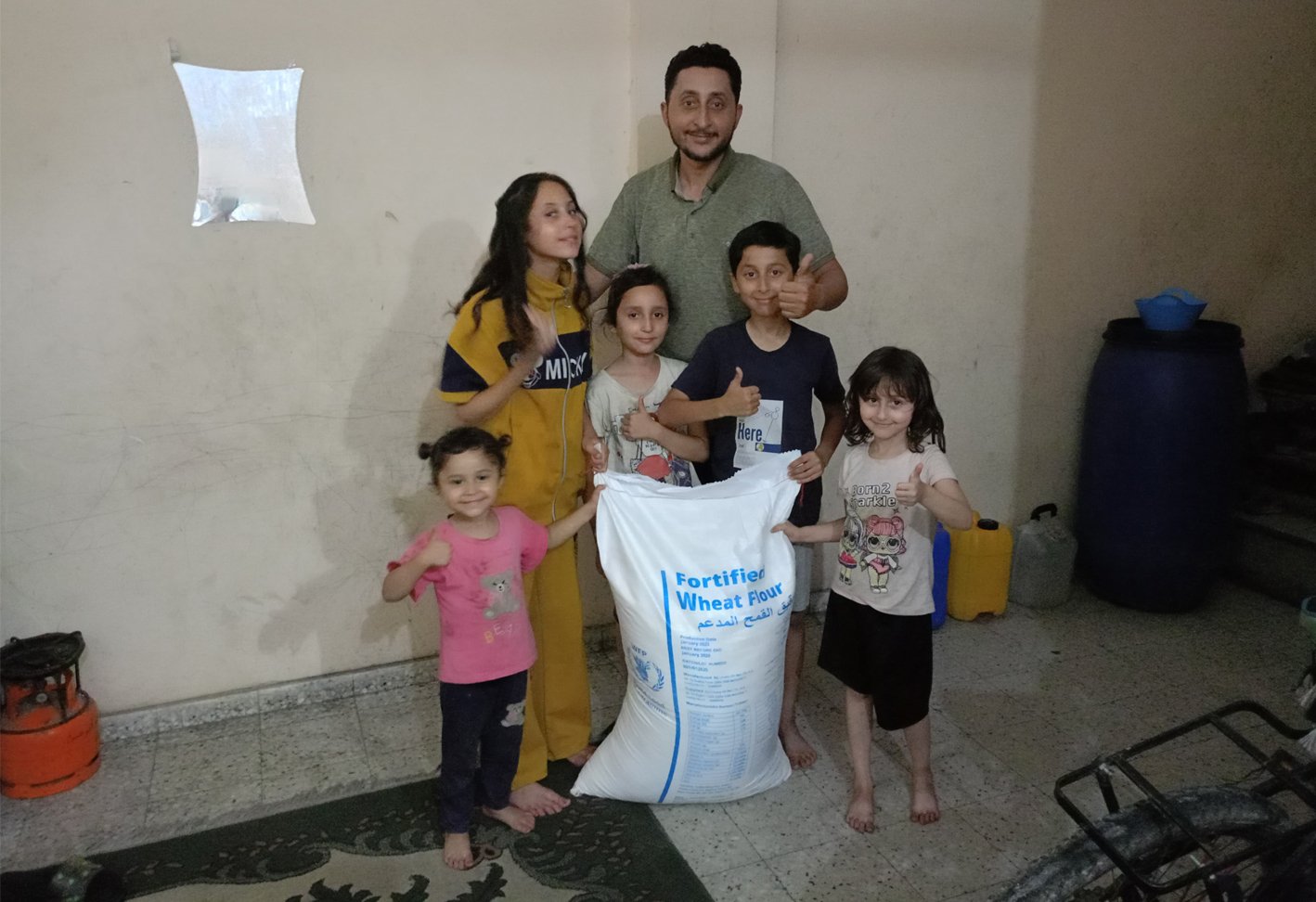
Soon, he was handed a 50 kilo bag of flour – enough to bake bread for our family for two whole months.
From joy to sadness
As my husband made the short walk back home, carrying the heavy sack on his back, he was beaming with joy. He was still worried he might be robbed again, but the fact he was walking through densely populated areas close to home – instead of making a long trek through depopulated neighbourhoods from one of the GHF sites – gave him some reassurance.
On his way, people kept asking him, “How did you get that flour?”. Children on the streets clapped and whistled joyfully when they saw him with the sack on his back, hopeful that their parents would soon receive similar messages.
The men in our neighbourhood cleared the way for my husband to pass and congratulated him. He told them he hoped a text message would reach them soon, too, so they could also receive flour.
When my husband arrived home, our children were waiting. They were thrilled to see the flour. My eldest daughter, Saida, who is 13, said: “Finally, we don’t have to eat bread made from rice or pasta anymore.”
Before receiving this flour, I, like many mothers in Gaza, had been baking bread using ground rice and pasta due to the flour shortage. The resulting bread was of very poor quality – it would quickly harden and become inedible. Us mothers in Gaza have learned through bitter experience, however, that this bread helps our children feel full for longer than just eating rice or pasta alone. Baking it is one of the strategies we’ve been forced to develop to manage the famine we are facing.
Sadly, just hours after my husband returned with the sack of flour, Israel announced it was once again halting the entry of flour trucks into northern Gaza, claiming – without evidence – that Hamas was seizing the aid.
Over two days, on 26 and 27 June, WFP distributed flour to 5,300 families – comprising over 24,000 individuals, Nassar, from WFP, told me. The amount of flour the agency had was far from enough to meet the needs of Gaza’s entire population, so beneficiaries were chosen at random, he explained. My family was one of the lucky chosen few.
Sadly, just hours after my husband returned with the sack of flour, Israel announced it was once again halting the entry of flour trucks into northern Gaza, claiming – without evidence – that Hamas was seizing the aid. WFP’s supply of flour has run out, and it has had to stop its distribution. The vast majority of families in the area where we are living – those men and children on the street who cheered and congratulated Abdullah as he walked by – received nothing.
My husband gave away about 15 kilos of the flour that we got to some of the poorest families in our neighbourhood. He told me: “Those who feed others – God will feed them more.” I wholeheartedly agreed.
Our single hope
Now, people are hoping beyond hope that a ceasefire agreement will soon be agreed, paving the way for a permanent end to the war, and that international pressure will push Israel to allow large quantities of aid to enter Gaza. If the current negotiations fail, we believe the situation will grow worse and that we will be subjected to new waves of displacement and yet more Israeli ground incursions.
As we wait to hear our fate, many people are forced to go to the Gaza Humanitarian Foundation’s centres, facing the risk of being shot just to get food. But my family – and many others – refuse to go there, no matter how severe our hunger becomes. The risk of being killed just is not worth it.
Since my family received the bag of flour, I have felt a slight sense of relief after many days when my children’s eyes followed me asking the painful question: “What will we eat today?”
This flour may last us two months, but it does not ease the worry or extinguish the hunger burning in Gaza. Most families are still without flour, without food, clinging to a single hope: that this war will end and Israel will allow enough food and aid to enter for us to survive.
I won’t be ashamed to speak the truth: Like every mother here, I dream of eating a piece of red meat or eggs fried in ghee. I long to see joy in my children’s eyes as they sip a warm glass of milk or taste a piece of candy. These dreams are small – the size of life in Gaza itself. But for now, people continue to endure hunger with patience, holding onto the belief – even after so many months – that the situation will not get worse than it already is.
Somehow, despite everything, we continue to believe that after hardship will come relief.
Edited by Eric Reidy.


