


Share & more
Google and Meta have run over 100,000 advertisements for businesses that the UN says are facilitating illegal Israeli settlement in the occupied West Bank.
The New Humanitarian cross-referenced both tech-giants’ ad libraries with a UN human rights office database listing 158 firms involved in construction, demolition, surveillance, resource extraction, and pollution in the occupied Palestinian territory. Of these, 39 firms purchased ad space from Google and Meta after they were added to the UN list. Another three firms bought ads before they were listed.
At least seven of these businesses recently promoted products and services directly related to settlement, including housing, an expedited gun license programme, and machinery used in the demolition of Palestinian property.
Other firms’ ads are less explicitly tied to settlement. Israel’s national water company, Mekorot, has advertised infrastructure projects that span both Israel and occupied areas. The accommodation platforms Booking.com, Airbnb, and Tripadvisor – all listed by the UN for “supporting the maintenance and existence of settlements” – account for most of the ads.
Israel’s West Bank settlements, including in East Jerusalem, are widely considered illegal under international law. Expert legal opinion views the settlements as a violation of the Fourth Geneva Convention, which prohibits the transfer of civilians into the occupied territory, and thus views these actions as a war crime.
In July 2024, the International Court of Justice (ICJ) ruled that Israel’s occupation of the Palestinian territories is illegal and must be brought to an end “as rapidly as possible”.
This is not the first time tech giants have been accused of running digital ads related to Israeli activities in occupied Palestine. A 2025 investigation by Al Jazeera exposed Meta ads promoting settlement housing and seeking donations for Israeli military units active in the Gaza Strip. But previous coverage of these digital ads has either focused on specific tech platforms or specific companies buying ad space.
This investigation has identified dozens of such companies and represents the most systematic examination of the digital advertising ecosystem aiding Israel’s occupation of the West Bank to date. It sheds light on a crucial yet undercovered digital and financial aspect of Israel’s colonisation of the West Bank.
Alongside its destruction and occupation of the Gaza Strip in response to attacks by the militant group Hamas in late 2023, Israel has also presided over record-high settlement expansion, skyrocketing violence by Israeli settlers, and moves towards “de facto annexation” in the West Bank.
“Corporations operating in armed conflict zones bear a heightened duty of due diligence to avoid contributing to or profiting from violations of international law,” said Shahd Hammouri, an international law lecturer at the University of Kent.
Providing a platform for organisations flagged by the UN for their activities in illegal settlements, Hammouri added, “constitutes a clear failure of their due diligence obligations”.
The ads may violate the tech giants’ own guidelines. Meta’s ad rules “forbid organisations or individuals that proclaim a violent mission or are engaged in violence to have a presence on our platforms”. Google’s policy forbids ads that incite “hatred against, promotes discrimination of, or disparages an individual or group on the basis of their race or ethnic origin, religion, disability… or any other characteristic that is associated with systemic discrimination or marginalization”.
Rasha Abdul-Rahim, a technology and human rights expert, said the platforms’ tolerance of pro-settlement ads, plus their censorship of evidence of alleged Israeli crimes, amounts to a “systematic effort” to promote Israeli policy goals at the expense of their own rules.
Representatives at Meta and Google, including the latter’s ad liaison, Ginny Marvin, did not respond to questions about their review processes for West Bank settlement ads or their potential complicity in violations of international law.
Expedited gun licenses
Google is hosting a Hebrew-language ad campaign for Caliber 3, a company based in the Gush Etzion settlement bloc, south of Jerusalem, which has been described by Israel’s Haaretz newspaper as an “anti-terror fantasy camp”.
Caliber 3 is listed in the UN database for providing security services and equipment to illegal settlements. Its offerings also include a gun shop and a shooting range for tourists.
Its Google ads, some of which were still active in April 2026, promote an “expedited gun license” programme at the shooting range, offering “full support throughout the process” of obtaining a private firearms qualification.
Only Israeli citizens are eligible for the qualification, despite Caliber 3’s presence on Palestinian territory. The licensing criteria measure an applicant’s suitability based on residency and work in “eligible locations” that are exposed to potential risks, effectively categorising West Bank settlers as the most in need of firearms.
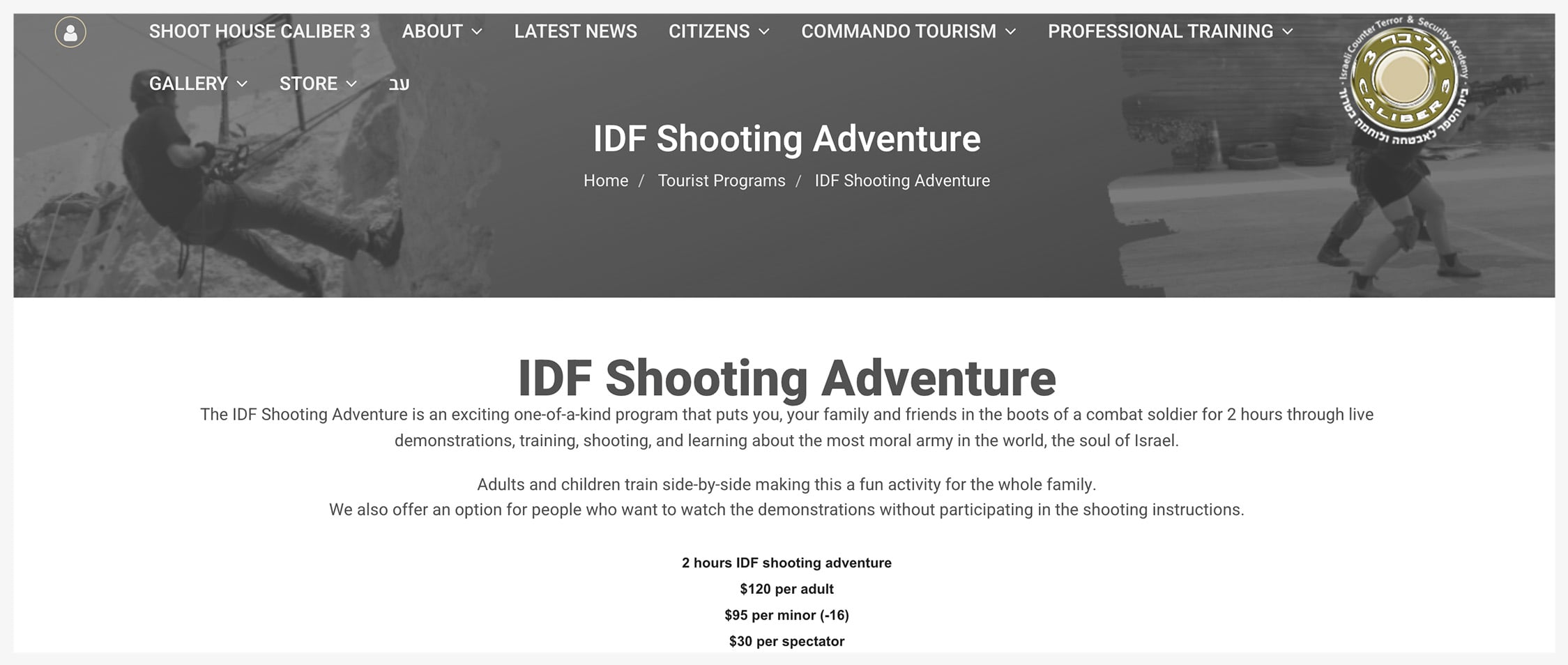
The Google ads guide users to Caliber 3’s website, where they can book the accelerated licensing programme or view a range of “tourist experiences”.
Caliber 3’s “IDF Shooting Adventure” is marketed as an educational experience, allowing patrons “to learn about the most moral army in the world”. Caliber 3 describes the experience as “perfect for family and friends” and “suitable for visitors aged 4+”.
The website shows glowing reviews of their tourist programmes, primarily from American visitors. Participants are able to use .22 calibre rifles and 12-gauge shotguns to shoot at cutouts of “terrorists”. Videos on Caliber 3’s website show that these targets depict Arab men wearing the keffiyeh, a Palestinian scarf.
The firm has close ties to Israel’s military and political establishment. Owner and founder Sharon Gat is described on the company’s website as a colonel in a special forces unit of the Israel Defense Forces (IDF). He regularly appears in Israeli and international media campaigning for the expansion of firearms licensing and the use of aggressive “counter-terror” operations in the West Bank. Most other employees are either former or active IDF service members, and two have held senior security positions within the Israeli Prime Minister’s Office.
Caliber 3’s ad campaign on Google coincides with a sharp rise in settler attacks against Palestinians, including shootings and physical assaults. The attacks have followed a state-backed effort to arm settlers across the West Bank. Itamar Ben-Gvir, Israel’s national security minister, has publicly celebrated the approval of more than 240,000 new gun permits since he pushed to expand licensing in 2023, compared with around 8,000 annually in previous years.
“The overwhelming majority of settlers we are now facing are holding some kind of weapon,” Manal Tamimi, a human rights activist and resident of the Palestinian village of Nabi Saleh, told The New Humanitarian. “We didn’t see this before.”
Amid escalating settler violence against Palestinians and impunity for the perpetrators, private firearms qualifications are “not a license for a weapon, but a license to kill Palestinians”, Tamimi said.
Since October 2023, the UN has documented 1,084 Palestinian killed and 11,900 injured by IDF and settler attacks. By March this year, settler attacks had displaced more Palestinians in the West Bank than in all of 2025, which Human Rights Watch has described as a “two-decade high”.
Caliber 3 did not respond to questions about Google’s verification and moderation process when purchasing ads.
Settlements for sale
Google and Meta have run ads for at least seven real estate and development firms flagged by the UN for building illegal settlements. Two firms explicitly publicise “vacant units” in illegal settlements in ad content.
One such company, ZF Building, is deeply enmeshed in the settler movement. While registered in the Israeli city of Modi’in, ZF Building’s CEO, Ran Yanai, lives in the Giva’at Hamivtar settlement in occupied East Jerusalem, according to documents published by the Israeli Corporations Authority.
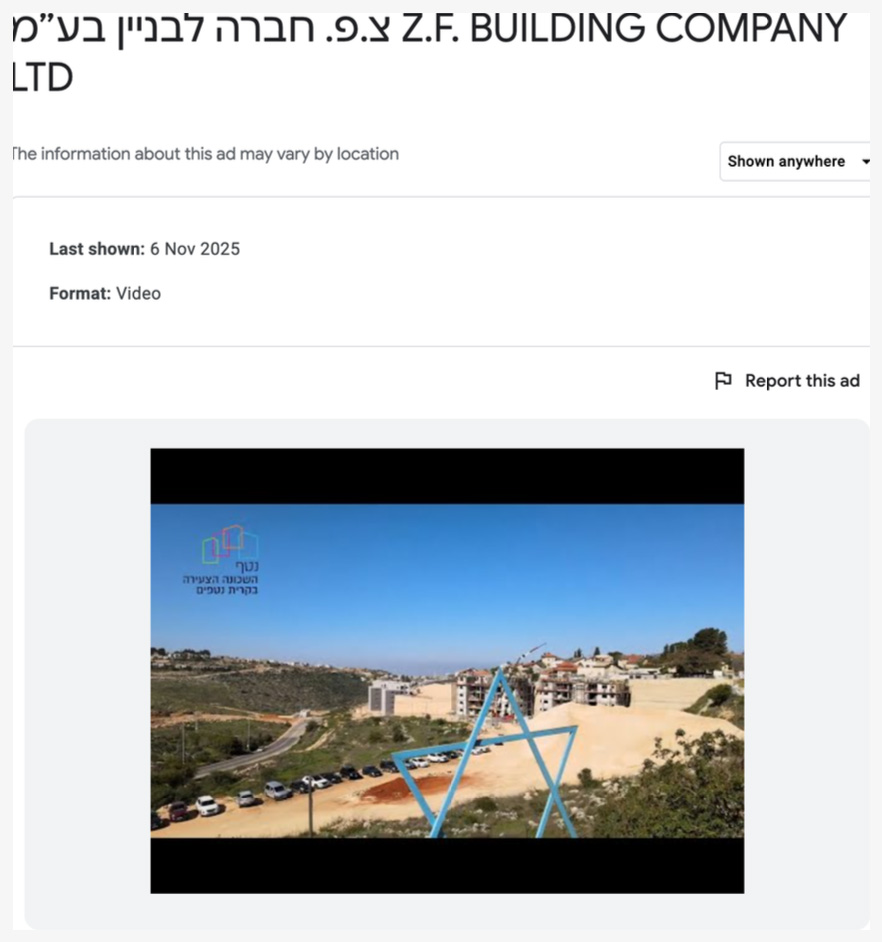
ZF Building’s website proclaims a firm commitment to “promoting the vision of settlement” and boasts of developments in 12 West Bank settlements. It has aired over 800 ads on Google through various accounts.
The company’s ads encourage Israelis to move to vacant apartments in settlements such as Nokdim, south of Bethlehem, and Kiryat Netafim, north of Ramallah. The content targets young Israeli audiences, inviting them to join the “young religious community” already living in the settlements. Other ads offer “special benefits for reserve soldiers”, and many tout the affordability of the units compared to cities in Israel.
In video interviews embedded in the ads, young settlers carrying infants tout cash “surpluses” after purchasing their apartments, leaving them with “money left over to decorate”.
Other ads show a large, blue Star of David overlooking the rolling hills of the northern West Bank.
On Meta, the real estate firm Sarfati Shimon advertises units in occupied East Jerusalem. Israel unilaterally annexed East Jerusalem in 1980, but its settlements there are considered illegal under international law.
In 11 of its 20 ads, most of which were launched in January 2026, Sarfati Shimon invites settlers to “be the first to discover Pisgat Ze’ev”, a large East Jerusalem settlement.
Sarfati Shimon’s ads include videos encouraging young families to move into the newly developed Nofarim residential complex. The ads tout close proximity to the Jerusalem Light Rail, which links Pisgat Ze’ev to Israel.

By allowing firms to advertise illegal settlements on their platforms, Google and Meta are failing to apply human rights due diligence frameworks and potentially violating obligations under the UN Guiding Principles on Business and Human Rights, said Hammouri, the law lecturer. The tech giants may be exposing themselves to legal liability by showing this content, she said.
While these ads persist on major platforms, Israel continues to tighten its grip on the West Bank. Despite the ICJ’s 2024 ruling that its occupation is unlawful, Israel has since moved to formalise annexation. Israel approved plans last year for over 3,000 new homes in an area known as E1, which would link existing settlements and further endanger prospects for a contiguous Palestinian state.
In December 2025, 19 settler outposts built without prior government permission received retroactive approval.
In February 2026, Israel’s security cabinet ratified measures that help international and Israeli settlers purchase West Bank land. Since 2022, the number of settlements and outposts has risen from 141 to 210.
At least five other real estate firms – Anglo Saxon Real Estate, Shikun & Binui, Rotshtein Real Estate, Galnor Construction and Development, and Impact Property Developers – have been flagged by the UN for facilitating West Bank settlement and have purchased thousands of Google and Meta ads.
Neither ZF Building nor Sarfati Shimon responded to questions from The New Humanitarian about their ad purchases.
Demolition machinery
Meta is also running an extensive campaign for Comasco, a supplier of construction and demolition machinery that has been used to destroy Palestinian homes and build illegal settlements in the West Bank.
Comasco serves as the Israeli Ministry of Defence’s supplier of backhoe loaders – machines that combine the functions of a bulldozer and an excavator. These backhoes, made by the British manufacturer JCB, have been used “to demolish residential and farm buildings belonging to Palestinians, to destroy water pipes and uproot large numbers of olive trees and other agricultural produce”, according to a 2021 report by Amnesty International. Footage of demolitions published by the Israeli human rights group B’Tselem frequently features the JCB backhoe.
Meta is currently running more than 140 Hebrew-language ads purchased by Comasco, including 60 ads for the backhoe. Comasco’s Google ads, purchased between 2021 to 2026, have touted the equipment’s “performance, reliability, and flexibility”.

While most firms identified by this investigation have used digital ads to target Israeli audiences, Comasco targets Meta’s EU users alongside Israelis. The tech giant’s ad library shows that Comasco has targeted users in France, Germany, Italy, and Sweden, reaching between 2,000 and 6,000 European accounts for each ad.
Comasco did not respond to a request for comment on its use of Meta ads.
“A culture of impunity”
Although these firms have been publicly flagged by the UN’s human rights office for facilitating Israel’s illegal settlement expansion, they face almost no impediments to buying digital ads.
“The platforms aren’t always checking the advertisers’ domains or a company’s verifiable owners,” a digital advertising expert told The New Humanitarian, speaking on condition of anonymity at their employer’s request.
Automated ad screening, which looks for illegal and explicit content, is not designed to detect companies on the basis of their activities in West Bank settlements. While ads by these companies may be reviewed by humans, this requires that they be flagged by platform users after the ads have gone live, when the “damage is already done”, the advertising expert said.
Unless tech platforms or regulators take more serious action against ads that encourage violations of international law, the content is likely to continue unabated, said Mohammed Alshurafa, a corporate accountability expert at the University of St Andrews who focuses on Palestinian rights.
“Significant gaps between stated commitments to human rights principles and actual practice”, plus “weak and inconsistent enforcement of their own policies”, make it likely that these ads will continue to be published, Alshurafa said.
Abdul-Rahim, the technology and human rights expert, said a wider “erosion of trust and adherence to international law” has emboldened tech corporations and engendered a “culture of impunity”, particularly over the course of Israel’s genocide in Gaza.
She added: “They know they have the political cover from Trump and the US administration to ignore international law.”
Edited by Jacob Goldberg.


