


Share & more
As the sun dips towards the western horizon, softening the mid-day heat, Tapachula’s central plaza begins to fill up. People bustle between stores, perch on benches, and sit at outdoor cafes. A group of young kids rehearse a dance. Traffic snarls in the surrounding streets.
It is a perfectly normal scene for a small city in Mexico, but in Tapachula – around 30 kilometres from the southern border with Guatemala – at least half of the people filling the plaza, if not more, are not Mexican. They are Haitian, Cuban, and Venezuelan. Some come from as far away as West Africa. And all of them are stuck.
Since US President Donald Trump returned to office last January, undocumented migration across the US-Mexico border has dropped to historic lows. For many, the message sent by his administration’s intensified militarisation of the US-Mexico border, ending of pathways to seek asylum, and push for mass deportations has been received: the US is no longer an option, at least not for now.
“People aren’t planning on reaching the United States. They know they won't get there now,” Luis García Villagrán, an activist who has been working with migrants in Mexico for over 15 years and founder of a civil society organisation called the Centre for Human Dignity, told The New Humanitarian. “Very few, a minimum number of people, are trying to enter the United States.”
But throughout Latin America, the Caribbean, and other parts of the world, people are still being forced from their homes. Those pushed across borders by gang and cartel violence, dire economic crises, political repression, and natural disasters still need somewhere to go.
The effects of US policy, and its failures, are also playing a role in the displacement.
In Haiti, a US-backed United Nations force has made little-to-no progress in tackling gang violence or bringing long-absent political stability. In Cuba, an intensifying American blockade is intersecting with decades of repressive rule, pushing the island nation to the brink. In Venezuela, a long-running economic crisis, government repression, and US sanctions were already crashing into each other, making life untenable for many even before the US special forces raid that abducted President Nicolás Maduro in January opened a new era of uncertainty.
Over the past year, tens of thousands of people from these three countries – and elsewhere – have ended up in Tapachula. In the first nine months of 2025, more than 34,000 people applied for asylum in the southern state of Chiapas, where Tapachula is located – 60% of all asylum applications in Mexico over that period.
The Mexican Commission for Refugee Assistance, known by its Spanish acronym COMAR, has yet to release data for the rest of 2025. But local media reported that more than 20,000 people from Haiti have applied for asylum in Tapachula – the largest number of any nationality. Local activists also estimate that there are around 18,000 to 20,000 Venezuelans in Chiapas, mostly in Tapachula.
Meanwhile, more people continue to arrive every day. Many would like to continue their journeys north to reach family members and friends living in other parts of Mexico, or cities in the central and northern parts of the country where the economy is stronger and there are more opportunities for work, according to Fátima Andraca, director of humanitarian response for Save the Children in Mexico.
But once in Tapachula, policies put in place in recent years to stop the movement of people from southern Mexico to the US border are overlapping with the cascading consequences of US cuts to foreign aid to strand people in place. Left in limbo, people struggle to find work to take care of their basic needs, creating what Andraca called “a protection crisis with a humanitarian impact”.
“The southern Mexico border has become like a migration containment zone,” Andraca said. “People are forced to remain there for long periods without durable solutions and this increases their social, legal, and economic vulnerability.”
Migration city
Tapachula – surrounded by thick green jungle dotted with banana and mango plantations and home to around 350,000 people – is no stranger to migration. For decades, it has been a destination in its own right for people from nearby Guatemala and other central American countries seeking comparative economic opportunity in southern Mexico.
The city is somewhat notorious as a “pink zone”, where prostitution is not legal but tolerated. Most of the sex workers are from Central America, and many over the years have fallen victim to trafficking, exploitation, and abuse. Tapachula’s airport is also an increasingly common destination for deportation flights from the US, receiving around 11,000 deportees last year, and the city is home to one of the largest migration detention centres in the Americas, Siglo XXI, which was recently refurbished by the Mexican government to improve conditions.
As the first city in Mexico on the migration route to the US border, Tapachula has also long been a stopover for people heading further north. Some of the migrant shelters, or albergues, in the city have been around for over 30 years. They first opened to provide support to Central Americans escaping torture, murder, and persecution at the hands of US-backed rightwing regimes in El Salvador, Guatemala, and Nicaragua during the civil wars that wracked the region in the 1980s.
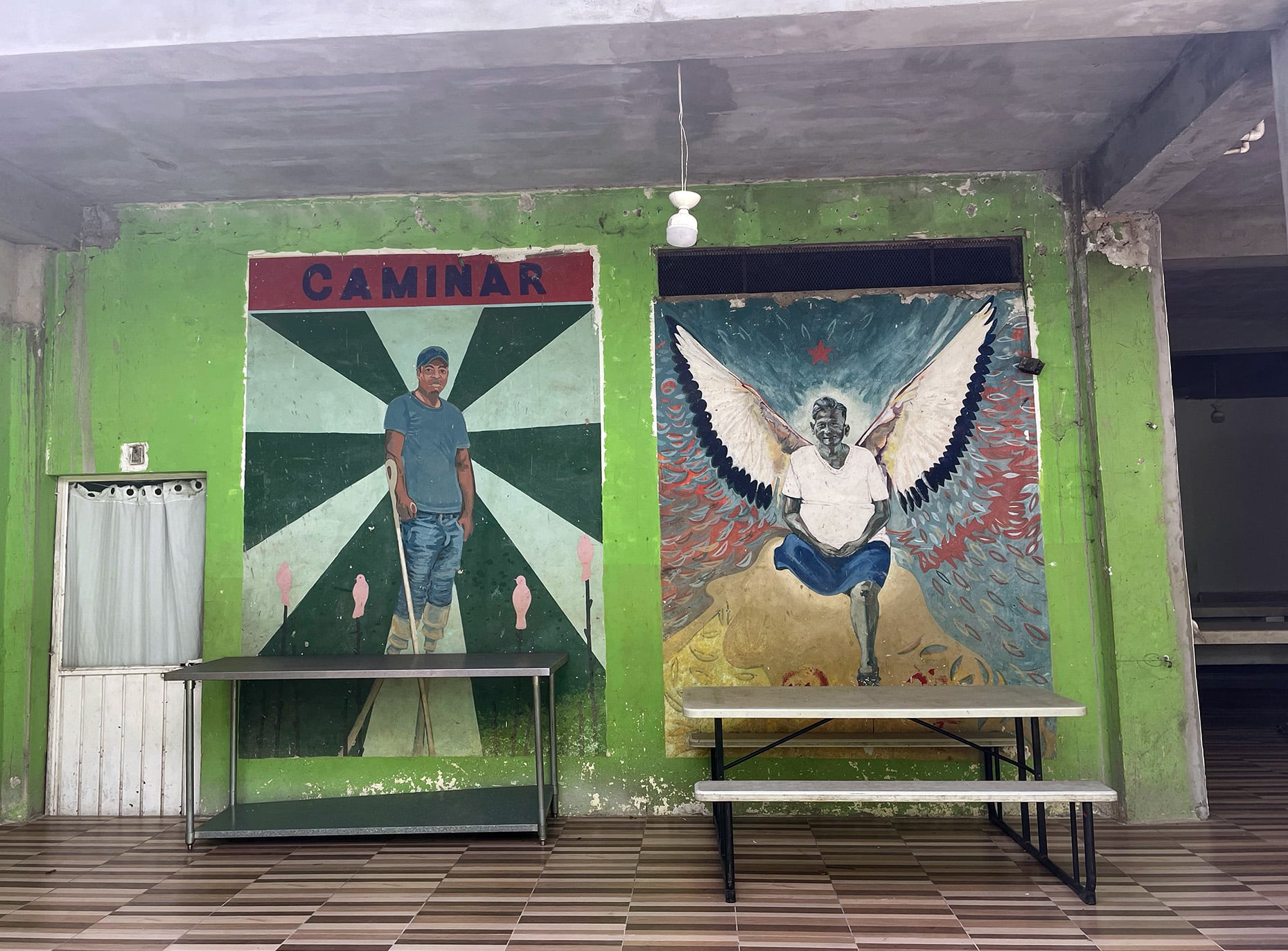
One of the albergues, Jesús el Buen Pastor, opened to provide a place for people to convalesce who were injured, maimed, or had limbs amputated after trying to hop on the network of trains known as the beast, La bestia, that migrants turned to in order to circumvent Mexican migration controls along highways and roads between southern Mexico and the country’s north.
Once the wars in Central America wound down, gang violence took root in the tenuous post-conflict period, planting the seeds for the next era of displacement and migration in the region, according to Herbert Bermúdez, director of Jesús el Buen Pastor.
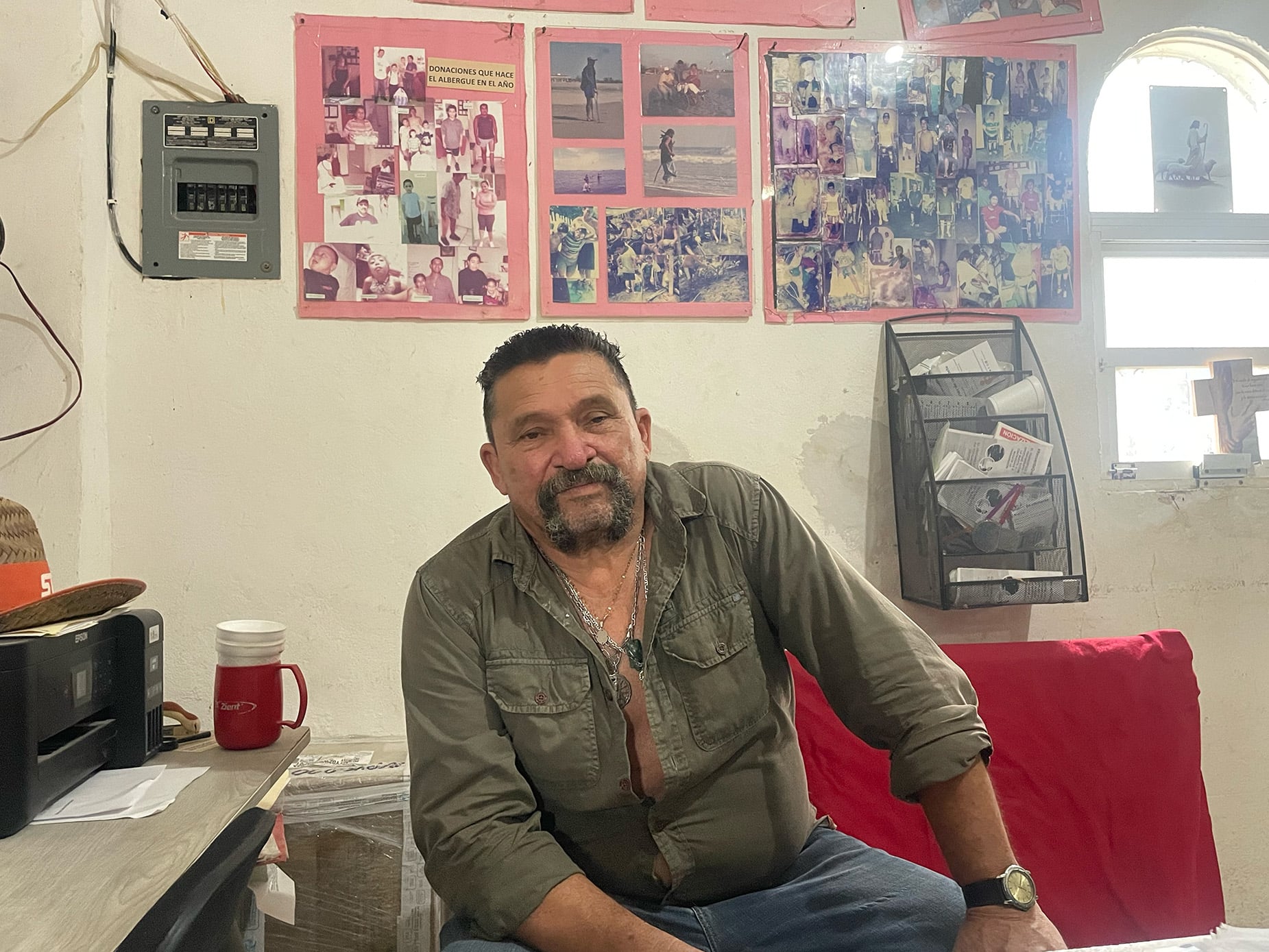
Bermúdez, originally from El Salvador, has twice been a migrant in Tapachula himself due to these dynamics. “I’m a veteran of the war in El Salvador,” he explained. The war lasted from 1979 to 1992. Over 65,000 civilians were killed, and more than 5,000 forcibly disappeared.
Bermúdez was forcibly conscripted into the Salvadoran military as a teenager. In 1985, he managed to escape. Unlike others, he said he never had “the American Dream”. Instead, he spent a decade and a half moving between Latin American countries working as a welder. In 2000, he returned to El Salvador, where he stayed until 2019, when threats and extortion from gangs pushed him to leave once again. Returning to Tapachula, he ended up at Jesús el Buen Pastor and found a sense of purpose helping to fix up and run the facility.
By that time, migration dynamics in the region had shifted dramatically. In 2014, for the first time since the US started keeping track, more Central Americans than Mexicans were caught by Border Patrol entering the US irregularly. The change was driven in part by a dramatic increase in children escaping rampant gang violence and making the journey on their own to seek protection.
In the decade that followed, the number of people from Latin America and beyond who were pushed from their homes for various reasons trying to reach the US for safety, stability, and a chance to rebuild ballooned, reaching record levels after the COVID-19 pandemic.
Successive US presidential administrations, both Democrat and Republican, invested heavily in policies to try to deter people from making the journey. Part of the strategy was to lean on Mexico to make it harder to travel from the south of the country to the US border. Mexican governments deployed the National Guard at the border with Guatemala, increased migrant detention, added more checkpoints along highways and roads, and bused people caught near the northern border back to the south.
At the end of 2023, Mexico stopped issuing humanitarian visitor cards to people who applied for asylum. The cards had allowed asylum seekers to live, work, access services, and travel freely throughout the country. Without them, leaving Tapachula became exponentially more difficult, unless people set out in large caravans that were harder for authorities to stop.
As administrative barriers and immigration checkpoints proliferated, Tapachula became a bottleneck, but hundreds of thousands of people continued to pass through. As recently as the end of 2024, Tapachula’s albergues were overflowing with people trying to make it to the US. But when Trump took office on 20 January 2025, “everything changed”, said Lorenza Reyes Núñez, director of another albergue called Todos son Ellos.
Caught in the net
In the months immediately after Trump’s return to office, hundreds of thousands of people found themselves stranded in Mexico by the blitz of policies he began implementing on day one to crack down on migration. Some ended up retracing their steps through Tapachula as they returned to their home countries. But for many, going back was not an option, and as the reverse movement slowed to a trickle, new people continued to arrive.
The new arrivals – alongside those who couldn’t go back – quickly found themselves ensnared in the net of policies intended to slow movement to the northern border, even if many were no longer aiming to reach the US. “Tapachula is no longer a transit city, but a city of forced waiting,” said Andraca, from Save the Children.
Without a humanitarian visitor card, people need to be granted asylum in order to have legal status to move freely throughout Mexico. By law, asylum claims are supposed to be decided within 45 days, but people The New Humanitarian spoke to said they had been waiting for a response for anywhere from six months to over one year. To keep their applications active, they have to sign in at a COMAR office in-person every 15 days.
Sadat Mohammed, a 26-year-old from Ghana, was standing outside the massive COMAR centre in Tapachula when The New Humanitarian visited recently. It was mid-morning, but the sun was beating down, and there was no shade for the 60 or so people waiting in a patch of dust by the entrance as noisy traffic rumbled by on the adjacent street.
“It’s difficult for me to live in my country. I left because I don’t want to die.”
Mohammed had already been in Tapachula for a year and two months. “I left my country because I’m a homosexual and I’m a Muslim. It’s difficult for me to live in my country,” he said. “I left because I don’t want to die.”
Mohammed applied for asylum in October 2024. When he finally received a decision eight months later, in June of last year, his application was rejected. Shortly after, he tried to leave Tapachula to go to Monterrey or Tijuana, cities in the north where he heard it was easier to find work. But Mohammed only made it to Tuxtla, the capital of Chiapas, before he was stopped by Mexican immigration authorities and sent back.
One run in with the authorities was enough for Mohammed, but some of his friends tried again. “And they busted them again,” he said. “Same thing.”
Mohammed is now reapplying for asylum and expects the wait time to be similarly long. “It’s difficult. There’s no job. It’s really difficult now,” he said.
A system in crisis
Before Trump returned to office, asylum application processing times in Mexico were already routinely exceeding the 45 days prescribed by law, but when his administration slashed US foreign assistance it plunged Mexico’s asylum agency into crisis.
In the space of just one decade, Mexico went from receiving a few thousands asylum applications per year to over 140,000 in 2023. That number dipped to around 79,000 in 2024. As numbers rose, the agency struggled to scale up to keep pace and relied significantly on budget support from the UN’s refugee agency, UNHCR.
For its part, UNHCR was heavily funded by the US, which donated nearly 87% of the $57.9 million its Mexico operations received in 2024. When Trump cut the vast majority of the US’s foreign aid budget, UNHCR’s funding plummeted. Last year, it received just under $33 million for its Mexico operations, with contributions from the US accounting for around 28% of that, after some funding was restored later in the year.
UNHCR has had to cut over 200 staff positions (more than 50% of its workforce) in Mexico, close multiple offices across the country, and scale back programmes providing legal assistance, psychosocial support, shelter, cash assistance, and specialised support for survivors of gender-based violence, according to Silvia Garduño, a spokesperson for the agency.
All of this has had a measurable impact on people seeking asylum in Tapachula, Garduño said. “Delays in the asylum procedure have intensified, disproportionately affecting non-Spanish speakers, particularly Haitian asylum seekers. At the same time, reduced support has made it more difficult for people to meet basic needs, increasing protection risks and negative coping mechanisms,” she added.
When The New Humanitarian visited, Maritza Dayamis, a 55-year-old from Cuba, was sitting on a stool across the street from the COMAR centre in Tapachula, waiting for her nephew, who was inside. She had been in Tapachula for a year and still had not received a decision on her asylum application. Like everyone else, she had to go to the office every 15 days to give her signature to keep her application active. Maritza had already signed 24 times.
“It’s a place that, at this moment, it’s not possible to live in because of the lack of food, electricity, medical care, and lack of options. It’s so painful to leave your country and to say these things, but it’s the reality.”
“At first, the plan was to go to the United States like everyone,” she said.
Since Trump returned to office, however, people are now looking to stay in Mexico and make their lives here, she added. Returning to Cuba is not an option. “It’s a place that, at this moment, it’s not possible to live in because of the [lack of] food, electricity, medical care, and lack of options,” Dayamis said. “It’s so painful to leave your country and to say these things, but it’s the reality.”
María, a 60-year-old from Cuba who asked to be referred to by only her first name, was also waiting across the street. She had left Cuba nine months before and had already signed 20 times at COMAR without receiving a response to her application. She said she never thought about going to the US because of the language difference. “All I want is to get my residency and stay here until the end of my days,” she added.
Like others, she said she wanted to go to cities elsewhere in Mexico where there are more job opportunities, but without a response to her asylum application, she was stuck. “I just need an answer,” she said.
Fede, a 31-year-old from Haiti who also requested to be referred to only by his first name, was selling spare electronic parts from a cart in a market behind Tapachula’s central plaza. He had been in the city for 10 months and was still waiting for a response from COMAR. He came to Mexico with his wife and was trying to eke out some kind of living while she looked after their newborn child. “The legal process is taking a long time. We are becoming desperate,” he said.
“There’s no work”
All of the people waiting for responses to their asylum claims The New Humanitarian spoke to in Tapachula said finding a job and being able to afford rent and other basic necessities was their biggest concern and struggle.
“There’s good work, but if I don’t have residency I cannot apply for them,” Dayamis said. “Once I get my residence I’ll have more options.”
People seeking asylum have the right to work in Mexico, according to Garduño, from UNHCR, but since migration authorities stopped issuing the humanitarian visitor cards, they don’t have the documentation companies ask for to prove this.
Chiapas also has the highest poverty rate in Mexico among residents, and cartels that smuggle drugs and people have a strong presence in the state. As recently as 2024, thousands of people were displaced by violence between rival factions. And the reach, power, and threat of cartels in Mexico was dramatically illustrated in recent days, as members of the Jalisco New Generation Cartel launched a wave of violence that touched 20 of the country’s 31 states in retaliation for the killing of the group’s leader, Nemesio Oseguera Cervantes, known as “El Mencho”, by Mexican authorities.
In this precarious environment, people waiting for responses to their asylum claims have little choice other than turning to the informal economy to try to earn money. Some find piecemeal work on banana, mango, and coffee plantations, on construction sites, or on tuna fishing boats off the nearby Pacific coast. Others work in restaurants, set up stalls in markets, or try to sell plastic water bottles at traffic lights.
All of the work is low-paid, and wage exploitation is common. Haitians, many who speak little or no Spanish, are particularly at-risk.
“They come with the hope of receiving a warm welcome, finding work, and making a living,” said Dieula Larose, a cultural mediator from Haiti working with Médecins Sans Frontières (MSF) who has been in Tapachula for more than two years. “When they arrive here, there’s no work, it is difficult to find a health centre, and those who come from Haiti do not speak any Spanish.”
“They carry everything that they lived through there [in Haiti], the trauma that they experienced that caused them to flee their country,” Larose continued. “Arriving here only makes them more vulnerable, since they are migrants who don't know the language.”
Out of desperation, people will take any job they can find, but even jobs that are considered good – like working in a restaurant – don’t pay enough to even cover rent. “And then what happens is prostitution and labor exploitation... so there are more sexual assaults, more rapes, and so on,” she said. “They escaped from [Haiti] because of the same problems, only to arrive here and find the same thing, and then they feel they are in exactly the same situation.”
The need to escape
“Recently, it has become very complicated because the organisations that provide help no longer exist,” Larose added.
This too is a consequence of the US’s foreign aid cuts. NGOs across the world have seen their budgets slashed, and most with a presence in Tapachula have reduced their activities to the bare minimum. Even organisations like MSF and Save the Children, who have not faced severe cuts to their global budgets, are shifting resources towards crises in Africa and the Middle East to try to plug gaps left by the withdrawal of other groups.
Operations in Mexico and other parts of Latin America, where needs are considered to be less acute, are being scaled back as a consequence, according to several aid workers The New Humanitarian spoke to.
Meanwhile, more people continue to arrive in Tapachula every day. “They don’t have anywhere to go because the system is collapsed, because the system doesn’t have enough budget to attend to this kind of crisis,” Andraca said.
For people pushed from their homes, however, the immediate need to escape outweighs the uncertainty caused by the absence of a clear path forward. “Right now, people’s plan is to get out of danger in their country,” Larose explained.
Where they might find a degree of the safety and stability they seek remains an open question. But, looked at through the longer lens of the history of migration in Tapachula, one thing seems certain, as Bermúdez summed it up: “We are the gate from south to north. There’s always going to be movement.”
With reporting support from Benjamín Alfaro, Roger López, and Médecins Sans Frontières staff in Tapachula. Edited by Andrew Gully.


