


When Haitian doctor Mikana Jolie leaves for Fontaine Hospital, she takes two tap tap minibuses through some of Port-au-Prince’s most violent areas. To reach the first stop, she walks over shards of glass and the charred remains of molotov cocktails from gang clashes with police.
One morning last September, word spread of gunfire along the route. She went anyway. That day, she was the only doctor on duty in the hospital’s nutrition unit.
“She needs a checkup,” Jolie said, pointing to an emaciated girl with an oxygen tube secured beneath her nose. “I admitted her last week. If something happened because I wasn’t here, I couldn’t forgive myself.”
The Fontaine Hospital is located in Cité Soleil, a poor, gang-controlled commune in the northwestern reaches of metropolitan Port-au-Prince. When The New Humanitarian visited in September, 22 severely malnourished children between six months and two years old were receiving treatment: full capacity.
A record 5.7 million Haitians — more than half the population — are food insecure, including 1.9 million facing emergency levels of hunger, according to the World Food Programme (WFP).
Battered by frequent natural disasters – including the devastating 2010 earthquake – and endemic poverty, Haiti has experienced chronic hunger for decades. But the past few years of political instability, rising gang violence, and international aid cuts have seen the emergence of the worst hunger crisis in Haiti's history.
Last June, the UN’s Food and Agriculture Organization (FAO) listed Haiti among the world’s five hunger hotspots of highest concern, while the latest analysis – released in mid-October 2025 – by the global hunger monitoring body known as the IPC showed a 3% increase from the previous year and warned that the number of acutely food insecure was projected to rise to 5.9 million by March 2026.
The youngest are among the hardest hit. More than 1.2 million children under five live in areas gripped by severe hunger. Women and displaced families bear a disproportionate burden, WFP warned.
“There are many interconnected factors: high inflation, repeated natural disasters. But the most significant is insecurity linked to armed conflict,” Wilfred Nkwambi, the WFP’s head of programmes in Haiti, told The New Humanitarian. “It affects the economy, agriculture, and supply chains all at once.”
Gangs control about 90% of Port-au-Prince – many of them armed with weapons smuggled in from the United States. Over 1.4 million people have been displaced. Schools have become shelters, filled with children sleeping on classroom floors instead of learning. Port-au-Prince is now “one of the most dangerous places in the world for women and girls”, according to Lola Castro, WFP’s regional director for Latin America and the Caribbean.
The nutrition unit at Fontaine Hospital is designed for stays of up to 45 days, but many mothers and children remain for months. Some children require physiotherapy to rebuild muscle lost to hunger. Others must learn how to chew.
In some cases, mothers need trauma therapy to take care of their children.
While exact statistics are unavailable, nurse Daphnée Day said the latter are becoming increasingly common: mothers too traumatised to attend to their children’s needs. She estimated that roughly a third of the women in the ward — seven out of 22 — fell into this category.
Most are believed to have survived sexual violence.
“I know my daughter will love him one day”
On a plastic chair in one corner of Fontaine’s nutrition unit, Marie-Claire Jean (her name was changed at her request), sat with her eight-month-old grandson on her lap.
“My daughter wants nothing to do with him,” she told The New Humanitarian.
A year and a half earlier, gangs had swept through their neighbourhood in Cité Soleil, torching homes, looting, and killing. Jean’s daughter and son were attacked on the street. The brother escaped. The sister was raped by several men. That was the day her son was conceived.
Jean knows little more. Her daughter refuses to speak about it.
Four months ago, her daughter’s breast milk dried up. The family couldn’t afford milk formula, and Jean saw the baby grow thinner by the day. She has stayed at the hospital with him ever since.
“I know my daughter will love him one day,” she said of her youngest grandson, who learned to sit, crawl, and cut his first two teeth during the months spent in the hospital.
“I’m a person who figures things out,” she added resolutely, referring to how she plans to feed him.
Even so, after months without income, she worries about how she will support her family once their stay ends. She used to make a living selling vegetables at a market in Cité Soleil, sourcing most of her produce from the town of Kenscoff, south of the capital.
But Kenscoff, too, has now fallen to the gangs.
Gangs feast on the breadbasket
A lush hillside town 30 minutes from Port-au-Prince, Kenscoff was known as the capital’s breadbasket. Until recently, hundreds of farmers there produced vegetables and fruit, raised cattle, goats, and pigs. Children walked to school through wide, green fields. Residents believed the violence would never reach them.
But in January 2025, it did. Thousands fled down the hills, leaving behind their livestock and harvests.
“It was like a cyclone,” said Gilbert Jérôme Michel, a former Kenscoff farmer now living on the outskirts of Port-au-Prince. “They took block after block. They stole everything of value and set the houses on fire.”
On his phone, Michel scrolled through photos of his former land: rows of lettuces, carrots, broccoli, and leeks along the slopes. He showed how he had planted trees to shade the crops and raised vegetables to feed neighbours’ animals.
He paused at an image of the elementary school where he taught agriculture and natural sciences for 31 years.
“Each student tended a small plot. My wife led cooking classes, teaching children to prepare what they grew,” he said.
In the evenings, Michel used to work with a farming association focused on soil conservation and mountain agriculture – channelling rainwater, building terraces, planting trees, rotating crops, and using compost and natural cover to “increase yields and protect the land and environment of Kenscoff”.
“The gangs are feeding on generations of work,” he said, fearing the collapse of the community would erase decades of knowledge. “All of my former students have been displaced. I am trying to start an agricultural school for them, but I don’t have the money”.
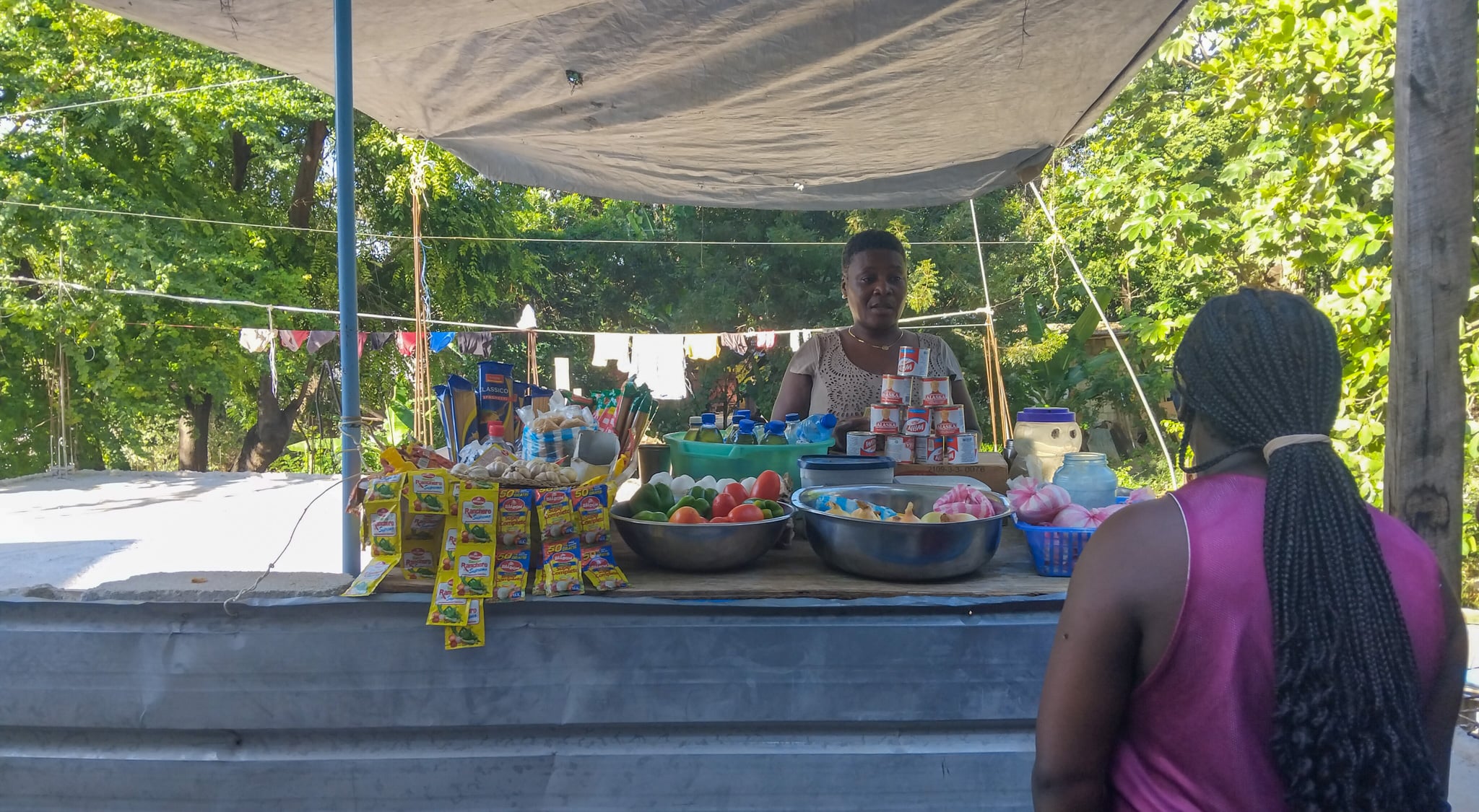
Still, he is fortunate. He now teaches geology at a nearby school. He runs a small stall outside the house, selling dry goods and a few vegetables.
Aid cuts mean help is drying up
Many others are not so lucky. Three in four people sheltering in schools and public buildings face Crisis or Emergency levels of acute food insecurity, according to WFP.
In central Port-au-Prince, outside a makeshift home of tarps, blankets, and sheets, Myriam Bienemy stood with a Bible tucked under her arm, last September.
Aside from the clothes she was wearing, it was the only item she carried when she fled the Carrefour-Feuilles neighbourhood of the capital in August 2023. Behind her, she left a house “with electricity every day” and a small street business selling rice, beans, soda, and phone charging.
Here, survival depends on sharing. Each morning, she hopes “someone” — often another displaced person earning a few coins from street sales — will return with food to share.
“There is a God in heaven who gives me food,” she said.
But this Tuesday afternoon, she had not eaten. She gave her portion of bread soup – a proteinless broth with a few slices of onions and carrots – to a neighbour’s two-and-a-half-year-old child diagnosed with malnutrition.
Nearby, the child played barefoot on the concrete, the sun bearing down on narrow paths between roughly 1,500 temporary shelters crowded into the yard of a Mormon church.
At what is known as the Mormon Church displacement site – established last March when residents from seven other camps in downtown Port-au-Prince fled a new wave of gang violence – nearly half of all children are malnourished: 904 of the 1,884 screened by Médecins du Monde Argentina. The organisation is one of three providing medical care there, according to Francesca Beaujour, a member of the site’s coordination committee.
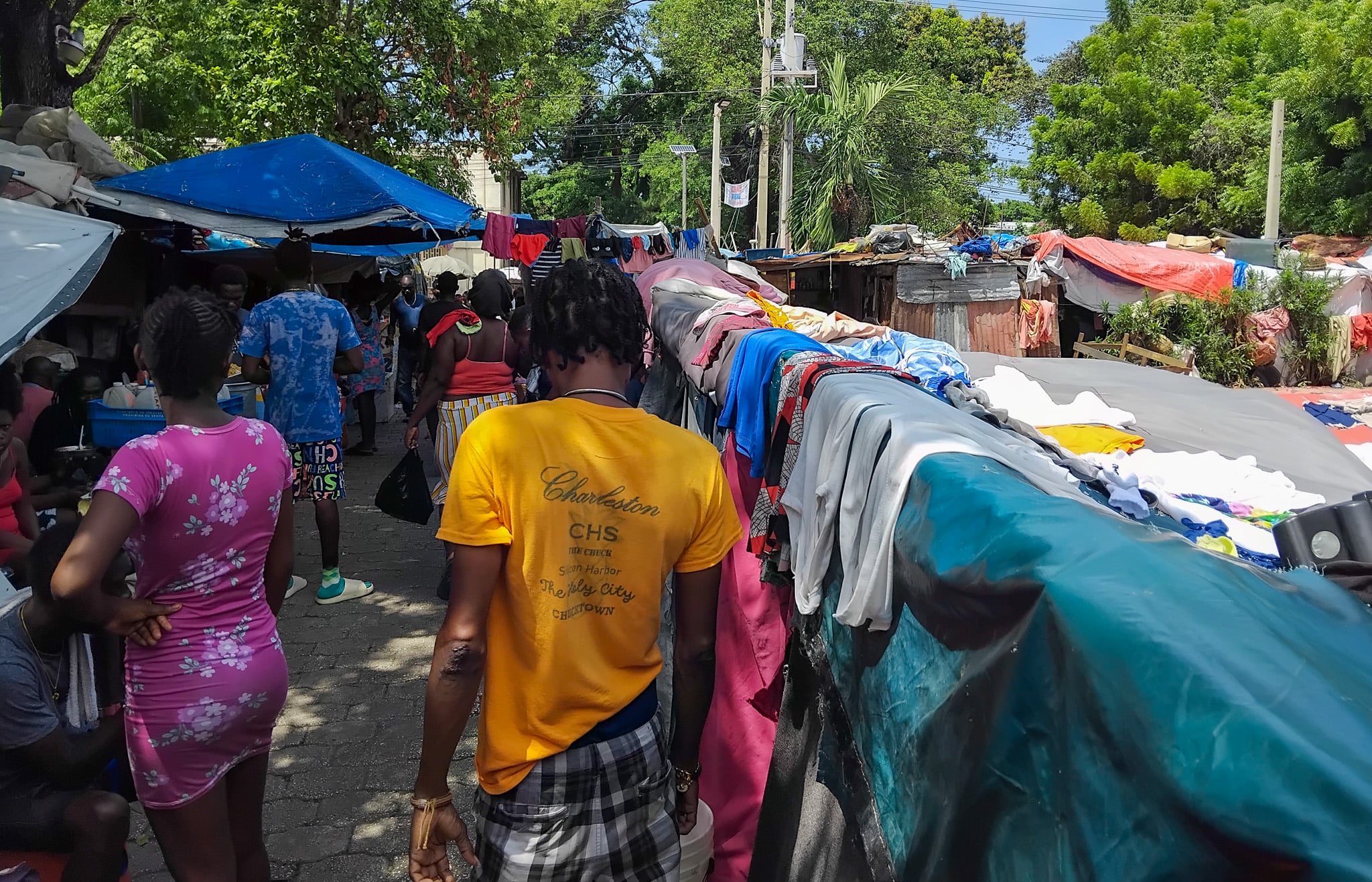
“No one is currently distributing food,” she said. “We received bread and some meals only during the first week [after we arrived].”
WFP confirmed that it served hot meals in the initial days after displacement, when people often have no means to cook.
“Giving a hot meal when people arrive was like saying, ‘You’re in a new place, there is hope,’” said Nkwambi from the WFP.
That was before October last year.
Since then, funding shortfalls have forced WFP to halt the provision of hot meals. Monthly rations to people facing emergency level hunger have been halved. In October, the agency announced it needed $139 million over the next 12 months to reach Haiti’s most vulnerable families.
“There are so many crises: Gaza, Sudan, Ukraine, natural disasters elsewhere,” Nkwambi told The New Humanitarian. “Donors are stretched thin. No one has completely withdrawn, but many are constrained.”
WFP describes Haiti as the most underfunded crisis in the world.
The strain is visible at Fontaine Hospital, which receives WFP support. “Food deliveries arrive more slowly and in smaller quantities," said Karen Ulysse, who recently took over the direction of the hospital from its founder, her father José Ulysse.
She attests that donor fatigue is “very real” — she sees it firsthand among individual contributors, the vast majority of whom are based in the United States.
“Every week, I receive emails from donors cancelling their monthly contributions. They’re usually small — $10, $25 — but they add up,” she said.
Donations from UNICEF, the hospital’s main funding partner, have also dropped to roughly a third of the value of the previous year’s contract. UNICEF’s nutrition programme under the Humanitarian Action for Children appeal reported a 72% funding gap in 2025.
And Ulysse points out that “nutrition care is more than food”.
It’s everything from oxygen supply and medicines to mental healthcare and education.
“But anything beyond milk formula and peanut paste is extremely hard to fund. Donors prefer Band-Aid solutions because those are easier to report,” Ulysse said. “We need a holistic approach to combating hunger. Otherwise, the cycle of violence will never end.”
Food is used to recruit children
If malnutrition is a major concern in the care of babies and toddlers, hunger impacts children and teenagers in other ways too. At Petit Cœur de Jésus School in the Port-au-Prince neighbourhood of Solino, principal François Onel explained how “food is the weapon" used by gangs to recruit children.
But it works slowly, he added, and without those ensnared realising it.
“It is the children themselves, some as young as seven, who go looking for it,” he said. “Their parents leave early to find work in the city: carrying bags, selling small items, taking whatever odd jobs they can. The children go the whole day without eating, [some girls] sell their bodies to survive.”
Just down the road, at a gang base near the school, three dozen young armed men sit in shifts, day and night. Cooks deliver large buckets of food: big breakfasts, lunches, dinners.
Barefoot children linger near the base, sitting or lying on the ground.
“The armed men are their neighbours,” Onel said. “Will they eat without giving something to the children? Of course not.”
When the armed men finish eating, they pass on the leftovers, he explained. The children eat. In exchange, they run errands. Hold a gun. Fetch drinks. After a while, Onel said, they are no longer just hanging around – they are gang members.
Food production suffers as agriculture takes a hit
As gangs continue to expand geographically, they are tightening their grip on rural areas and causing declines in agricultural production far beyond Port-au-Prince.
The Centre and Artibonite departments have been the hardest hit. The latter accounts for up to 80% of the country’s rice production, but thousands of hectares of arable and irrigated land had reportedly already been abandoned by early 2024.
Farmers are attacked by armed groups, who steel their harvest and destroy their agricultural infrastructure.
Those spared by the violence struggle to sell their produce, as armed groups block roads and disrupt supply chains.
“Our farmers’ produce is stuck and rotting,” said Sélanie Apparézon of KOSIAH, a citizens’ organisation working with farming communities in Hinche – a commune in central Haiti – that once relied on sales in the capital.
“Port-au-Prince was our lifeline,” she said. “But for three years, we haven’t been able to reach it. Families sell land [for cash] just to keep their children in school.”
Gangs controlling roads have caused fuel prices to surge. In some areas, gasoline now costs three times what it once did. Imports have risen sharply in price as gangs control what moves through Port-au-Prince’s ports.
“We need fuel not just for transport but also for watering our cabbage and cassava. Farming tools and pesticides have doubled in price too,” Apparézon said.
Speaking by phone from Miami, Haitian logistics and agriculture entrepreneur Geoffrey Handal said that transporting containers to and from the ports now requires armored vehicles, raising costs by as much as 50%.
Cheap US rice imports and foreign aid kill off local production
Handal comes from a family that exported Haitian coffee for nearly two centuries. After working as a banker in London, he returned to Haiti in 2008. He realised that the country — once built on coffee exports — “had no coffee left to ship”.
His country first fell into debt due to the billions of dollars it was forced to pay to France in compensation for the independence from colonial rule it obtained through what is considered the region’s first slave uprising. But analysts trace Haiti’s agricultural decline back decades, beginning with the fall of the Duvalier dictatorship in 1986, when trade restrictions that had safeguarded Haitian farmers were dismantled. In the 1990s, under pressure from the United States and the International Monetary Fund (IMF), Haiti cut rice import tariffs from 35% to 3%. The country quickly became a key market for cheap American rice, outcompeting local farmers.
Foreign food aid compounded the problem. Until the mid-2000s, WFP relied heavily on “in-kind donations” — food and supplies sent directly from donor countries — increasing competition for Haitian farmers. USAID programmes often funnelled funds back to US agribusiness through procurement contracts, as US laws required much of the aid to be purchased from American producers.
After the 2010 earthquake, large-scale foreign aid further weakened local agriculture, according to critics such as Jake Johnston, a senior research associate at the Center for Economic and Policy Research in Washington, DC.
“In just the first two months after the quake, humanitarian organizations distributed more than forty million pounds of food. Almost all of it was imported. For many local farmers, that was a death sentence,” Johnston writes in his book Aid State: Elite Panic, Disaster Capitalism, and the Battle to Control Haiti.
Deforestation and poor soil sealed the dependence.
In 2019, Handal decided to invest despite the challenges because, as he put it, “agriculture is at the center of societal change”. He now focuses on pepper production, rotated with corn and other crops.
The insecurity of the past four years has been personal to him. His cousin and uncle were murdered; an aunt was shot. Gangs have taken over his $6 million building in Port-au-Prince.
“I’ve probably lost it,” he said. “I don’t know. I can’t access it.”
Still, he argued that the setbacks in food production cannot be blamed solely on unrest and food imports.
“It is decades of state neglect,” he said, noting that roughly half of Haiti’s food is lost after harvest due to the lack of a “distribution system to store, process, and transport large quantities”.
“There are no factories to process crops because farmers don’t produce enough. And farmers don’t produce more because there are no factories,” he added.
In response, Handal is building the missing value chain for his products, from storage facilities to “packaging that meets market standards”. In pursuing that vision, another obstacle has emerged: a shortage of skilled workers.
“The ones who could build solutions are gone,” he said. “About 90% of college graduates have migrated.”
Most agricultural experts are now foreigners who rarely go into the fields, he added. And while small-scale farmers carry valuable knowledge, they lack access to capital and technology to identify “where and how we can improve, how to modernise and adapt to climate change”, Handal said.
“We can’t wait until the crisis is here”
One partnership has offered some promise: a food-production cooperative in northern Haiti called Mèt Fèy Vèt (Kreyol for Master of the Green Leaf).
At the Mèt Fèy Vèt factory in the commune of Limonade, northern Haiti, a poster hanging in the reception shows a fried corn ball split open, and golden, melted cheese spilling from the inside.
“I invented that recipe,” said Harry Nicolas, the cooperative’s founder and director, with a smile. “Everyone stops when they see it.”
Two years ago, after hearing a UN warning that nearly six million Haitians were at risk of severe hunger, he said to himself: “We can’t wait until the crisis is here. We must start preventing it now”.
Already known nationally as a television personality who made short films promoting local food, he went to the media and urged Haitians to grow corn.
“Corn can be grown everywhere in Haiti,” he explained to The New Humanitarian while showing his facilities. “It can be harvested in about 10 weeks. And there is so much we can do with it.”
Outside, a mound of roughly 100,000 corn cobs delivered by a nearby supplier glowed in the sun. The cobs are going to be chicken feed. The kernels will be ground and turned into cookies, cakes, and bread in the newly built bakery. There, he will also install a machine to make corn-based spaghetti.
Nicolas’ aim is to make corn desirable again, he said, describing it as an ingredient seen as low-status in Haiti — particularly after the surge of imported food following the 2010 earthquake.
“It made Haitians look down on their own food,” he said.
He recalled a moment that changed his life.
“I was working as a tour operator. One day, I took a group of foreigners to learn about traditional Haitian cuisine. I asked the cooks to prepare maïmoulin — cornmeal — with beans, soy sauce, and orange sauce.”
The cooks refused. They said they wouldn’t serve “poor people’s food” to foreigners. Nicolas insisted. In the end, the cooks prepared the dish, but still refused to bring it to the guests.
“That day, I said I’m finished with tourists. I will educate Haitians.”

“Change has to come from within”
In a room inside the factory, cassava bread was stacked in sealed plastic. Nicolas lifted the lid from a pot simmering on the stove. The smell of nutritious chocolate milk filled the room.
It is part of a pilot project: a school breakfast programme for public schools. The cooperative now produces 5,000 portions a day and plans to increase its output fivefold.
“The government reached out because they realised that when kids arrive at school hungry, they can’t learn,” said Nicolas.
Now, the school meals programme — run by Haiti’s Ministries of Education and Agriculture with the WFP and other partners — sources roughly 72% of its food locally, a figure they hope will reach 100% by 2030.
It reflects a broader shift away from imported food aid. According to WFP, locally sourced meals are healthier and strengthen domestic agriculture. For the 2024-2025 school year alone, the school meals programme injected more than $10 million into Haiti’s agricultural economy, said Tanya Birkbeck, WFP’s communications officer.
“Shorter supply chains also mean children can still eat when roads or ports are blocked by armed groups or extreme weather,” she added.
According to Nicolas, interest in supporting the Mèt Fèy Vèt cooperative – 90% of whose members belong to the Haitian diaspora in the United States and Canada – rose immediately after the dismantling of USAID.
“People understood that we can’t rely on outside forces. Change has to come from within,” he said, adding that the cooperative aims for full independence, “through solar energy, land, cattle, everything”.
Nicolas walked through a newly built studio at the cooperative, where he plans to revive the production of films and radio programmes, teaching young people “how to organise, grow crops, and turn raw goods into marketable products”.
One upcoming campaign will focus on the 2,000 hectares of state-owned land he now manages.
“Many Haitians believe state land is only for the elite. But an ordinary citizen like me accessed it, so can they,” he said. “From slavery to today, control has always been about food. If we solve our food problem, we restore our dignity.”
Teaching food sovereignty to the young
Back at Fontaine Hospital, Ulysse has put in place a local initiative to address the food crisis too.
On a Saturday last September, 25 students aged 15 to 22 gathered in a courtyard cafeteria waiting for their weekly farming class. Ulysse founded the year-long programme in 2025, inspired by a book quote that stayed with her: “He who feeds you controls you.”
The quote reminded her of a conversation she had with Onel, Petit Cœur de Jésus School’s principal, about students joining gangs just to secure one meal a day.
His school receives support from her foundation for lunches, so she asked him to select the most at-risk students for the programme.
“The ultimate aim is food sovereignty,” she said. She wants participants to form a cooperative, selling compost and crops and “even raising small animals like rabbits, guinea pigs, or pigeons”.
Funded by a grant by the Global Initiative Against Transnational Organized Crime, the initiative focuses on urban agriculture – teaching students how to grow food in the crowded neighbourhoods where they live, using pots and recycled containers.
She recalled meeting with one of the fathers, a gang member, to ask if he would allow his child to join the project. “He broke down in tears,” she said. “He told me he used to sell plantain chips on the street, until gangs blocked the roads, he lost his income and joined a gang to feed his children. ‘Thank you for trying to save my son,’ he told me.”
Ulysse said the project is about more than food: planting, nurturing, and watching something survive.
“This is a place where death and destruction is everywhere,” she said. “I want them to see that they can contribute to life instead.”
With reporting support from Centre Impact-Sakapfet Okap, in Limonade, near Cap-Haïtien. With additional reporting by Jeff Claudy Synal in Torbeck, southern Haiti. The New Humanitarian used transportation provided by Fontaine Hospital in Port-au-Prince and by Centre Impact-Sakapfet Okap in Limonade.
Edited by Daniela Mohor.


