

Share & more
On 9 January 2024, Israeli forces opened fire on civilians waiting for aid trucks bringing food into the north of the Gaza Strip, killing seven people and wounding several others.
The incident took place three months into Israel’s retaliatory military campaign in the Strip. Israeli authorities had ordered some 1.1 million people in the north of Gaza – half of the enclave’s population – to evacuate south, and were restricting the entry of food and other critical supplies in an apparent effort to starve out several hundred thousand Palestinians who had refused or were unable to leave.
The aid delivery on 9 January was one of the first to reach northern Gaza since the beginning of the 2023 invasion. Two days later, as desperate civilians waited for another expected aid delivery, Israeli forces once again opened fire, killing 12 and injuring dozens.
A few days after that, the same thing happened, and then again a few days later, and then again and again – until the individual incidents became an undeniable pattern of attacks on people seeking aid that has persisted and escalated to the present day, killing almost 3,000 people and wounding nearly 20,000 over the past 23 months.
These attacks amount to a pattern of what legal experts say are evidently war crimes and crimes against humanity, being committed in broad daylight with impunity, as part of a project to displace and potentially destroy the ability of Palestinians in Gaza to survive as a group – a key aspect of the legal definition of genocide.
The lack of a concrete response from Israel’s allies and the international community to each attack, each atrocity, has only helped to enable those that have followed. And as Israeli forces learned they could act with impunity, the violence has also become more brazen.
Now, with Israel ordering the evacuation of Gaza City and pushing forward an invasion explicitly aimed at taking it over, the violence against aid seekers is being wielded as part of an apparent strategy to push Palestinians out of the north of Gaza – and potentially the entire enclave – perhaps permanently.
For over a year, The New Humanitarian has been conducting an open-source investigation documenting Israeli attacks on people seeking aid in Gaza. We have compiled a database of nearly 200 incidents that took place between January 2024 and the end of July this year, resulting in at least 1,215 people killed and 4,691 wounded.
These numbers are a conservative estimate, and do not include attacks on people attempting to get aid from the US- and Israeli-backed Gaza Humanitarian Foundation (GHF), which began operating on 27 May this year.
In just over three months, Israeli forces have killed nearly 1,172 people in the vicinity of the GHF’s militarised food distribution sites and wounded many more – adding to the already staggering number of casualties among people seeking aid. These attacks are a direct outgrowth of the pattern that began in January 2024 and that continues to this day.
Over the past 23 months, counting the casualties we’ve recorded and numbers from the UN’s human rights office (OHCHR) and the ministry of health in Gaza from recent attacks at GHF sites and elsewhere in Gaza, these attacks have killed at least 2,957 people and wounded 19,866 as they tried to obtain the bare necessities of survival.
This accounts for around 4.6% of the more than 64,000 deaths from Israel’s military campaign recorded by the ministry of health in Gaza, and just over 12% of all wounded.
Read more:

EXCLUSIVE: Israel has killed nearly 3,000 Gaza aid seekers
Our interactive database shows nearly 200 attacks, and a sharp uptick since the Gaza Humanitarian Foundation began operations on 27 May.
The frequency and lethality of attacks has dramatically escalated since the GHF began operating at the end of May. In the 17 months between January 2024 and 27 May this year, we recorded 663 fatalities. In just three months since then, more than 2,200 people have been killed.
Each of the attacks on aid seekers we have documented is a potential war crime. Some incidents, like the “Flour Massacre” on 29 February 2024 in which 118 people were killed and 760 wounded, have drawn international outrage and condemnation, and precipitated calls for the attacks on aid seekers to end. But those calls have not been backed up by effective action, and the killings have continued.
Responding to a detailed request for comment, the Israeli military, or Israel Defense Forces (IDF), did not address questions about these patterns of violence. Instead, they sent a statement about casualties around GHF sites, saying they had examined reports of civilian harm and issued instructions to forces based on lessons learned.
The statement also said the IDF was working to “minimise possible friction” between people seeking food from the GHF and soldiers – including “through the installation of fences, signage placement, the opening of additional routes”, and other unspecified measures around distribution sites, where troops have shot thousands of people.
The Israeli government media office did not respond to a request for comment.
In past cases of attacks on people seeking aid that have garnered enough attention to necessitate a public response, Israeli authorities have put forward various arguments to defend their actions. At times, they have outright denied responsibility, saying the incidents never happened or that unidentified attackers were responsible for the casualties. They have also often argued that troops felt threatened and acted in self-defence or that they were targeting militants or Hamas-related infrastructure.
Looking at the incidents we recorded, those defences don’t hold up.
Over time, clearly discernible patterns have emerged as the same locations or same types of places have been repeatedly targeted. When aid agencies trucked food into northern Gaza in early 2024, Israeli troops shot people as they waited for the convoys. When the UN partnered with prominent families to manage the increasing chaos around these convoys, Israeli forces killed them.

Later in 2024, as Israel laid siege to the northernmost parts of Gaza, troops attacked locations where aid had been delivered shortly after aid workers left. In the spring of 2025, when people turned to soup kitchens as a main source of food, Israeli forces bombed the soup kitchens. And as Israeli-orchestrated famine set in this summer, when people began going to depopulated areas of northern Gaza to meet the few aid trucks allowed to enter, Israeli forces shot and bombed them in the thousands.
On multiple occasions when Israeli authorities have entirely cut off the flow of aid into Gaza, laid siege to specific areas, or when stocks have run out, strikes on people collecting aid have slowed or stopped. When aid has been allowed to resume, so has the killing. Put simply: Civilians in Gaza face death by starvation and deprivation when aid is blocked – or by fire when it has been allowed to resume.
The fact that these attacks have happened over and over again suggests they must be intentional, according to Adil Haque, an international law professor at Rutgers University in the US.
“These are not isolated incidents. They're not just similar incidents. They are a pattern, and reflect policy and an acceptance on the part of the state that this should continue indefinitely,” Haque said.
Haque was one of several international legal and humanitarian experts The New Humanitarian consulted about the attacks on aid seekers and their legal implications. All agreed that these patterns contribute to a substantial body of evidence supporting legal arguments that Israel is committing numerous war crimes, crimes against humanity, and genocide in Gaza.
Looking at the incidents in the database over time reveals how Israel has used attacks on people seeking aid in Gaza as a tactic to achieve specific goals during different periods of its military campaign – from deadly crowd control to forced displacement to the destruction of a people’s collective ability to survive. These patterns show that attacks on aid seekers have not been random or incidental but committed with intent.
Here is a rundown of the main patterns that emerge from the database and their legal implications:
Patterns
Deadly crowd control
The Israeli attack on aid seekers on 9 January 2024 was the first in a string of more than 64 similar incidents that continued until the end of March last year. All but one of these attacks took place at either the Kuwait or Nabulsi roundabouts in northern Gaza. During this period, at least 430 people were killed and 1,733 wounded.
The roundabouts are just north of two checkpoints on the Netzarim Corridor, a military road and security zone bisecting Gaza that Israeli forces began building in November 2023, and which they have used to control access to the north.

On 9 October, two days after Hamas’ unprecedented, deadly attack into southern Israel, then-defence minister Yoav Gallant ordered a “complete siege” on the Gaza Strip. “There will be no electricity, no food, no fuel, everything is closed,” Gallant said.
“We are fighting human animals and we are acting accordingly,” he added.
Around two weeks later, when Israel began allowing limited amounts of aid into Gaza, almost all of it was delivered to the south. By mid-December, UN-backed hunger monitors from the Integrated Food Security Phase Classification (IPC) system were warning that there was a risk of famine because of the siege. The hunger crisis was particularly dire in the north.
In early January 2024, Israel tightened the siege on the north even further. On the rare occasion that it allowed aid convoys to cross the Netzarim Corridor, they were met by crowds of thousands of hungry, increasingly desperate people at the Kuwait and Nabulsi roundabouts who would get as close as possible to Israeli troops stationed at the checkpoints to try to collect cargo directly from passing trucks.
Chaos often ensued. As people rushed to trucks to try to grab what they could, Israeli soldiers opened fire indiscriminately into the crowds. These attacks included small arms and tank fire from Israeli soldiers at checkpoints and from fixed positions as well as artillery fire and drone and airstrikes.
The attacks in January 2024 established a pattern that has repeated for nearly two years: Israel besieges parts or all of Gaza, causing a hunger crisis; authorities eventually allow some food to enter, but in vastly insufficient quantities and restricted to a few locations; desperate people rush to those locations to try to secure food for themselves and their families; Israeli forces open fire, killing and injuring people en masse.
These repeated incidents are “shocking, because it means that the IDF has accepted this practice of shooting unarmed, starving civilians on a regular basis”, Haque said. “That indicates that this is state policy.”
“Because these incidents are daily occurrences, because they have been widely reported and well documented, everyone in the Israeli chain of command is aware of them, or certainly should be aware of them, and is either consciously disregarding this information or is aware of the information and simply is satisfied that the crimes continue,” Haque added.
A tool of forced displacement
The initial attacks on aid seekers in January 2024 coincided with Israeli efforts to force Palestinians out of northern Gaza to areas south of the Netzarim Corridor. Those attacks finally paused after Israeli airstrikes on 1 April 2024 killed seven staff members from the NGO World Central Kitchen – one Palestinian and six Western passport-holders.
In the aftermath of the WCK killings, the international community, including Israel’s Western allies, demanded action, and Israeli authorities finally opened border crossings to allow aid directly into the north.
For several months, attacks on people seeking aid were more sporadic, but they began to escalate again in October 2024. At the time, Israel had declared a complete siege of the three northernmost parts of Gaza – Jabalia, Beit Lahia, and Beit Hanoun – and was launching a major military operation in the area with the apparent aim, once again, of forcing the Palestinian population from the area, potentially permanently.
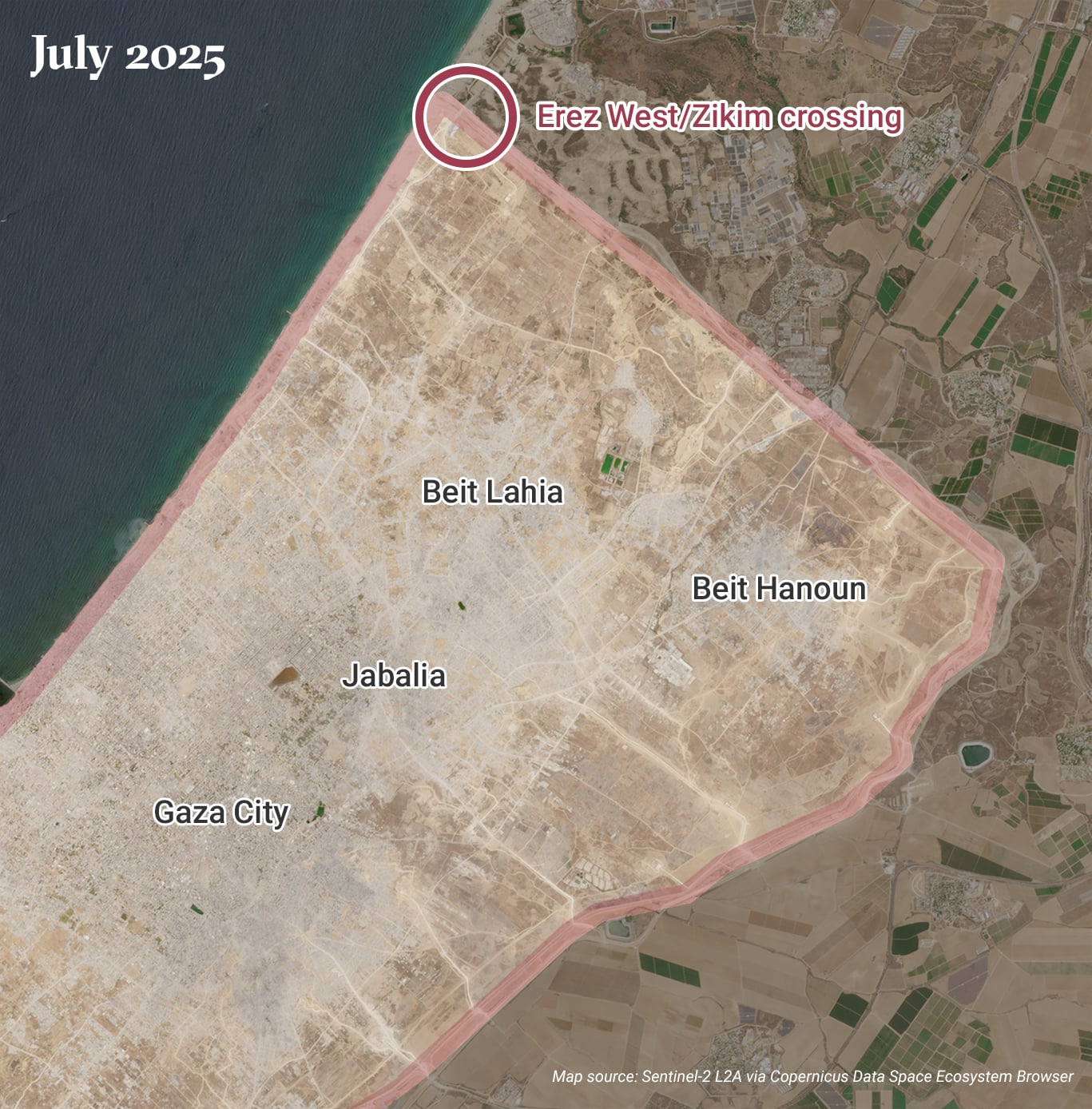
During the operation, we recorded a significant increase between early September and the end of November in the number of attacks on people seeking aid in Gaza City and Jabalia, including attacks on people collecting water and at least three strikes on bakeries.
In November 2024, after a blockade of more than five weeks, UN aid trucks were allowed into northern Gaza. On 7 November, a World Food Programme convoy dropped off 11 truckloads of food and water in Beit Hanoun, followed on 11 November by another three trucks.
Almost immediately after aid workers left on 11 November, Israeli artillery pounded the area where the trucks had delivered. Troops returned early the following morning to the school where aid had been dropped off, forced civilians to leave under fire, and then burned down the school.
Israeli authorities blocked two subsequent UN deliveries to the same area scheduled for 12 and 13 November, and on 13 November shelled civilians who had gathered to wait for another convoy further west, on the coastal road near Gaza City.
“The Israeli government and the Israeli military keep an extremely close eye on everything that happens inside Gaza, and particularly on all humanitarian operations and movements, so it is hard to buy the idea that things like that are coincidences,” said Jeremy Konyndyk, president of the NGO Refugees International.
Every aid delivery in Gaza has to be cleared with Israeli officials, who tell humanitarians where and when they can move. “If they have gone ahead and cleared an aid movement, approved a distribution, and then the next day that same military bombs the site where the distribution happened, and that happens repeatedly, that looks a hell of a lot like intent,” Konyndyk said.
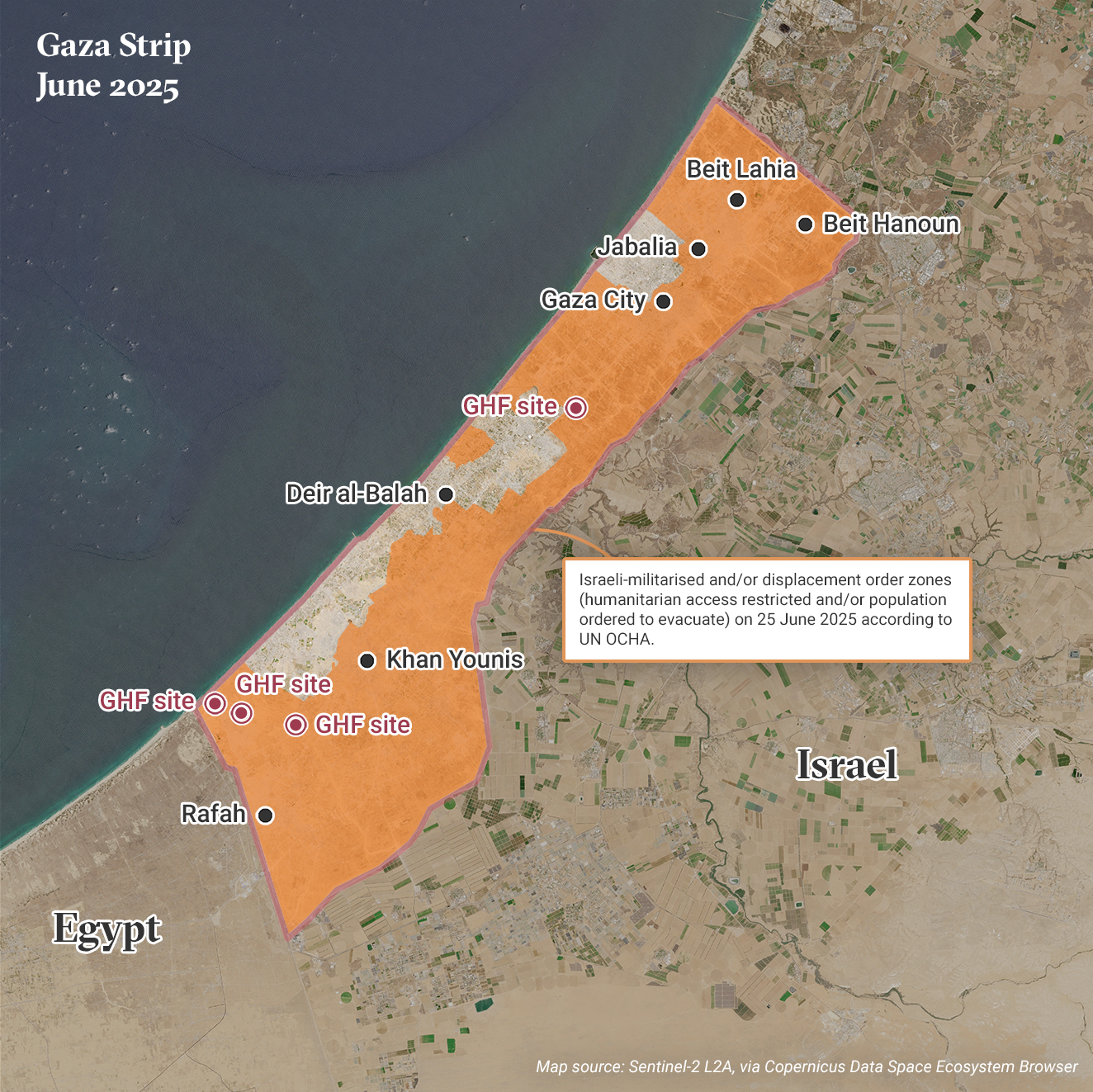
This string of incidents between 7 and 13 November last year illustrates another pattern captured in the database: The Israeli military announces a major military operation in an area of Gaza, orders the civilian population to evacuate, imposes a siege on those who remain, and then allows aid deliveries in another area to try to draw people there while attacking those trying to access food and other basic necessities in the area under evacuation orders.
This pattern has repeated in recent months ahead of Israel’s current assault on Gaza City, with the GHF’s distribution sites – all located in the south – and deadly attacks on people trying to obtain aid from convoys entering through the Zikim border crossing in the north both playing a crucial role.
“What this begins to look like is a sort of carrot-and-stick approach on [Israel’s] part, where the GHF is the carrot – kind of a poison carrot – and these strikes on aid seekers in the north are the stick,” Konyndyk said. “This begins to look like a fairly coherent plan to use strikes on aid to push people out of the north.”
In September, after Israeli forces escalated airstrikes on Gaza City and ordered people to leave and move south, GHF reported a 15-20% increase in the number of people at their militarised distribution sites, all in southern Gaza.
Destroying community resilience
The ceasefire from 19 January to 18 March was the only prolonged period since October 2023 where we recorded no attacks on people trying to obtain aid. It was also the only period over the past 23 months that Israel began to allow more significant amounts of aid and commercial goods into Gaza to feed the population.
But before the ceasefire ended, Israel once again imposed a total siege on Gaza, starting on 2 March, just after the beginning of the Muslim holy month of Ramadan. It lasted until 19 May. And almost immediately after Israel withdrew from the ceasefire, attacks on people seeking aid resumed.
Between 26 March and 4 June this year, Israeli forces systematically targeted people at soup kitchens, which have formed the backbone of the community humanitarian response in Gaza. We documented at least 14 of these strikes, just over half of all of the attacks on people collecting aid during this period. The attacks, which were primarily airstrikes or artillery or tank fire, killed or wounded at least 104 people, many of them children.
One of the first strikes in this cluster came near the end of Ramadan, on 26 March. An Israeli airstrike hit a soup kitchen as people lined up for food just before the end of the day’s fast. At least five people were killed or wounded. Many were children, videos of the incident show.
Nearly all of the attacks we recorded during this period were in southern Gaza, where the majority of aid was delivered during the ceasefire.
After happening regularly for just over a month, the pattern of attacks stopped when soup kitchens ran out of food and shut down. The World Food Programme’s warehouses were empty by 25 April, and World Central Kitchen, which provides food to many soup kitchens in Gaza, ran out of supplies on 7 May.
The only change after this period was the availability of food supplies, suggesting the targets were not – as Israeli authorities have routinely claimed in strikes killing civilians – militants, or some kind of Hamas command-and-control centres buried under the soup kitchens, but rather the soup kitchens themselves and/or the waiting civilians.
This apparent pause lasted until late May, when aid groups were allowed to bring in some flour to allow bakeries to again provide bread. The morning after trucks arrived, Israeli forces hit at least two bakeries, killing or wounding more than 70 people.
During the same period, beginning around 18 April, we recorded what appears to be a parallel pattern of 13 attacks on restaurants, cafes, markets, and other places where food supplies were concentrated and being distributed as aid or commercial goods.
We have not been able to verify the targets of all of these incidents as thoroughly and did not include them in the database. But together with the strikes on aid seekers and soup kitchens during the same time period, they show a pattern of systematic attacks on food supplies accumulated during the ceasefire, and on people trying to access them.
All of these attacks helped push Gaza into famine, which was officially declared by the IPC on 22 August.
The IPC has issued four famine warnings since November 2023, which have been echoed by many humanitarians. Israeli officials responsible for the military campaign and restrictions on humanitarian aid have denied these warnings. In August, Israeli Prime Minister Benjamin Netanyahu called the IPC declaration a “blood libel”.
That catastrophic hunger has driven people in Gaza to continue to risk death for the chance of food – including through the new GHF system, where people return daily despite the thousands of casualties.
“You must assume that the policymakers that have designed the system knew very well about the situation on the ground, but they also knew about these alarm bells. And they decided to continue this plan despite these alarm bells,” said Itamar Mann, an international law expert with the University of Haifa and a Humboldt Fellow at Humboldt University in Berlin.
Legal implications
Compounding crimes
These patterns suggest Israeli authorities have adopted a strategy of systematically committing war crimes and crimes against humanity that are contributing to genocide.
The most clear-cut atrocities are the shootings of people waiting for aid near Israeli checkpoints or border crossings – like the killing of at least three people witnessed in northern Gaza in June by The New Humanitarian contributor Hani Qarmoot.
“When the gunfire stopped, the silence screamed. Three people were dead. One was a boy, maybe 10 years old. I watched his older brother cover his face with a torn shirt. I wanted to cry, but the tears wouldn't come,” Qarmoot wrote.
These attacks have happened in areas controlled by Israeli forces, who are firing on civilians from fixed positions. These factors potentially make them willful killings – a grave breach of the Fourth Geneva Convention, said Haque, the international law expert at Rutgers.
Because these attacks are repeated and widespread, they may also constitute crimes against humanity, including murder, systematic attacks on civilians, and possibly extermination, Haque said.
Manufacturing deprivation and forcing people to move around in search of necessities, all to push them from their homes (as Israeli authorities have done), would amount to using war crimes as a tool for forced displacement – itself a separate war crime and a crime against humanity.
The attacks on soup kitchens and other similar civilian locations are also potential war crimes. Looking at each incident in isolation, war crimes investigations would need to consider if the apparent targets and circumstances could justify an individual strike. Prosecution of these crimes is often difficult, especially because it can be hard to disprove claims by belligerents that attacks were on military targets.
Zooming out, however, the pattern of attacks we’ve documented – in the context of the Israeli military’s overall conduct in Gaza – adds to evidence that Israel is committing genocide, legal experts told The New Humanitarian. Most significantly, they contribute to the genocidal act listed under article 2(c) of the Genocide Convention: “deliberately inflicting on the group conditions of life calculated to bring about its physical destruction in whole or in part”.
International criminal tribunals looking at genocide in Rwanda and the former Yugoslavia have found patterns of repeated conduct can offer evidence of intent, a key element of genocide, the legal experts pointed out.
The attacks on people seeking aid have also happened alongside Israeli strikes on healthcare, water, and other infrastructure that have destroyed the essentials of life in Gaza – all while violence, restrictions, and bureaucracy have crippled humanitarian aid.

Two years of Israeli-imposed restrictions on humanitarian work and deep insecurity have made it nearly impossible to deliver aid, with just 114 trucks coordinated by the UN arriving at their destinations so far in September. About three times as many were intercepted before delivery by hungry people, or by armed gangs – who Israeli forces have allowed to operate without challenge.
All of this has shrunk the available necessities to barely anything but food. Through the GHF, Israeli authorities now have direct, unprecedented control over nearly all of that food – a tool to control where people go, whether or not they eat, and whether they die while trying.
In July, the GHF said this explicitly, writing on social media that “control of aid means control of Gaza”.
“The very fact of that kind of control… I think plausibly fulfills the legal conditions for Article 2(c) of the Genocide Convention,” said Heidi Matthews, an international law expert at Osgoode Hall Law School in Canada.
Despite the mass killings, people continue to go to the GHF distribution sites – a choice between certain death by starvation, or possible death by bullets and bombs. Forcing people to make that choice is additional evidence of the intentional creation of genocidal “conditions of life”, Matthews said.
The killings are one piece, but the manufactured deprivation, undermining of aid, and now famine all build on each other to indicate genocide as both goal and outcome – making every daily horror part of that all-encompassing crime, she explained.
“Every individual act of killing or wounding becomes genocidal by virtue of the intention established by the whole constellation of facts,” she said.
Accountability or impunity
As the two-year mark of the beginning of Israel’s military campaign looms, whether there will be accountability for any of these apparent war crimes – or for the larger genocidal project to which legal experts say they contribute – remains an open question.
“We’ve normalised horror,” said Juliette Touma, a spokesperson for the UN’s agency for Palestinian refugees, UNRWA.
In February 2024, when at least 878 people were killed or wounded in the Flour Massacre, Touma recalled being in a room full of journalists in Jerusalem as phones began buzzing. The mass killing dominated news coverage, bringing wide attention to the unfolding catastrophe.
That was more than 18 months ago. At the end of July this year, Israeli forces killed or wounded 760 people in just one attack, firing into crowds of people waiting for trucks in northern Gaza. They had killed or wounded about the same number of people across two attacks just a few days before.
“There's been impunity – and that has been going on for a long, long, long time… This carte blanche has got us, all of us, where we are right now,” Touma said.
“I think the bigger question is, how do we get out of here?” she asked. “The impact is about our global values and our humanity, and what we believe in: human rights, international law, justice and accountability. You see Gaza as the graveyard for all of these things.”
The ICC has issued arrest warrants for Netanyahu and Gallant, and its Israel war crimes investigation is ongoing. But the US has issued two rounds of sanctions aimed at hampering the ICC’s work and penalising those investigating Israel, and it is unclear if states will enforce the warrants against Netanyahu and Gallant.
The case brought by South Africa in December 2023 accusing Israel of committing genocide in Gaza is also making its way through the International Court of Justice (ICJ), the UN’s top court, but a ruling is likely still years away.
States could choose to arrest and prosecute individual Israeli soldiers suspected of committing war crimes under the principle of universal jurisdiction. A constellation of organisations is now collecting evidence – often based on soldiers’ own social media posts – to support these types of cases, as well as filing criminal complaints.
The Genocide Convention also requires states to act to prevent and punish the crime of genocide. Without waiting for the ICJ, states – particularly Israel’s Western allies – could act on their own, using their substantial leverage to pressure Israel to stop committing atrocities. There are signs that some European states are moving in this direction, but most have either continued to provide support for Israel’s actions or done little to stop them, despite watching two years of what rights groups have described as a “live-streamed genocide”.
There are many avenues for potential action, according to the legal experts The New Humanitarian consulted, but most countries – especially those with the most power – have chosen either passivity or complicity. For now, the corrosive impunity that Touma described remains, and the killings continue.
Edited by Eric Reidy.


