

Share & more
It was around noon on 23 June when a brief but shocking piece of news broke: Israel had attacked Evin prison in Tehran.
Just days before, the Islamic Republic had executed two Iranian citizens – Majid Masibi and Mohammad Amin Mahdavi Shayesteh – on charges of spying for Mossad. Many saw the strike as a direct response.
Israeli Defence Minister Israel Katz confirmed that Evin had been targeted alongside several other sites, including the flagship building of the Islamic Revolutionary Guard Corps (IRGC) and the headquarters of the much-feared paramilitary Basij forces, saying the targets were "regime targets and government repression bodies in the heart of Tehran".
For many Iranians, nothing symbolises state repression more than Evin.
Evin is not just a prison. It is where trauma and resistance live hand in hand – a shadow cast over tens of thousands of families for decades. For more than 40 years, Evin prison, which sits at the foot of the Alborz Mountains in an upscale residential area, has been one of the most visible symbols of both the former monarchy’s and the Islamic Republic's authoritarian rule. It is the Iranian security apparatus' primary site for incarcerating dissidents, foreign journalists, academics, and diplomats.
When I saw the images of its destroyed gate, tears welled up in my eyes. Like so many others, I had been there. A flicker of relief stirred at the collapse of a symbol of tyranny – but the tears weren’t of joy, they were of grief for the innocent lives lost, for the terror of families awaiting news, and for the prisoners trapped behind its walls at that very moment.
Memories and nightmares
As the news spread, families of detainees rushed toward Evin, hoping for answers. They found only roadblocks. Israel's strike on Evin spread panic among families of the political prisoners, who were left scrambling to determine their loved ones' fates. Nearly a month later, families of most of those who were in solitary confinement or under interrogation still hadn't heard from them.
Their fears transported me back to my own arrest in October 2022, during the Woman, Life, Freedom uprising in Iran. I was dragged from my home and thrown into a dark vehicle with no idea where I was headed. When the car stopped, we were at the gates of Evin. I was blindfolded and disoriented, but through the tinted windows, I caught glimpses: mothers crying, pleading, demanding to know if their children were alive.
Now, after the Israeli missile strike, the scenes repeated – but this time, some parents would never get their answers.
Iranian judiciary spokesperson Asghar Jahangir announced that 71 people were killed in the attack – including prison administrative staff, conscripted soldiers, inmates, family members of prisoners who were at the prison for visits or legal follow-ups, and neighbours living near the prison. The attack was carried out during visiting hours, and the judiciary said Evin's medical centre and visiting rooms were targeted.
Among the dead were a doctor who worked at the medical center as well as a prison social worker and her five-year-old son. Iran also confirmed that top prosecutor Ali Ghanaatkar had been killed. Ghanaatkar's prosecution of dissidents, including 2023 Nobel Peace Prize laureate Narges Mohammadi, led to widespread criticism by human rights groups.
The administrative building, visitation hall, infirmary, courthouse, and the iconic gate were all destroyed. That giant iron gate, the one that haunted my dreams, now lies under rubble. When I first arrived at Evin, I couldn’t see it – I was blindfolded. But I could hear voices shouting in panic, and the smell of smoke was thick in the air.
Torture beyond the rubble
The Israeli strikes on Evin caused shock and panic. After the strike, chaos reigned. Water, gas, and phone lines were cut. Special security units arrived not to provide aid, but to restore control. The injured received minimal help.
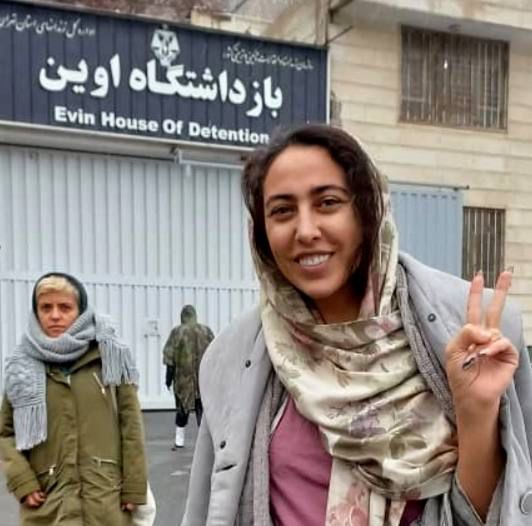
Large swaths of Evin were rendered dysfunctional. A day after the strike, the judiciary said Iran's prison authority had transferred inmates out of Evin prison, without specifying their number or identifying them.
According to human rights activists in Iran, Evin prison housed an estimated 120 men and women in its general wards, as well as hundreds of others believed to be in its secretive security units under interrogation or in solitary confinement. Women prisoners remained in Evin the night of the strike before being moved to Qarchak Prison, a women’s only facility in another part of Tehran. Male prisoners were transferred to facilities including the Greater Tehran Penitentiary (Fashafouyeh).
Sayeh Seydal, a jailed Iranian dissident who narrowly escaped death when she stepped out of the prison's clinic moments before it was destroyed, later called Qarchak a "hellhole" during a phone call to her family. She said the women were packed together with no hygiene care and limited food or drinkable water.
A family member of one of the male prisoners relocated to the Greater Tehran Penitentiary said: “They locked everyone up in a large hall that can hold a maximum of 30 or 40 people, but now they are keeping more than 120 people there.”
My own memories of Evin still burn. I was held in ward 209, cell 33. Nine women in a two-by-four-metre room. No windows. No darkness. The lights were never turned off. We had to sleep on the floor. We had to ring a bell and wait to be blindfolded just to use the toilet. We didn't know if it was day or night. It was so inhumane that we used to wish to be moved to Qarchak. But now, even Qarchak has become a hell deeper than we could imagine.
Among the women transferred are several with conditions needing treatment, including 73-year-old civil rights activist Raheleh Rahemi, who has a brain tumor.
A war on two fronts
The New York-based Center for Human Rights in Iran criticised Israel for striking the prison, saying it violated the principle of distinction between civilian and military targets. France's foreign minister, Jean-Noël Barrot, also condemned the strike on the prison, which was housing two French nationals. “The strike aimed at Evin prison in Tehran put in danger two of our nationals, Cecile Kohler and Jacques Paris, hostage for the past three years. It's unacceptable,” he said.
After the missile strike, the Islamic Republic launched a new wave of arrests – many on fresh charges of espionage. Families of political prisoners now fear that Iran may execute detainees as revenge against Israel. They see a terrifying precedent: After Iran's war with Iraq ended in 1988, authorities executed at least 5,000 political prisoners after perfunctory trials and then buried them in mass graves in the Khavaran cemetery in the southeast of Tehran. The still grieving families of those killed have never been allowed to access the graves.
Already, during Israel's military campaign, Iran executed six prisoners – including Masibi and Shayesteh – who were sentenced to death before the 12-day war in June.
“To get to democracy [Iranian society] needs powerful tools to reinforce civil society and the women's movement,” Mohammadi, the Nobel laureate and veteran activist, said in a 30 June video message to the Associated Press from Tehran. "Unfortunately, war weakens these tools."
Political space is already shrinking with security forces increasing their presence in the streets of the capital, she added.
Hope and the future
I may have left Evin, but Evin hasn’t left me. It lives in the sound of chains I still hear in my sleep. In the phantom scent of smoke that sometimes fills my nose. In the echo of a mother screaming, not for her daughter's freedom, but just for proof that she's alive.
I had once hoped that the great iron gate of Evin would fall – not from an airstrike, but opened by the people. That light would pour through it, not smoke. That the fall of that gate would be a celebration, not a mourning.
More than 60 acres of vegetation surrounding the prison were scorched in fires in the aftermath of the attack, satellite images show. Videos posted to social media, including ones shared by the Iranian government, show burned-out cars and tangled metal. An exterior wall on the medical center is blackened and bars on its windows are crumpled. Inside, medical equipment and beds are covered in shattered glass.
Maybe one day a child will walk past that site and ask, “What was here?”, and their mother will answer: “This used to be a prison. Where people were jailed for speaking, writing, resisting. But it's over now. They turned it into a museum – so we never forget and never let it happen again.”
This piece was published in collaboration with Egab. Edited by Dahlia Kholaif and Ali M. Latifi.


