


Share & more
As Lebanon and Israel discuss a ceasefire but Israel’s bombing continues, more than a million people have been forced into displacement, many under mass evacuation orders that have led to confusion, chaos, and uncertainty: Will they ever be able to return home?
On 2 March, just a few days after Israel and the US began bombing Iran, Hezbollah joined the war by launching missiles into Israel. What followed was the first evacuation order of this round of conflict, with Avichay Adraee, the Israeli military’s Arabic-language spokesperson, posting a warning on X (formerly Twitter) telling the residents of dozens of towns and villages in southern Lebanon to leave.
The notice read, in part, “Urgent and repeated notice to the residents of the following Lebanese villages… For your safety, you are required to evacuate your homes immediately and move away from the villages by a distance of no less than 1,000 metres... Anyone who remains near Hezbollah military personnel, facilities or military assets is putting his life at risk.”
The evacuation orders and their accompanying maps showing red no-go zones, which Amnesty International has criticised as “overly broad” and sowing “panic and terror”, have since become a regular feature of the war.
But many people don’t know the moment Israel orders them to leave. Without immediate access to X, they have been learning they have to take flight from social media posts that spread on TV news, word of mouth, and WhatsApp news groups.
Najib Farhat, 35, a lawyer from the village of Baraachit, about seven kilometres from the Israel-Lebanon border, was awoken by Israeli jets roaring overhead at 6am on 2 March. He told The New Humanitarian he recognised the sounds as a clear “signal of a strike”, so he asked his parents to pack “as much as they could, knowing we might not be able to return”. Farhat later learned of the official order, first from a WhatsApp group, then from a television broadcast.
Farhat and his family spent 22 hours on the road to the southern city of Sidon, a drive that usually takes around two hours, because so many people were trying to escape at once. They are now staying in a friend’s home further north; many others are sleeping in shelters, rented accommodations, with family, and in tents on the street.
International humanitarian law requires advance warning to protect civilian populations in war time, so many have questioned both the legality – and the intent – of these orders.
As Fadi Hachem, a human rights lawyer who lectures at the Lebanese American University in Beirut, told The New Humanitarian: “When warnings drive populations into conditions of extreme vulnerability without access to food, water, or medical care, the protective intent of the order is severely compromised.”
In addition, rights groups have said the orders may amount to the war crime of forced displacement, especially after Israeli officials explicitly said in late March they were demolishing south Lebanon houses and villages “in accordance with the model as Gaza”, and Israeli troops would remain in the area, with 600,000 displaced people not allowed to return “until the safety of Israel’s northern residents is guaranteed”.
Adraee has defended the orders, saying Israel is targeting Hezbollah and protecting civilians.
Nighttime orders and short timeframes
Before setting off for Sidon, Farhat learned that his village was one of 55 locations in south Lebanon ordered to evacuate. Since then, those orders have extended to include all of Beirut’s southern suburbs, an area that is often described as a “Hezbollah stronghold” but is also home to hundreds of thousands of civilians, including some low-income populations like migrant workers who have settled in the area due to relatively affordable housing.
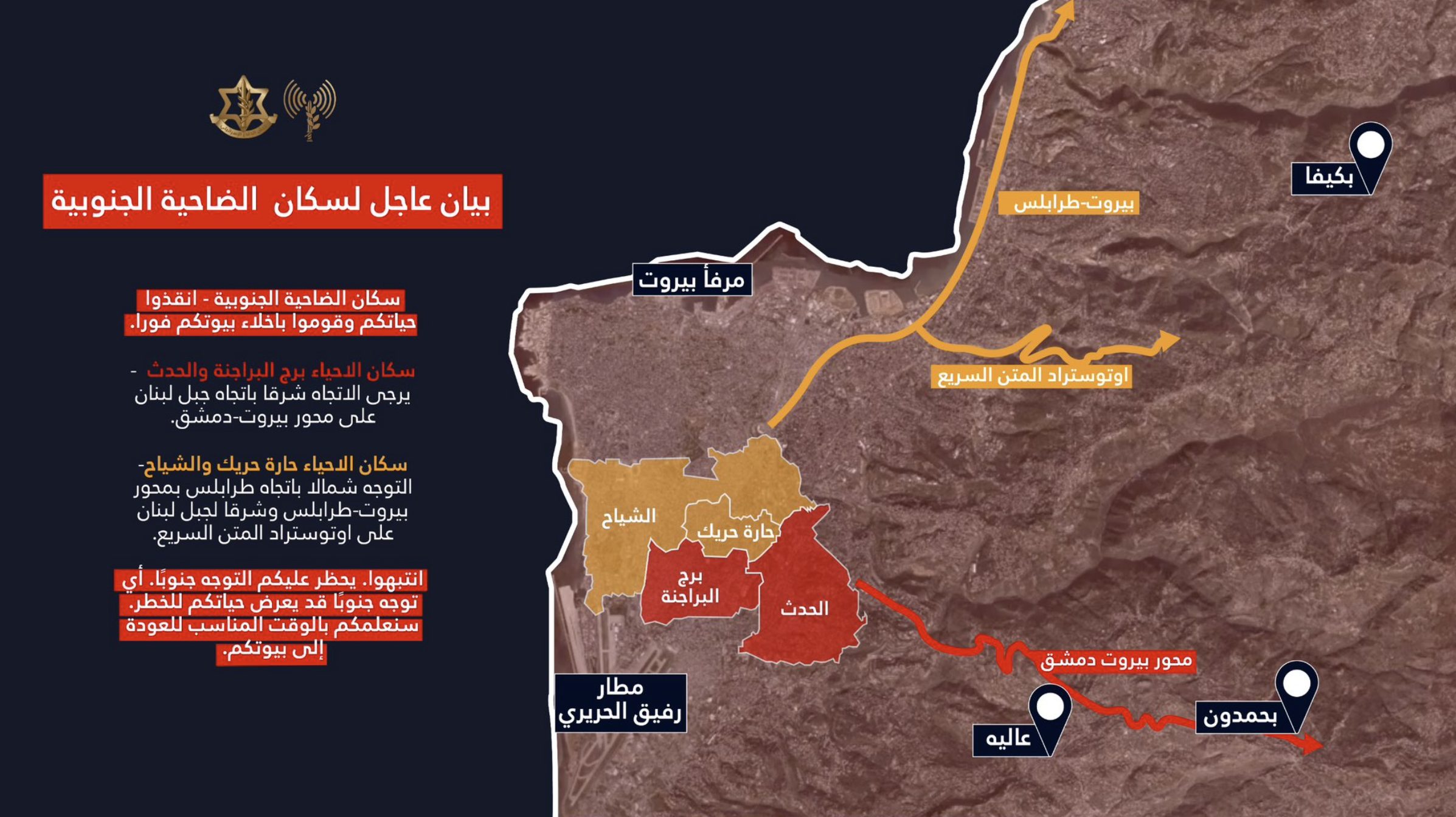
On 31 March, Israel expanded its evacuation order to a wide swathe of territory south of the Zahrani River, including part of the Bekaa Valley.
Some of these orders include maps but don’t mention lists of specific neighbourhoods, adding to the uncertainty.
Following the notices, which are also issued for individual buildings, small areas, and entire neighbourhoods, Israel has sent ground troops into south Lebanon and heavily bombed across the country. In total 2,089 people have been killed in Lebanon, and Israel’s airstrikes have hit civilian infrastructure like bridges and destroyed homes.
Hachem argues that “warnings issued within extremely short timeframes, sometimes less than 15 minutes before strikes, cannot be considered effective [advance warning] as required” under international humanitarian law.
Sometimes warnings come without sufficient time to flee: On 31 March, for example, a mass evacuation warning was put out at 1:43pm on X for part of Beirut’s southern suburbs, and a strike reportedly hit 16 minutes later.
In other cases, warnings have been sent out for entire towns and villages in the middle of the night. A review of over 100 warnings issued by Adaee on X since 2 March reveals that nearly 20 were issued between 1am and 7am.
This has a particular impact on the elderly and other groups who do not have access to constant phone updates or social media. Many rely on relatives abroad who are keeping up with the news and awake when orders are issued.
“Fear is our constant companion. We are used to fleeing our homes, but this time there are no safe places anymore,” Mounifa Hteit, 79, told The New Humanitarian. She fled her home in the southern city of Nabatieh a few hours after receiving a call from her daughter in Canada, who was awake and saw the notice, telling her that she needed to flee.
“My mother-in-law keeps asking us what’s happening when she hears a strike. She doesn’t know about evacuation orders because she doesn’t have a mobile phone or access to breaking news alerts,” said Salim Younes, who fled his home in the village of Babliyeh a month ago with his family, but ended up turning around because he couldn’t find anywhere to stay.
Safe evacuation
Given that Israel has bombed parts of Lebanon that were previously considered safe – and the fact that the orders are often so broad that they have forced tens of thousands of people to move at once – many people find the journey itself terrifying.
On 12 March, Younes and his family – including his worried mother-in-law – left their Babliyeh home, around 60 kilometres north of the border, after hearing from a friend that evacuation orders had been issued for the area.
“Israel used to target a single building or village. Now it’s everything – it’s becoming a collective evacuation.”
They took a few belongings, along with their cat and birds. When they got to al-Sarafand, a seaside town about 12 kilometres away from home, Younes said “we spent three hours in the car, waiting and searching for a shelter. We didn’t want to sleep in tents or on the streets.”
“[Israel] used to target a single building or village,” Younes said from his home in Babliyeh, where he has stayed since their original flight. “Now it’s everything – it’s becoming a collective evacuation.”
Hachem, the human rights lawyer, said that despite similarly chaotic and stressful scenes in late 2024, when nearly a million people were displaced, Lebanese authorities haven’t put in place any emergency evacuation plans, which could entail identifying safe routes to shelters and taking measures to reduce traffic.
“Both parties to the conflict are responsible for protecting civilians, and the Lebanese Army must take steps to designate safe evacuation routes,” said Hachem.
Lebanon still lacks a nationwide early warning system, despite international investments in emergency preparedness, including a $6.2 million programme funded by the European Union between 2022 and 2026. Some Gulf countries have installed missile and drone alert systems, although some are new and it isn’t clear how well these would function with Israeli airstrikes.
Instead, gunfire has become a daily informal warning system in places like Beirut’s southern suburbs, with people firing into the air to signal that strikes are imminent.
Health concerns
In addition to the immediate dangers of death and severe injury, the strikes potentially pose other health concerns. “With every strike, we smell gunpowder and other unknown pollutants,” said Taheer Audi, who has remained in her Baalbek home throughout the war.
Individual orders usually instruct civilians to move between 300 and 1,000 metres from a particular building. These orders might save lives at the moment of a strike, but – with an estimated 37,836 buildings damaged or destroyed in the first five weeks of the war – the massive environmental contamination raises questions about whether areas outside of designated areas can truly be considered safe.
Najat Saliba, a member of parliament and former professor of atmospheric chemistry at the American University of Beirut, told The New Humanitarian that “when buildings are destroyed, these materials can release hazardous gases”.
“Demolished concrete, along with iron and other metals coming from destroyed buildings, generate fine particles… that can penetrate the lungs and contribute to respiratory and cardiovascular diseases,” Saliba added.
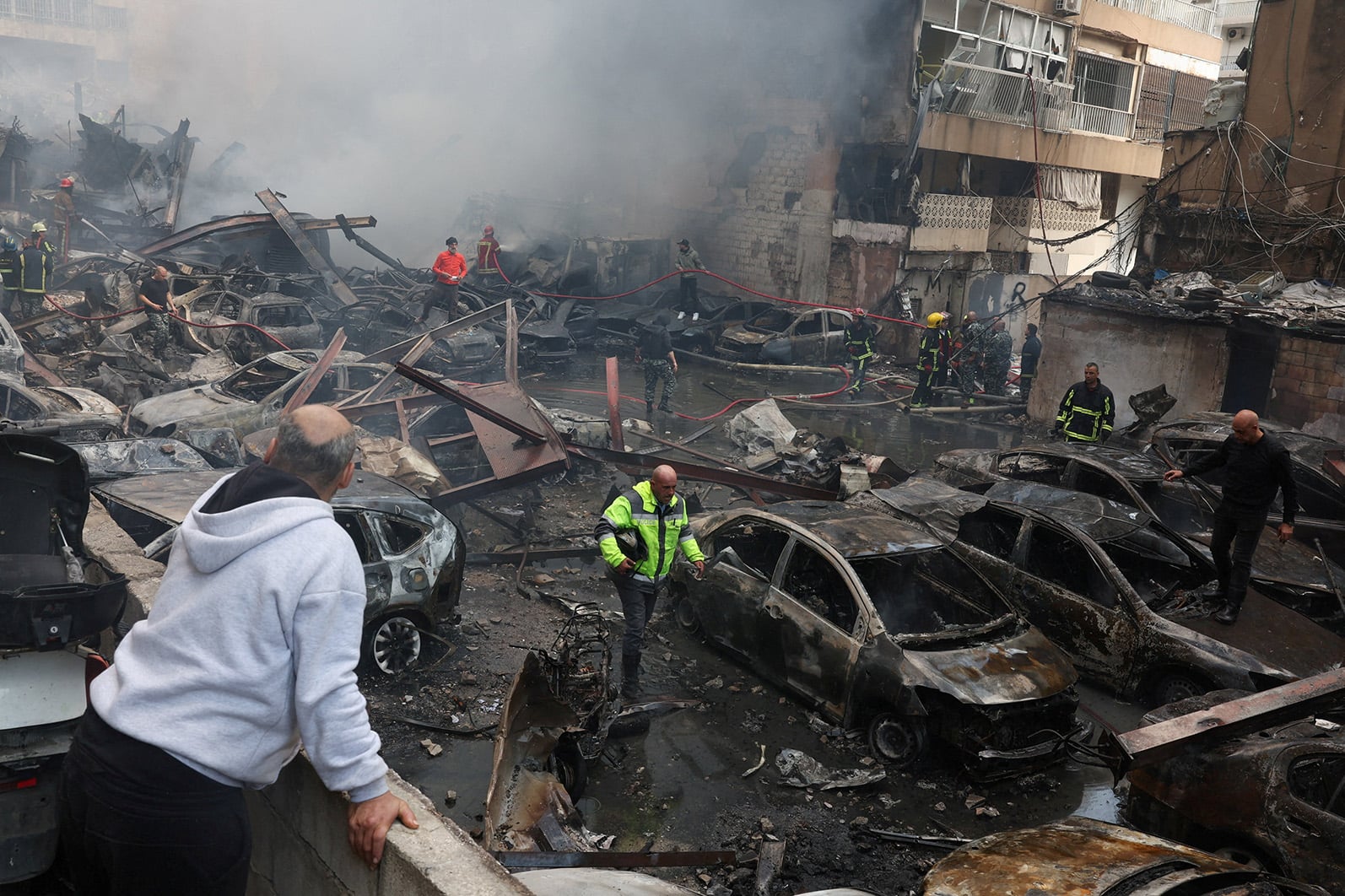
Videos circulating on social media show thick black smoke rising above residential buildings, with fires spreading across neighbourhoods. Fires like these increase the risks of health problems, Saliba said, as the combustion can release toxic emissions of known carcinogens.
There are also further risks given that Israel has targeted five (out of 45) branches of the al-Amana-affiliated chain of petrol stations.
Neither the Lebanese Ministry of Public Health nor the Ministry of Environment have issued guidance on how civilians can minimise their exposure to pollution from airstrikes, or what they should do afterwards.
When asked for comment, a spokesperson for the Ministry of Health said questions about the environmental impacts of the conflict should be directed to health specialists. The Ministry of Environment did not respond to a request for comment.
“Environmental risks need to be monitored and communicated daily. I don’t see this coming from the cabinet, and this is a significant gap,” said Saliba.
No safe place
Some people, like Audi in Baalbek, have opted to stay put, believing that given the constant bombings, moving from place to place with each warning won’t keep them safe.
Audi believes that “evacuation warnings give no window to escape”. She even remained at home despite a warning issued for her village prior to a March Israeli commando raid in the nearby village of Nabi Sheet. “How will I know the new place is actually safe and won’t be bombed?,” she asked.
Others have come to see the warnings as one of Israel’s tactical tools. Ibrahim El Gharib, a reporter for Lebanese TV channel Al Jadeed, told The New Humanitarian that he was reporting from Baalbek when Israel issued a warning for a specific building. “But the strike hit another building, resulting in casualties,” he said.
Last week, Israel bombed 100 targets in Lebanon in a matter of 10 minutes, killing more than 300 people, many in parts of Beirut that had never been seen as likely targets. There was no warning.
Even more than before, it has left many in Lebanon wondering if there is anywhere left in the country for them to go. “Honestly,” said Younes, at home in Babliyeh despite the dangers, “there is no safe place anymore.”
Edited by Annie Slemrod.


