


Share & more
Kathy Harrington and Andrea Rudnik, two long-time humanitarian volunteers in southern Texas, remember a US-Mexico border crowded with people on the move. Just a few years ago, shelters and camps sprawled across the borderlands, packed with families who had travelled thousands of miles in search of safety, stability, and the chance of a better life.
The conditions were often crowded, chaotic, and dangerous. But there was movement, anticipation, and, for many, hope. Now, the number of people attempting to cross the border has plummeted.
Since US President Donald Trump returned to office in January 2025 – ending access to asylum, militarising the US-Mexico border, and launching the mass deportation campaign – the number of people apprehended crossing the southern border has gone from 100,000-300,000 per month throughout 2024 to around 10,000 per month. With those lower numbers, public attention on migration has moved to focus on the impacts of the Trump administration’s mass deportation campaign in cities across the US.
That, however, doesn’t mean that the humanitarian crisis at the border has ended, according to Harrington and Rudnik, even if its tempo and contours have changed.
“People may not see the crisis because they see it as we’ve sealed the gates,” Rudnik explained. “But the fact is there’s a lot of people here now who came here for the American dream, who came for safety reasons, for their children’s education, to live in a more dignified way. And that’s being snatched away from them.”
Researchers estimate that around 5,000 people remain in border cities in northern Mexico, living in precarious conditions. Tens of thousands of others left stranded by US policies, or who have more recently been forced from their homes, are stuck in difficult and dangerous situations in other parts of Mexico and throughout Latin America.

“City of forced waiting”: Stuck at Mexico’s southern border
Every day, people forced to flee countries in Latin America and the Caribbean are arriving in the city of Tapachula, with nowhere else to go.
Many in northern Mexico have been there since before Trump returned to office, and a small number of people continue to arrive, hoping, at some point, to enter the US.
Others are recent deportees – some of the 20,000 non-Mexicans the US has expelled to Mexico during Trump’s second term. US Immigration and Customs Enforcement (ICE) often hands these people to Mexico’s National Institute of Migration (INM), which immediately buses them to southern Mexico. Some, however, manage to stay near the border or later make their way back north.
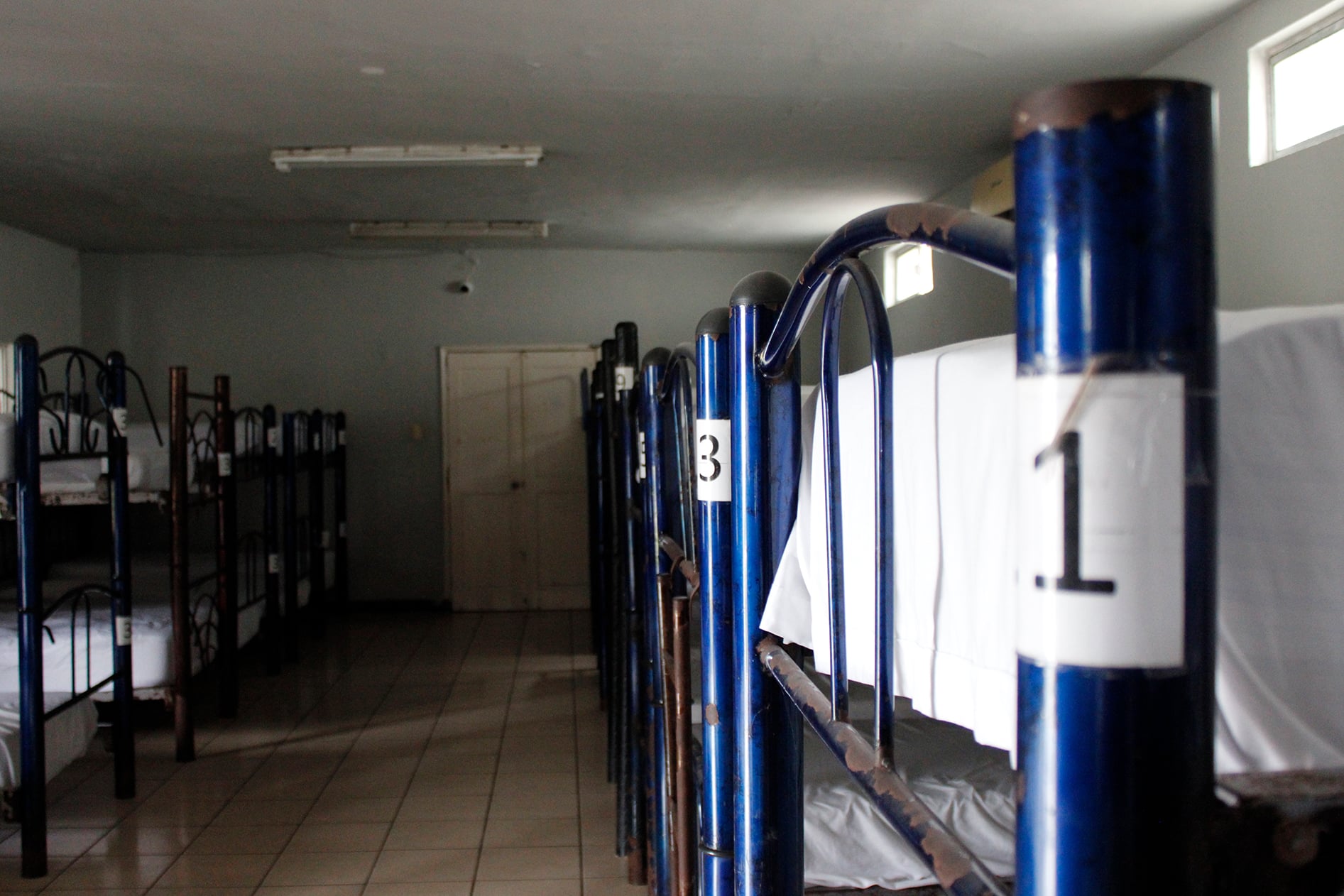
Regardless of how people end up in northern Mexican border cities, the conditions they find themselves in are precarious. Living in shelters or small apartments, they struggle to obtain legal status. If they are able to find work, it is usually in jobs that do not pay enough to cover basic expenses, and they frequently face violence and discrimination.
Meanwhile, the aid and support available for people stuck in the border region has been drastically scaled back, both because of the lower numbers and visibility, and because of the effects of US aid cuts. Volunteers like Harrington and Rudnik, whose work now focuses on supporting the network of shelters in northern Mexico, are some of the only responders left.
A crisis shifts shape
Harrington and Rudnik began their humanitarian work at the US-Mexico border as volunteers with Team Brownsville in 2018. Back then, a different series of policies put in place by the first Trump administration had restricted access to asylum, causing refugee camps to form in northern Mexico – including in Matamoros, a Mexican city across from Brownsville, Texas, where Harrington and Rudnik both live.
Team Brownsville was part of a robust network of churches, shelters, and aid groups operating across northern Mexico and southern Texas. In Matamoros and other Mexican border cities, thousands of people waited for appointments to cross into the US to seek asylum – the final step in months, and sometimes years, of travel through Latin America.
Under President Biden, a cellphone application CBP One became the principal mechanism for securing an appointment. Each day, the application released a limited number of slots, like a lottery.
“You would see people leaping and jumping and screaming because they had got their appointment,” said Rudnik. “They were going to cross – they knew the date, they knew the time.”
By 2023, “we were getting up to a thousand people per day,” Rudnik recalled, referring to people arriving in Brownsville after crossing the border through legal channels. “Kathy and I were rushing to get supplies, taking one after another after another trip to the store.”
Harrington travelled to camps in convoys of volunteers, delivering food and hygiene kits, stringing up lights, and installing generators.
“We saw some mighty thin people,” she said, recalling those who had passed through the Darién Gap, the infamous jungle corridor connecting Columbia and Panama. “Their clothes were all torn and dirty. I cannot tell you how many little kids’ feet we washed.”
The border was a place of acute humanitarian need. But there was a direction to the crisis: people were passing through, and the humanitarian infrastructure – if struggling to keep up – was there to help them on their way. “But the moment [Trump] came in, it all changed,” said Harrington.
Stuck at the border
One of the first acts the Trump administration took was to shut down CBP One and cancel all existing appointments. At the flip of a switch, around 300,000 people in the app’s pipeline were left stranded.
What happened to the 300,000 asylum seekers stranded in Mexico by Trump?
Hundreds of thousands of people fleeing crises were left in limbo on day one of Trump’s second term. Fifteen months later, where are they?
At Casa del Migrante, a shelter in Matamoros, director José Luis Elías Rodríguez remembered the “collective psychosis” that followed.
“There were people crying and people screaming: everything I invested, everything I lived through, everything I had planned, everything I promised, everything I dreamed of has collapsed,” he said of what they were experiencing. “Husbands began to drink out of desperation. Some women began to lose their hair, and the children began fighting each other.”
Going on two years later, the sense of being stuck without options has not changed. Parents recently deported from the US whose children remain in the country feel it particularly acutely. Rudnik sees them “using FaceTime, working in the shelter, doing whatever they can to take their minds off the fact that they’re not with their kids. But they really only have one goal – that desire to be with loved ones.”
That is one of the things keeping thousands of people in Mexico’s northern border cities, even as attention and resources have moved away.
At Casa Clínica Lulu, a shelter and medical clinic in Reynosa, Mexico, director Lourdes González, who everyone refers to as Lulu, said that before January 2025, her clinic received support from international aid organisations. “We had like eight organisations working with us. But now they’re all gone,” she said.
Meanwhile, people arriving from detention centres, having been deported, increasingly present with severe psychological distress, displaying symptoms she likens to schizophrenia. Some deteriorate to the point of screaming through the night, leaving other residents frightened. “There is no help for people with mental problems [in Reynosa],” she explained, adding that she personally drives people to Matamoros, which is about 90 kilometres away, to access psychiatric care.
Many international NGOs scaled down their operations following the abrupt withdrawal of US funding in early 2025. Others, like Médecins Sans Frontières (MSF), which ended its nine-year presence in Reynosa, shifted their limited resources elsewhere due to the reduced footfall at the border.
Speaking with The New Humanitarian, MSF officials said their programming is now focused on Mexico City, where larger numbers of third-country nationals – including people who were in the CBP One pipeline, recent deportees, and new arrivals – are congregating. But across MSF’s projects in different parts of Mexico, the challenges are similar: people trapped in limbo, high levels of uncertainty and trauma, and complex mental health needs.
Challenges facing NGOs
The impact of Trump’s policies on the ability of humanitarian organisations to continue to operate had a precursor. Well before Trump returned to office, the Republican Governor of Texas, Greg Abbott, alleged that the presence of aid groups encouraged people to migrate and falsely claimed that some nonprofits might be involved in assisting unlawful border crossings.
A series of investigations followed, including one that focused on Team Brownsville. The accusation was that the group had misappropriated funds.
“They blindsided us,” Harrington said. “They went into our bank and demanded our records. We were lucky that our lawyers agreed to take us pro bono because they knew we weren’t doing anything wrong.”
Other nonprofits working on migration in Texas, including Catholic Charities of the Rio Grande Valley in McAllen and Annunciation House in El Paso, were also targeted.
None of the accusations, ranging from harbouring undocumented migrants and involvement in human smuggling to poor financial accountability, were ever proven. But the investigations contributed to an increasingly hostile environment.
“Many backed off,” explained Pastor Carlos Navarro, who has supported migrants through his church in Brownsville for 40 years. “They said, ‘No, that’s too dangerous’. Only one or two decided to stay here no matter what.”
By December 2024, Team Brownsville had disbanded. Only later did Harrington, Rudnik, and fellow volunteer Gerry Page begin again under a new name: Madrinas de Justicia, or Godmothers for Justice.
Today, they act as intermediaries between American donors and a modest network of charities, shelters, and clinics in northern Mexico. But donations have slowed, volunteers have vanished, and many peer organisations have closed.
At the same time, those locked in limbo in Mexico are increasingly exposed, says Gladys Cañas Aguilar, president of the Matamoros-based civil association Ayudándoles a Triunfar.
Some are still trying to cross the border irregularly, either to escape the precarious, often dangerous situation in Mexico or to reunite with family members in the US. “Unable to enter legally, migrants seek out more inhospitable, rugged, and dangerous routes, putting their lives at risk,” Cañas Aguilar said.
Most, however, remain stuck in northern Mexico, waiting for some ambiguous point in the future when things might once again change.
People in limbo
Natalia, a young mother, is among those caught in this new cycle of immobility. She and her family fled Ecuador, spent two months living on the streets in the southern Mexican border city of Tapachula, and reached Matamoros in January 2025, just in time for Trump to return to office. They have lived at a migrant shelter in Matamoros ever since.
“I would like to return to my country but given the reasons we left, going back is complicated,” said Natalie. She did not say what specifically pushed her to leave her home but mentioned violence and safety concerns.
Now, like many others in limbo in the border region, she is trying to regularise her legal status in Mexico. “We’re focusing on stabilising things first – sorting out paperwork and all that. We’re trying to get settled, to find a home, [and] move forward as a family.”
For families like Natalia’s, obtaining legal status in Mexico is one of few options – but a slow one. In the first half of 2026, Mexico’s asylum agency, COMAR, registered around 20,000 new applications. At the same time, COMAR’s capacity has collapsed. A significant amount of its funding came from the UN’s refugee agency, UNHCR, which has been hit hard by US cuts to foreign assistance.
Given the demand, applications can now take up to two years to process, adding another layer of waiting for families such as Natalia’s.
One resident at Casa del Migrante, the shelter in Matamoros, lived in the US for 11 years, after fleeing crime and violence in Honduras. He was deported in February, and does not want to regularise his status in Mexico while his daughter, who is 14, remains in the US. Doing so, he fears, would only put more distance between him and his family.
“My hope is that the migration laws change and that my daughter can help me later on when she reaches legal age,” he said.
Another man told The New Humanitarian that he was deported and separated from his wife and four children after living in Arkansas for 28 years. With his eldest set to begin college, and a heavily fortified border between them, video calls are their only contact.
Swimming upstream
Shelters in Matamoros and Reynosa providing services to the stranded now partially rely on Harrington and Rudnik’s Madrinas group to find US-based individuals or corporate and religious donors to fund urgent renovations, pay salaries, or even provide basic supplies. Because of the US aid cuts and dwindling attention, some shelters have been forced to close down.
“People still need help,” said Harrington. “They’ve lost everything in their lives. They have nowhere to go. So, if I’m able to, I help.”
But she and Rudnik said they feel like they are swimming upstream – against public opinion in the US, pressure from their families, and the policies of their own government.
The network within which they operate is tightknit, but increasingly dependent on individual goodwill.
“We motivate each other,” Rudnik said. “If it were not for us, we wouldn’t be able to do the work.”
For Cañas Aguilar, of the association Ayudándoles a Triunfar, the fundamental issue is one of failed policy. “There is still no migration policy that respects the human rights of migrants,” she stated. “They see [migrants] as commodities, political pawns, migration flows, or border issues. But they never see them as human beings.”
Edited by Eric Reidy.


