

Share & more
A rising tide of deadly attacks this year by jihadist gunmen on displaced people returned to areas of northeastern Nigeria – declared safe by the authorities – has thrown into question the sustainability of the state government’s resettlement policy.
In September, more than 60 civilians were killed when insurgents of Jama’atu Ahlis Sunna Lidda’awati wal-Jihad (JAS) – better known as Boko Haram – attacked the military base and village of Darul Jamal on the Nigeria-Cameroon border.
Darul Jamal had become the showcase home for 3,000 internally displaced persons (IDPs) who had been living for a decade in an overcrowded camp in the nearby town of Bama. It was part of the Borno State government’s ambitious “stabilisation” strategy that has seen the return of more than 170,000 IDPs to their home areas over the past few years.
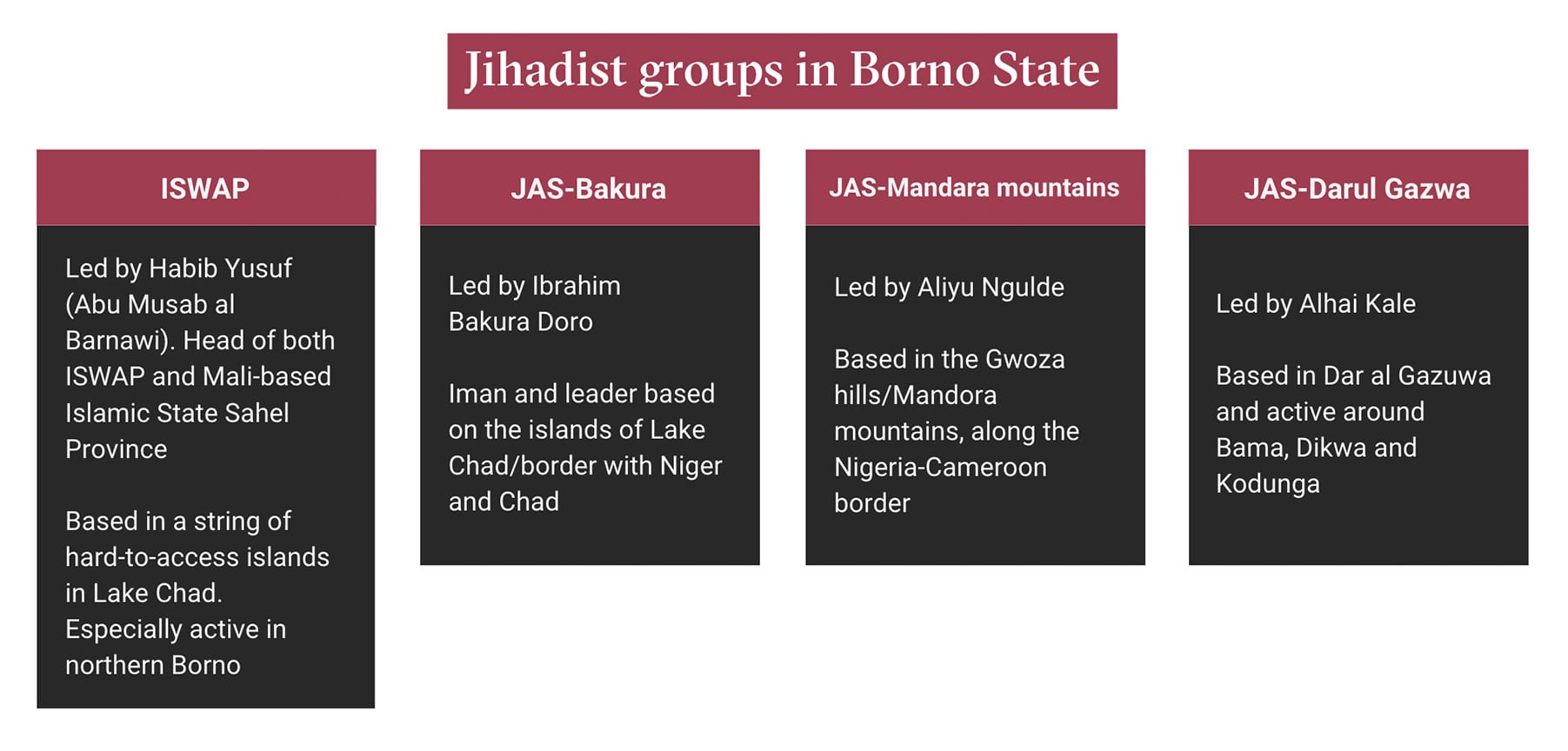
Darul Jamal was targeted by the Aliyu Ngulde faction of JAS, based in the adjacent Gwoza Hills/Mandera mountains. The speculation is that it was punishment for the passing of information to the military by IDPs and vigilante groups on the movement of insurgents in the bush.
When Borno State Governor Babagana Zulum visited Darul Jamal the following day to offer his condolences, he urged the former IDPs to stay and rebuild – a refrain he has repeated on other occasions this year at scenes of similar atrocities.
But without adequate security – and systematic economic support to the newly returned IDPs – the “Reconstruct, Rehabilitate, and Resettle” pillar of Borno’s stabilisation strategy (one of nine pillars) looks decidedly shaky.
“[The policy] requires the government to answer more elaborately the question of what’s to be done around security,” explained Anietie Ewang of Human Rights Watch. “You can’t just return people and expect them to face whatever is out there.”
To understand the toll of these attacks on communities, earlier this year The New Humanitarian visited the towns of Damasak, Gamboru Ngala, and Monguno in northern Borno, Dikwa and Bama in the east, and Gwoza to the south.
We interviewed more than 60 former IDPs who had been resettled from camps in the state capital, Maiduguri. For a better insight into the insurgency, we also spoke with ex-JAS fighters who had recently surrendered to the army.
The IDPs all stressed their feeling of vulnerability. All of them knew someone who had been either kidnapped or killed by the insurgents – some of them family members. With only threadbare protection from a seemingly indifferent military, there was a profound sense that they were on their own. “We can rely only on God”, was a common refrain.
Nguro Soye lies just outside Bama, roughly 70 kilometres from Maiduguri. It was resettled in 2022 with IDPs from Maiduguri’s Dalori II camp. When The New Humanitarian visited a few months after their arrival, the residents spoke of the constant harassment they faced from JAS at night – despite the presence of a military detachment only a few kilometres away. That threat appears to have only increased.
“Most of us have regretted coming,” said Fatima Mohamed, who arrived in Nguro Soye with her husband and teenage sons. “In Maiduguri, we stayed peacefully, but here there is no security. Everybody is thinking of leaving – and many have – because Soye at night … You lie in bed listening, wondering what will happen.”

“Losing ground”
Much of Borno’s countryside has been depopulated by the 15-year insurgency. The army switched to a “super camp” strategy in 2019 after losing a series of remote outposts, concentrating its forces in fortified bases in key towns. The drawback is they have offered little challenge to the consolidation of jihadist control over the wider terrain.
Yet, until recently, the military felt it had the upper hand – an optimism shared by the state government. An estimated 160,000 former JAS fighters and their families had deserted for amnesty and resettlement through the so-called “Borno Model” between 2021 and 2024. The stabilisation strategy, enthusiastically backed by the UN Development Programme, had looked set to rebuild state authority and legitimacy.
But the Islamic State West Africa Province (ISWAP), which is distinct from JAS and the largest and most sophisticated of the insurgent groups, is still very much present. It has worked out how to overpower the military’s bases, with a devastating attack in September on Banki being the latest. Its use of dismounted night assaults, drones, IEDs, and feint attacks all demonstrate a tactical dexterity.
Nigeria’s military on the other hand – called to deploy in hotspots across the country – is overstretched. Its tendency to withdraw under attack – “dislodging” is the common expression – leaves hard-to-replace equipment behind, which is then either torched because it is unserviceable, or looted, researcher Malik Samuel has pointed out. The fact that reinforcements and air support can be slow to arrive only deepens the military’s morale problem.
In April, Zulum made a shock announcement that the state authorities were “losing ground” to the insurgents, and that attacks and kidnappings were occurring “almost on a daily basis without confrontation”. It was a belated recognition of what IDPs were already painfully aware of.
Voluntary or coerced?
In 2022, roughly 900,000 people lived in Borno’s 65 formal and 158 informal camps – with a further 1.4 million staying within the host community. For years, the Borno government has sought to close the camps. Zulum characterised them as havens of drug abuse, sex work, and aid dependency. Returning people to their areas of origin was presented as a means to restore dignity, self-sufficiency – and kickstart rural economic recovery.
Camp closures began in 2021, and he set 2026 as the deadline for all formal camps to be shuttered. The assistance NGOs could provide the returnees was restricted by a government keen to promote the autonomy of the former IDPs.
Camp life is a struggle. They are overcrowded and under-serviced, but returning people to their ancestral homes has not been strictly voluntary. Most IDPs found work in Maiduguri and developed mutual support systems. Abandoning a known lifestyle, for the unknown of rural homes most have not seen for more than a decade, is a difficult choice. The term “voluntary forced” has been coined as – in essence – the choice to stay or go is constrained.
A powerful inducement to go is the state government’s one-off stipend. Male returnees receive in total $70 and women $35. In addition, there are “starter packs” of food and non-food items. It’s an incentive that runs counter to Borno’s own Safe Return Strategy – that resettlement should be safe, dignified, informed and voluntary.
“I’m not saying that people should remain perpetually in IDP camps,” Ewang of HRW told The New Humanitarian. “If it’s safe to return, and people trust that it’s safe, they will go back. You don’t need to shut down the camps and force people to go back.”
The director of a Maiduguri-based development NGO, who asked not to be named so he could speak freely, said the lack of consultation with IDPs has been startling. “You need to have involved the community in the planning, listened to their concerns – that’s how you win buy-in,” he said.
An Abuja-based consultant argued that the one-off payment was not only insufficient, it guaranteed that returning IDPs would be stuck in poverty.
“The Borno state government is in over its head,” he told The New Humanitarian. “Ultimately, the issue of capacity is more than what’s discussed in workshops. You need an economic and livelihoods policy to sustain a returns programme.”
“They cut his throat”
IDPs resettled in rural towns scratch the meagerest existence. Typically, a two-kilometre-deep perimeter is deemed safe, but to earn a living – collecting firewood, or working on the farms of local landowners – they have to venture beyond that belt of land.
It’s in these spaces they encounter JAS, or its rival ISWAP. These interactions are always intimidating, but how risky tends to depend on which group the gunmen belong to.
ISWAP are harsh disciplinarians, but have banned theft from civilians, a practice known as fay’u. JAS, on the other hand, has historically been predatory. Its former leader, Abubaker Shekau, considered all Muslims who had not pledged allegiance to him as unbelievers and said it was therefore permissible to kill, plunder, ransom, or enslave them.
His death in 2021, at the hands of ISWAP, hasn’t altered the template of the three surviving JAS groups in Borno. The largest is led by Ibrahim Bakura Doro, based in the Lake Chad islands, who periodically skirmishes with ISWAP. The Ngulde faction has pledged allegiance to him and is well entrenched in the Gwoza Hills, while the smallest of the three, so-called Dar al Gazuwa, is led by Alhai Kale and active around Bama, Dikwa, Konduga, and Maiduguri.
There is a fourth JAS group, based in northcentral Niger State, under the command of a militant known as Sadiku, who also falls under Bakura, the recognised successor to Shekau.
The IDPs The New Humanitarian interviewed described kidnappings from farms, at roadblocks, or out in the bush as particularly prevalent in JAS areas. Ransoms demanded are usually between $1,400 and $2,000 per person – a substantial amount in a country where the minimum wage is around $21 a month. It forces families to turn to friends, well-wishers, and community leaders, widening the circle of victimisation.
“My friend was kidnapped, and they demanded two million [$1,400]. They call you on your phone and tell you where to bring the money,” explained Isa Kaslum from Galumba, near Bama. “The military won’t stop you. You just tell them you’re going to pay, and they say, ‘Go and pay, and then come back’.”
Ya Musaram was resettled in Burari, next door to Nguro Soye. She said Dar al Gazuwa gunmen enter her hamlet almost weekly. “When they come, they don’t leave you with anything. They will take even your cooking pot, your plastic mat – anything you have they want to take,” she said.
“If you make an excuse, they’ll put a gun to your head,” she explained. “Even if you say you don’t have anything, they won’t believe you and will beat you. One elderly man was keeping someone’s luggage, and he protested when they tried to take it – they cut his throat.”
The profits of plunder
Arawa Modu joined JAS a decade ago, taken by a relative to Shekau’s Sambisa Forest base when he was aged just 11. He was in Sambisa when ISWAP fought their way in and Shekau detonated his suicide vest to avoid capture.
Modu slipped away and connected with Dar al Gazuwa. He stayed with them until – exhausted by repeated raids by ISWAP and the army – he surrendered to the military in Bama six months ago. He is currently in the government’s amnesty programme.
For him, fay’u is key to JAS’s survival. He listed kidnapping and roadblocks as lucrative, with rustling livestock and then selling the animals on to JAS-Ngulde for transport to markets in Cameroon as the most profitable. He calculated each JAS fighter earned about 300,000 naira ($200) a month. Their commanders, who share out the booty, make a lot more.
“ISWAP preached to us in Sambisa. They said ‘We’re doing the same work, there is just a misunderstanding, join us’,” he explained. “But they said no fay’u – that was a red line between them and us. How can we stay in the bush without fay’u? That’s our livelihood.”
ISWAP is entrenched in northern Borno, especially on the western shores of Lake Chad. Its more politically astute approach not only bans fay’u, but focuses on the military as its principal target. However, fearing spying, ISWAP is deeply suspicious of IDPs and violently enforces its control.
Saidu Abacha was resettled in Marte, 130 kilometres northwest of Mauduguri, three years ago. He is still struggling to make a go of it: Collecting firewood earns him around $1 a day, if he’s lucky.
But ISWAP is strict over where and how many trees can be harvested. “They say we’re destroying the forest; we’re always nervous because you don’t know when they will come,” he explained.
Protection is part of the equation of a successful resettlement policy, but so too are the economic opportunities that would allow people to make a fresh start. The Borno government’s restrictions on NGOs working with the resettled – and donor aid cuts – have undermined the livelihood support that could have eased re-entry.
Instead, people are being offloaded in rural towns whose local economies have been hammered by years of conflict. Health services – in poor shape even in Maiduguri – suffer from even more extreme staff shortages, drug and funding shortfalls, and physical decay. Schools face similar problems.
In the absence of structured and sequenced support, Zulum visits rural towns delivering food and cash handouts. The aid is sorely needed – people are hungry – but the help is ad hoc and resembles political campaigning rather than systematic development assistance.
Buka Bukarslay was resettled in Marte in 2022 with his two wives and nine children. In his first year, he had a brother killed collecting firewood, and he himself was shot in the mouth and arm during an ISWAP attack on the town that killed the head of the vigilante CJTF that he was sitting next to.
When he is completely broke, he hitches a ride with traders heading to Maiduguri and looks for help from relatives in the city. “There is no income in Marte,” he explained. He would stay in Maiduguri if he could, but he doesn’t have the money to rent a room and his relatives have no space to spare.
“Boko Haram calls us to go back to the bush”
The majority of IDPs are teenagers. They didn’t grow up farming, and their social world was the urban IDPs camps. The lack of economic opportunities in the rural areas, the tussles over landownership that exist, and the antagonisms and frustrations stirred by the weakness of state authority can potentially sharpen the ideological appeal of the insurgents.
“The fundamental issue is: what people are returning to,” said the Abuja-based consultant. “The conditions that dragged people into terrorism a decade ago still exist.”
Babagana Umaru fought with JAS until he surrendered in 2017. He joined the federal government’s Operation Safe Corridor (OSC) amnesty programme in 2019, and graduated a year later, before resettling in Banki, on the Cameroon border. The start-up capital he was given was enough to start a roadside fruit and vegetable business.
But he has found civilian life tough. He feels the community hasn’t really forgiven him, and chafes at what he feels are deliberate slights when he’s omitted from invitations to weddings and naming ceremonies. His lack of money also grates – compared to what, on reflection, seems now an easier lifer in the bush when fay’u kept him comfortable.
Some of his comrades who also went through OSC feel the same. He says he “knows a couple” who have given up and rejoined JAS.
“Boko Haram calls us to go back to the bush,” he told The New Humanitarian. “It’s only my mum talking to me saying ‘Don’t go back’ that stops me. But sometimes my heart is heavy and I think about it.”
The same remobilisation is underway among some former JAS fighters who have passed through the state government’s scheme, regarded as less rigorous and securitised than OSC. These men – believed by Maiduguri residents to be behind a spike in local kidnappings – are helping to fuel JAS’s resurgence.
“So many have gone back,” said the head of a community-based NGO in Maiduguri who asked not to be named for security reasons. “They surrendered, but then didn’t find what they were looking for. It’s all about livelihoods.”
While talk of an alliance between JAS-Bakura and ISWAP seems unlikely given a recent resurgence of fighting between the two, there is speculation that there will be closer collaboration in the future between Bakura and Ngulde in the Gwoza Hills and Alhai Kale’s Dar al Gazuwa (ISWAP has tried and failed to seize the Gwoza Hills).
Former Dar al Gazuwa fighters told The New Humanitarian they expected tighter links between all three JAS groups – which will only strengthen the insurgency at a time when the military is struggling to contain ISWAP.
“They were talking about it before I left in July,” said Modu, who joined JAS a decade ago. “The problem is Bakura is wicked and Aliyu Ngulde [favours his Gwoza people]. But an alliance will come because Dar al Gazuwa is the weakest and will need help.”
A decade ago, the Borno conflict forced more than three million people from their homes. The terrifying scenario today is that if the security situation continues to deteriorate, a fresh wave of IDPs – including those newly resettled – will head to Maiduguri, where the camps that could support them are now closed.
Obi Anyadike reported from Johannesburg. Community workers, who asked not to be named for security reasons, reported from Maiduguri. Edited by Andrew Gully.


