


Share & more
A ceasefire was announced last month, but the war is not completely over. Life as we knew it before will not be restored. Israeli attacks continue, and the supplies we need are not being allowed to enter. The chances of making it to the second phase of the deal – and eventually to see reconstruction and stability – seem impossible. As far as many of us in the Gaza Strip believe, we will remain homeless, without a future.
Still, after two years of genocidal war, we are trying to breathe a sigh of relief. After two years of slaughter and displacement, I finally have a moment to reflect on the toll this has had on me and my family. We are alive. We are together. But we've lost our home in Khan Younis, and we are now indefinitely confined to living in a tent.
It is one thing to go about trying to survive a war knowing your home is intact and that, one day, you will return to it. It is another thing for there to be a ceasefire, knowing you survived the worst of a genocide, and that you have no home. That in itself is devastation. The uncertainty, the fear of what tomorrow and the future will bring, the inability to protect your family, is crushing.
For a Palestinian, a home is the homeland. Not a day passes without my kids crying over their demolished bedrooms and the comfort they won’t see for years to come. It’s what has broken me the most in the past two years – that the home I spent 20 years building has been reduced to rubble, and there is no knowing when we will be given the chance to rebuild it.
I cannot allow myself to fully despair. There are so many people around me who are suffering, and whose situations are even worse than my own. Last year, I wrote about how the war changed everything about how I do my job as a journalist. I am no longer just an observer but someone living through the same horrors and deprivations as the people I interview for my reports. Since then, I have also become an informal relief worker. As someone in touch with many people in Gaza and with access to international support networks, I had no choice.
A dual role
The transformation from being strictly a journalist to someone delivering aid started earlier this year. At the beginning of March, Israel imposed a total siege on Gaza. By May, the hunger crisis was unbearable. I had been reporting on people suffering from starvation for weeks – families dividing meagre portions of bread, children too weak to sit upright, mothers gathering scraps for ingredients.
Then the phone calls began. A family in one tent telling me they had no flour. Another saying they had run out of sugar. Many simply had nothing left. I could not just write about this. I had to act.
At the same time, people outside of Gaza who had gotten to know and trust me through my journalism were reaching out and asking where they could donate money to help. With their financial support, I gathered a group of friends and some neighbours. We roamed markets in al-Mawasi – the coastal area in southern Gaza where Israel evacuation orders and ground invasions have pushed much of the population – spending hours scouring stores with empty shelves for supplies.
When we found flour, oil, and some vegetables, we would try to buy items at a reduced cost compared to inflated prices of everything due to the scarcity and demand. I used my connections as a journalist and position coming from a well-known family in Gaza to negotiate with merchants and the few farmers who were left. When they knew I was purchasing items to distribute as aid, some gave me better prices.
I had come to know some of the families I delivered aid to through my reporting. Speaking with them, I learned about their needs and desperation. But the list of people who did not have nearly enough was long. I tried to reach as many as I could as more donations arrived. I prioritised women who the war had turned into widows, orphans, and families whose breadwinners were injured or had been taken captive by Israel. Many people who know me through my reporting also reached out to me for help.
I carried 20-kilo sacks of flour on my shoulders. I often had to give just a kilo to families because there was never enough compared to how many people were in need. That amount was not enough to pull them out of famine, but I hoped that it would help them keep hope alive. A mother would knead dough with trembling hands, and her children’s eyes would brighten at the smell of bread. At least they would have a meal or two after spending days with no decent food.
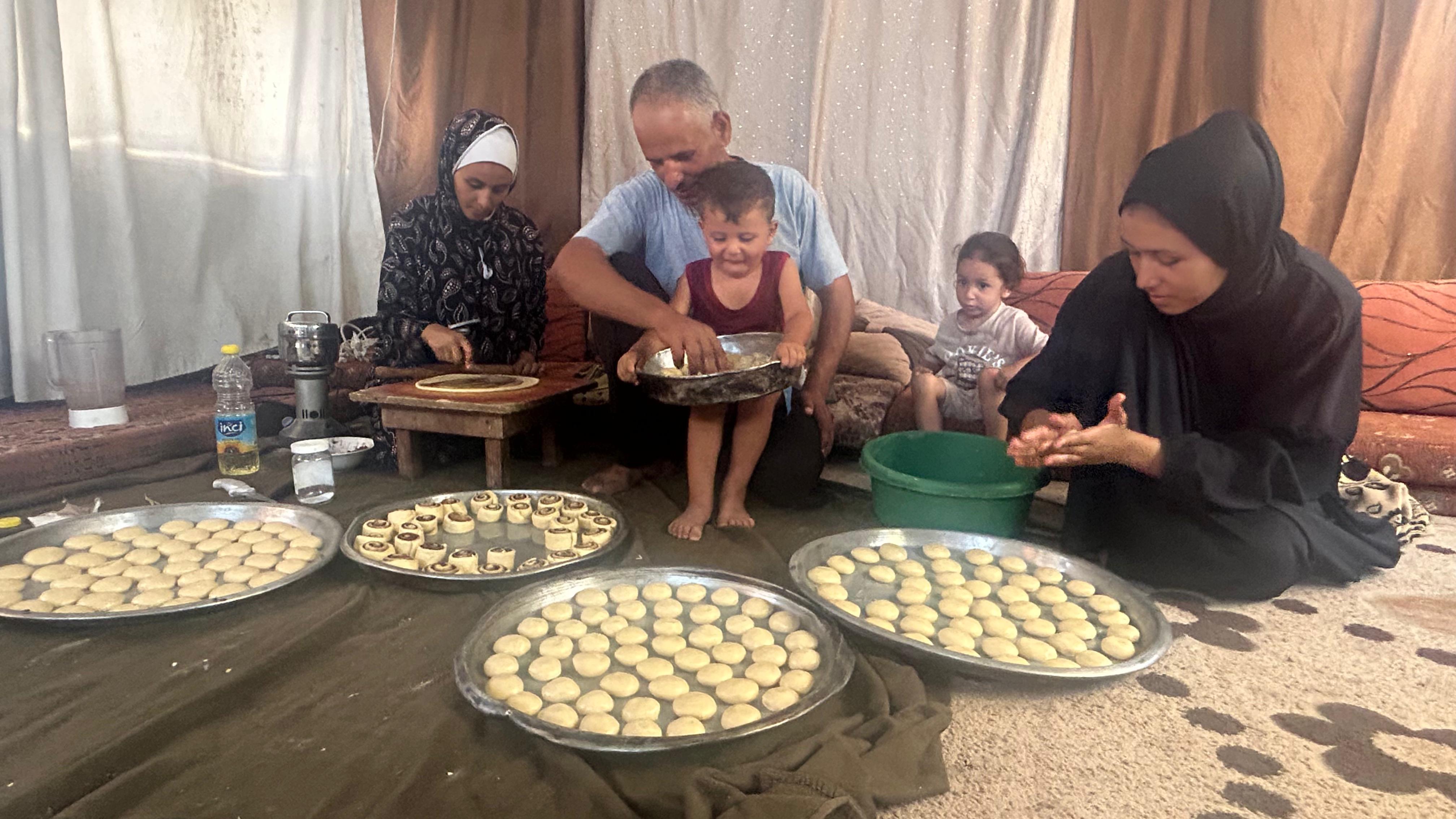
I still remember Abu Fadi Karkira arriving at his tent in a displacement camp in al-Mawasi in early September with a big tray full of ghoraybeh – a butter cookie – baked by a clay oven. He lifted the tray, his youngest son Amr, just three years old, tugging at his clothes, longing. When I helped him get sugar and ghee for the cookies, I saw laughter tumble out of tent flaps. Joy so small, yet so rare.
While volunteering, I kept reporting. I carried notebooks and relief bags at the same time. I mapped needs, connected donors abroad to desperate families here, always verifying: this family exists; this child is starving; these people matter.
The ceasefire
Anywhere in the world, journalists are expected not to mix their jobs with other societal roles they play to maintain objectivity and neutrality. But in Gaza – where at least 206 Palestinian media workers have been killed – this wasn't possible. For us journalists, there was no distance. The famine was not a headline. It was something we lived with every breath.
Now, with the ceasefire in effect, teams from the UN and other international organisations are mobilising to reach camps that have seen deaths, starvation, and silence. Some families are returning to the north. Some tents are being emptied. And yet, the hunger remains.
Prices of many food items have significantly dropped since the ceasefire. But essentials we need – like baby formula, food supplements for pregnant and breastfeeding women, poultry, meats, and milk – are still not reaching us. On top of that, Gaza’s economy has been destroyed. Many people simply have no source of income, and even those with savings have long since exhausted them. As a result, many families cannot afford to buy food even at reduced prices.
In the fragile quiet, I continue volunteering. I check on my demolished home. I document the plight of my people.
The need is also too large for UN agencies and NGOs to meet. Many people are falling through the gaps. Starvation and poverty have become entrenched in this society. It would take more than a ceasefire to erase them. So, I continue my dual role as a journalist and a relief worker, because people are still hungry.
The truce has created some space to breathe and to distribute items to people more safely. But every effort is stalked by fear of renewed bombing.
In the fragile quiet, I continue volunteering. I check on my demolished home. I document the plight of my people. I distribute loaves of bread and small sweets, which many families have not tasted in months. I use donations from abroad to pay for bread ovens to run, arrange for water tankers to carry drinking water to displacement camps, and deliver milk and diapers for infants.
I speak with mothers, children, and elders. I ask questions for my articles: When did you lose your home? When were you displaced? When and what was your last meal? Those are followed by other questions now: What would you like? What do you need? How can I help?
More to be done
Now, I balance my journalistic work – dispatches, photo essays, interviews – with relief work: providing people with butter, sweets, water, and medicine. I delegate when needed. I ensure transparency: documenting each bag, each distribution. Because in famine, trust matters.
In a tent lit by candle flame, I watched children taste ghoraybeh after months of having nothing sweet. I saw women weep into their palms, not for themselves, but for daughters who had lost weight. I heard laughter, at first sharp and uncertain, then deeper as sugar melted on tongues. I remember mothers clutching flour sacks to their chests when I placed them there.
These are the moments that sustained me – because it wasn't always clear if my words were read or heard beyond the borders of our besieged homeland.
In the wake of famine and under constant threat, volunteering, reporting, living – they have all become entangled. This ceasefire gives us air. But my work now is not simply to record suffering: It is to help fix it any way I can.
I don’t know when the bombings will truly stop. But I do know: Families will eat today. A few more loaves will be baked. Journalists will keep telling the truth. And Gazans will continue to persist, because we have no other option. They can kill as many of us as they like. We won’t be going anywhere. They can starve us and block our access to food, but we will always find a way.
This piece was published in collaboration with Egab. Edited by Dahlia Kholaif and Eric Reidy.


