


Share & more
IOM, the UN’s migration agency, is claiming UN immunity to justify its refusal to release documents about its EU-funded Assisted Voluntary Returns and Reintegration (AVRR) programme in Greece.
The documents – annual reports from the programme – were submitted by the agency to Greece’s European Programs Management Agency (YDEAP) and the European Commission. The New Humanitarian requested them under access-to-information laws in Greece and the European Union.
The amount of publicly available information on the programme has been shrinking for years. Until 2020, IOM’s website routinely published data on the number of so-called voluntary returns the agency had facilitated. However, it stopped updating its figures that December, and by January 2022, the platform had been taken offline entirely.
In July 2023, IOM Greece finally published a single brochure on its AVRR programme. Information about its staff’s continued visits to detention facilities, which had been included in earlier reports, was missing.
The New Humanitarian revealed in October how IOM Greece regularly visits detained migrants to encourage them to sign up for returns. The programme has nonetheless failed to meet its deportation targets over the past six years, despite receiving more than $60 million in funding, mostly from the EU.
In requesting the YDEAP documents, we had hoped to fill in the information gap left by IOM’s dwindling disclosures and shed light on why the AVRR programme has failed for so long to meet its targets.
Instead, the agency’s refusal underscores a recurring disregard for accountability.

“Not subject to the national law”
YDEAP, which oversees the distribution of EU funds for migration control in Greece, told us it could not process our request after IOM claimed it “is not subject to the national law of the Hellenic Republic”.
“The property, funds and assets of IOM shall be immune from search, requisition, confiscation, expropriation and any other form of interference, whether by executive, administrative, judicial or legislative action,” IOM Greece said in its correspondence with YDEAP. The New Humanitarian obtained a copy of this correspondence as part of its information request.
According to IOM, this immunity stems from a July 2024 agreement that its Director General promoted as a landmark partnership to further protect migrants in Greece.

Burned remains of the migrant detention facility on the Greek island of Lesvos after the Moria refugee camp burned down.
“As expressly provided for in Article 8 of the Agreement, IOM… shall enjoy immunity from legal process,” IOM Greece said in its correspondence.
This would mean that Greece’s government cannot compel the agency to release any documents concerning its operations in the country, even though these operations are funded by Greece and the EU.
Chris Jones, executive director at the pro-transparency NGO Statewatch, said IOM’s position was a “structural absurdity”.
“International organisations are now carrying out what are, in effect, sensitive state functions,” he told The New Humanitarian. “Yet they remain insulated from the very accountability mechanisms that supposedly bind states.”
In response to a request for comment on the findings presented in this article, an IOM spokesperson in Geneva said: “The reporting by The New Humanitarian contains material inaccuracies and misrepresents key aspects of IOM’s work.”
The spokesperson declined to specify what these alleged inaccuracies were, despite a request for clarification.
IOM stonewalls EU lawmaker
In July, we asked European Parliament member Tineke Strik to file a similar request for IOM Greece’s documents with the European Commission. This new request was also refused.
IOM objected to the release of its documents, again citing its “privileges and immunities”. With this came another justification: The disclosures would “endanger the internal security of Greece”.
Asked about IOM’s claims, Strik was unequivocal: “UN immunity cannot be used as a shield against democratic oversight,” she said. “The European Commission has a duty to ensure that all its implementing partners, including international organisations, are subject to the same transparency and reporting requirements as any other beneficiary of EU funds.”
“Invoking immunity to avoid scrutiny is not only contrary to that, it undermines public trust in the EU’s migration governance as a whole,” Strik added.
The IOM spokesperson, in their reply to The New Humanitarian, insisted that “we maintain full transparency with our donors and Member States and regularly publish organisational data and reports”.
A similar case in Nigeria
Through our reporting, we found that this was not the first time IOM has tried to use its UN status to dodge public scrutiny.
In 2019, IOM’s mission in Nigeria refused to release information about services it purported to provide to returnees in Edo state after a local NGO, FOI Counsel, filed a request under the country’s Freedom of Information Act.
FOI Counsel’s Executive Director, President Aigbokhan, had been trying to verify claims by the agency that returnees were running a pineapple processing plant in the state as a cooperative.
“I went to that place and discovered that there was no such factory. It never existed,” Aigbokhan said. “Then, we decided to ask questions.”
In its response to Aigbokhan, IOM said it “enjoys privileges and immunities in Nigeria since 2002”, which would exempt it from the country’s laws.
Aigbokhan sued IOM Nigeria to obtain access to the information, but ultimately had to drop the suit after costs piled up.
“Litigation is not cheap. It is very expensive for NGOs to track public records,” Aigbokhan said.
A pineapple processing factory ultimately opened in December 2020, but instead of being run by returnees as a cooperative – as IOM had originally announced – it was operated by a local company.
The cost of immunity
Blanket invocations of UN immunity hamper the work of journalists and researchers. For migrants enrolled in return programmes, they can have far more serious consequences.
We spoke to returnees who, after their deportation, were unable to access the services IOM promised them in Greece. In fact, between 2016 and 2023, only about a quarter of returnees from Greece received reintegration assistance in their home countries, according to Greece’s National Centre for Social Research.
To join the AVRR programme, individuals must sign a waiver that discharges IOM, as well as the Greek government, from any liability, including in the event of injury or death. The waiver remains valid even after a returnee’s participation in the programme ends, and it also applies to one’s “dependents, heirs and estate”.
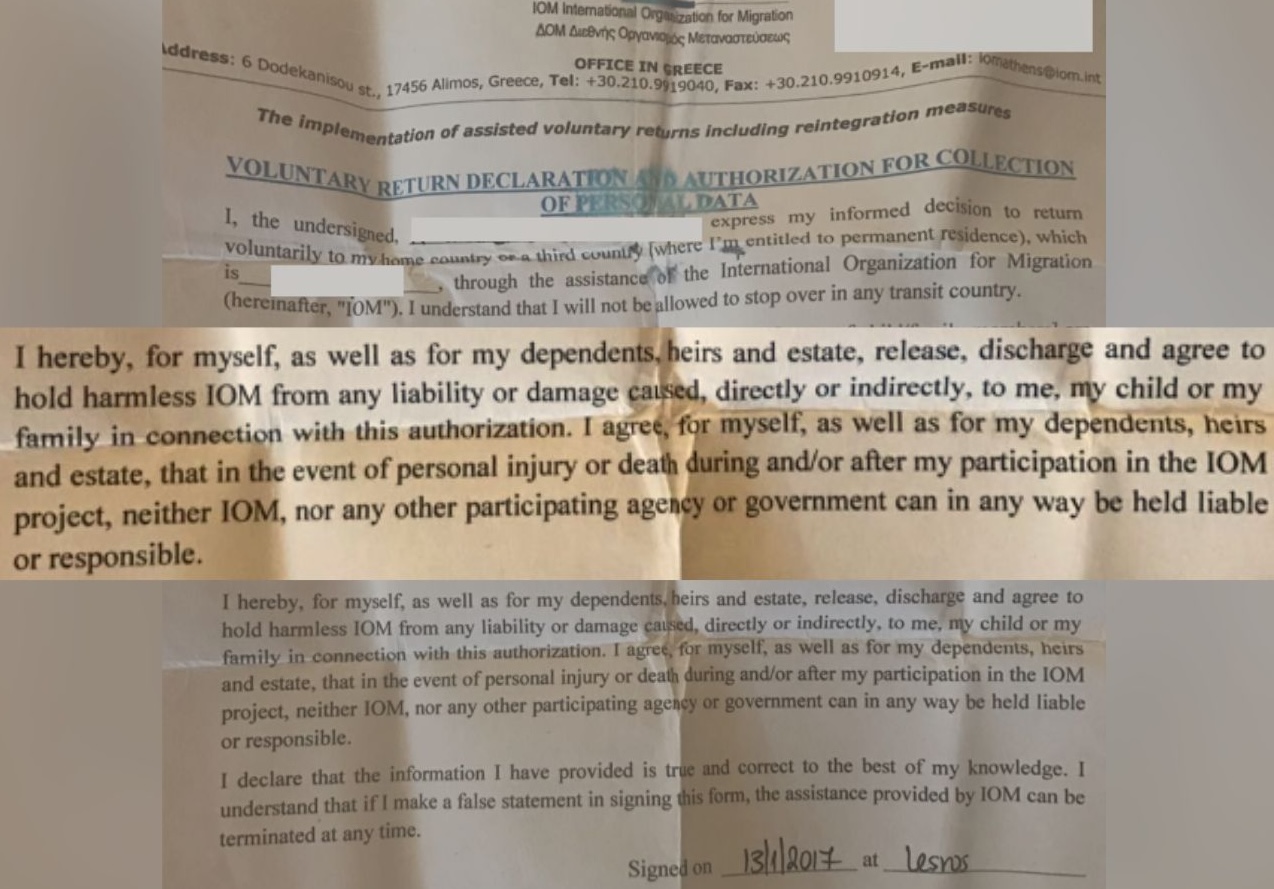
Valeria Hänsel, a migration expert at the German NGO Medico International, reported on the mistreatment of asylum seekers who signed up to IOM’s AVRR programme on the Greek island of Lesvos in 2017.
“It is shocking that IOM forces people to sign that neither they, nor any other actor, is liable in any way if people in the AVRR programme die or are harmed during their participation in the programme,” Hänsel said.
In her view, many of the abuses within the programme stemmed from the language used by IOM in its waiver, which would prevent victims from seeking recourse.
“People are driven to such despair that they agree to return to life-threatening situations, and yet the responsibility is shifted entirely onto the individual – even if those affected die in detention pending deportation.”
She added: “It goes without saying that such waivers are illegitimate and should not exist.”
Ultimately, unless IOM decides to change the way it responds to accountability efforts, it will continue to pay lip service to its touted principles of transparency and migrant protection in Greece. And not even the Greek government will be able to do anything about it.


