


Share & more
Battered by years of economic desperation and repressive rule, millions of Cubans have been struggling even more to get by since the US attacked Venezuela (Cuba’s main oil provider) and imposed a full oil blockade around the Caribbean island nation in January. In response, Progressive International, a coalition of dozens of leftist organisations – along with other activists, aid groups, and artists – organised a humanitarian aid convoy.
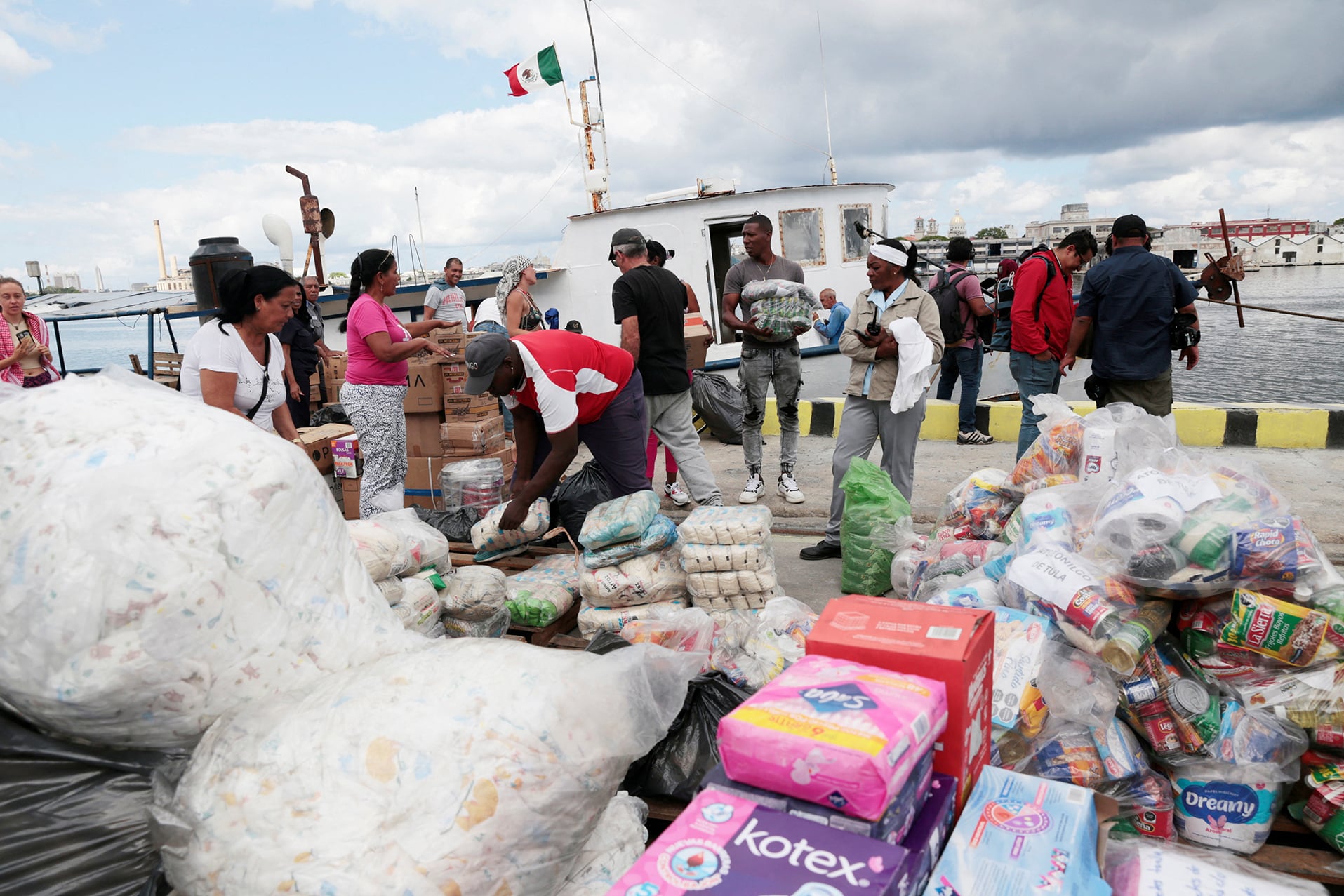
Called “Nuestra América” (“Our America”) – a nod to the anti-imperialist essay written by Cuban independence hero José Martí – the convoy was inspired by the Global Sumud Flotilla that brought aid to Gaza last year. It included several chartered planes from Milan, Miami, and Bogotá, as well as three boats from Mexico carrying medical supplies, solar panels, non-perishable food, and a range of other miscellaneous items, from sanitary pads to bicycles.
Arriving in Havana in late March, the 35 tonnes of aid came at a critical time. Since the start of the blockade, conditions in Cuba have rapidly deteriorated: Blackouts have grown longer, paralysing nearly all activities, limiting access to water and basic services, jeopardising hospital operations, and increasing food insecurity.
But while some expressed gratitude, others – both inside and outside Cuba – greeted the flotilla’s arrival with a lot more scepticism, fearing the aid won’t reach those who really need it and criticising the organisers’ ideological rhetoric.
“I have no words to describe the flotilla,” said Laura, a paediatric surgeon in Havana who refused to give her last name, fearing possible retaliation from the Cuban government. “Are we ever going to see any of this aid? Are the people on that ship aware of everything we’re going through? I don’t think so.”
Like many doctors in Cuba, Laura gave up her career because her salary was too low to make a living. She now works in the tourism industry – a key sector for the island but one that has also undergone a dramatic decline.
“The flotilla members are staying in luxury hotels… a world away from the realities the people are facing,” Laura added.
The participants of the Nuestra América convoy stayed at five star hotels that have light even during blackouts. They also used electric buses to move around the capital, while public transport in the country is paralysed, sparking indignation on social media and ridicule in parts of the humanitarian world.
“The flotilla got it wrong from the beginning. It made sense in Gaza, but Cuba isn’t Gaza. What we need here is oil; we haven’t had any issue entering aid,” said one longtime humanitarian worker in Cuba, who again asked to speak anonymously.
Since the beginning of the US oil blockade, Mexico has delivered more than 3,000 tonnes of aid and Brazil is sending more than 20,000 tonnes of food. The US, Canada, Chile, Spain, and the EU have also contributed funding or supplies.
A Russian oil tanker carrying 700,000 barrels of crude was allowed to dock in early April, providing some – if minimal – oil relief, and the US announced it would ease the blockade on a case-by-case basis, but the fuel and energy situation is still dire.
On 6 April, the UN resident coordinator in Cuba said in a press conference that the “humanitarian consequences [of the blockade] continue to deepen every day”. He added that about 96,000 surgeries have been postponed, that one million people depend on trucks for drinking water, and that food supply chains remain under severe stress. The UN, he added, has been struggling to distribute 170 containers with essential aid due to lack of fuel.
Falling foul of the ideological divide
The Nuestra América convoy was controversial from the get-go.
Presented as a gesture of international solidarity – and supported by high-profile figures such as Swedish activist Greta Thunberg and US congresswoman Rashida Tlaib – it was immediately decried by parts of the Cuban diaspora for failing to denounce Cuba’s authoritarian regime. Some critics also pointed to the fact that Mariela Castro, the daughter of former president Raúl Castro, sits on Progressive International’s advisory board as evidence that the flotilla lacked the independence that should be associated with humanitarian aid endeavours.
“Any domestic problem that any country may have is better than a foreign imperialist intervention.”
James Schneider, communications director for Progressive International, told The New Humanitarian that “[Mariela Castro] did not take part directly in the organisation or reception of the convoy”. Such statements, however, have done little to assuage critics’ concerns over the convoy’s ties to the government. President Miguel Díaz-Canel held several friendly meetings with a delegation of flotilla members, including British MP Jeremy Corbyn and French-American activist David Adler.
Members of the flotilla themselves pay little heed to all the criticism. “Any domestic problem that any country may have is better than a foreign imperialist intervention,” said Brazilian activist Thiago Ávila – one of 20 or so activists from Brazil, Mexico, the United States, and Italy who departed from Mexico’s Yucatán peninsula on an old fishing boat on 21 March.
Renamed “Granma 2.0” in reference to the boat that brought Fidel Castro and his followers to Cuba to start the revolution in the early 50s, the vessel carried humanitarian aid collected by groups linked to Mexican President Claudia Sheinbaum’s Morena party.
Aid diversion accusations
In addition to political and ideological divisions over the flotilla, many are also distrustful that the aid will be distributed fairly.
In Cuba, all humanitarian aid is managed through state institutions. Díaz-Canel’s government has been accused of improper delivery practices, and goods donated by Mexico have allegedly been resold in dollar stores.
“I have seen products in stores, whose packaging says ‘not for sale’,” said Juan Carlos Albizu-Campos, an economist and demographer living in Havana. “There is absolutely no transparency regarding how the government handles donations, how they are distributed, or who receives them.”
In early April, one of Mexico’s leading newspapers, El Universal, reported that the Cuban government had asked Mexico to withhold data on humanitarian aid for five years, claiming dissidents may sabotage distribution. Scheinbaum denied the allegations, saying her government “had nothing to hide”.
Étienne Labande, the World Food Programme’s country director in Cuba, told The New Humanitarian that they work smoothly with several ministries and have had no issue with distribution other than logistical problems due to the lack of fuel.
“We monitor everything we do, and we have a system for direct feedback from beneficiaries,” he said.
Some aid diversion accusations may be politically motivated but, given the magnitude of the needs, it is easy for Cubans to feel they are left out.
“I was affected by Hurricane Matthew [which devastated the eastern part of the island in 2016] and the promised donations never arrived,” said 30-year-old Jorge, who works in a small pizzeria in downtown Havana and asked for his last name to be withheld. “They announced that we would receive five items, but in the end we only got two. It’s all lies, control, and manipulation. It’s a way to lull the population into complacency.”
Limited transparency
On arrival at Havana’s cruise ship terminal on 24 March, the Granma 2.0 was greeted by a swarm of cameras and cheers from other flotilla participants.
Among the officials also present to witness its arrival was the president of the government-run Cuban Institute of Friendship with the Peoples (ICAP) – the entity tasked “with channelling [the flotilla’s donations] to institutions with social impact”.
Naima Martinez, the port director, told The New Humanitarian that the solar panels were going to Cuba’s National Electric System (SEN) to be redistributed to hospitals.
The next day, journalists and activists were invited to the William Sollers Paediatric Hospital of Havana to witness the distribution of most of the aid delivered by the ship. Two tonnes of aid carried by two other boats that arrived from Mexico was also delivered to the General Calixto García, a leading trauma centre in Havana, and to La Covadonga, a hospital that specialises in the treatment of epidemics.
Despite The New Humanitarian’s numerous inquiries, the ICAP provided no information regarding the final destination of the solar panels and other supplies. Yara Valera Ramírez, who works for the ICAP, attributed the lack of information to the blackouts.
But the aid did provide some relief to those who received it.
Lien García is the coordinator of the Cabildo Quisicuaba Museum, which houses a soup kitchen with 11,000 registered recipients in Havana. She said the ICAP had delivered five suitcases full of food and medicines brought to Cuba by members of the US-based Pastors for Peace organisation as part of the flotilla.
“On our end, we had no transparency issues; everything went very smoothly,” she said. “People criticise because not everything that is done is made public.”
For reporting purposes, TNH travelled on the Granma 2.0 boat.
Edited by Daniela Mohor.


