


Share & more
The UN’s support programmes for hundreds of survivors of sexual exploitation and abuse by its own peacekeepers in the Central African Republic (CAR) have failed to meet the needs of those affected, according to an internal audit.
The 30 July audit was posted on the website of the UN’s internal watchdog, the Office of Internal Oversight Services (OIOS), without public announcement. It follows an investigation by The New Humanitarian last year that exposed widespread abuse by peacekeepers in CAR and shortcomings in the UN’s assistance efforts.
The audit stands out as a rare internal examination of how the UN assists survivors of abuse by its personnel in CAR or elsewhere, and – against the backdrop of repeated UN vows of “zero tolerance” for these crimes – it delivers a critical verdict.
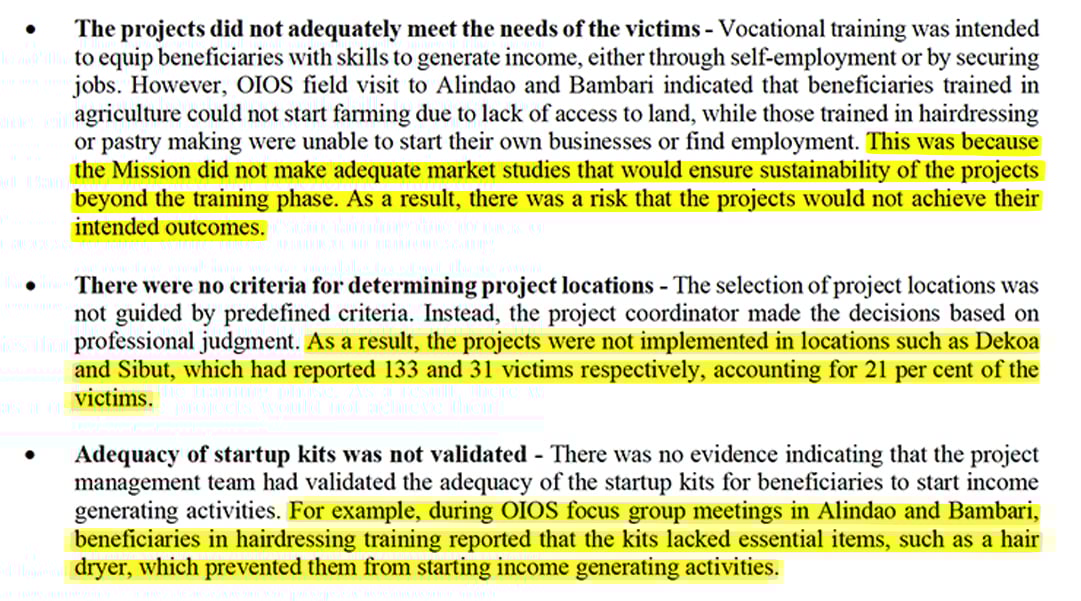
The CAR peacekeeping mission – known by its French acronym MINUSCA – did not consult survivors on the help they wanted before commencing projects, instead funding livelihoods trainings in soap- and pastry-making, hairdressing, sewing, and agriculture that were poorly designed and mismatched to local economies and contexts.
No criteria was used to determine project locations, with decisions left to the judgment of a MINUSCA project coordinator, a process that ended up missing many survivors, including in towns that experienced some of the worst abuses in recent years.
The organisation engaged by MINUSCA to implement the projects – an unnamed international NGO (INGO) – was selected without a competitive process, and agreements were approved without the required due diligence checks. MINUSCA, meanwhile, conducted no follow-up review, assessment, or evaluation of the projects.
CAR currently has some of the world's highest levels of humanitarian need, with 30% of its population severely food insecure, and around one in five displaced. This was produced not only by war and a neglectful government, but by a longer history of brutal slave raiding, and a French colonial system that saw half the population perish.
MINUSCA deployed in 2014 when an alliance of rebels called the Séléka ousted then-president François Bozizé, triggering widespread violence. Though the mission is credited for saving lives, its blue helmets have committed egregious cases of sexual abuse that have destroyed lives and severely tarnished the mission’s reputation.
Survivors and the local groups supporting them have long described a lack of assistance, raising concerns with The New Humanitarian in investigations in 2018 and 2024. Similar findings have also emerged from a 2023 investigation into assistance in the Democratic Republic of the Congo, where the UN has a major presence.
“At first I thought we would register and receive support, but it didn’t come,” said a woman who was exploited by a Gabonese peacekeeper and who spoke to The New Humanitarian in 2018. The woman said she received a one-off payment of around $35, a kit with sugar, soap, a toothbrush, and toothpaste, and a jerrycan.
Contacted on 4 September, MINUSCA spokesperson Florence Marchal said the mission had accepted the audit recommendations in July, noting they “are currently being implemented”. She did not respond to questions about whether the mission planned to share the findings with survivors in accessible languages and formats.
Survivors unconsulted
The audit began in November 2024 and was carried out “due to the reputational and operational risks of not effectively implementing these projects”. Three months earlier, The New Humanitarian had asked UN officials whether reviews had been conducted into support projects in CAR and was told OIOS had been asked to do so.
The UN says it is doing more to support survivors of sexual abuse by its own personnel, and the audit provides an opportunity for programmes to be independently scrutinised in a country that has seen a huge number of allegations mostly involving peacekeepers, with more than 800 survivors since 2015, according to a public UN database.
The audit examined five skills-training projects provided to survivors between January 2023 and March 2025. The projects were funded through a UN trust fund and MINUSCA’s own resources, and cost around $800,000 – a tiny fraction of the mission’s budget, which pays some top staff six-figure salaries.
Training was delivered in 14 locations to 628 survivors and women and girls exposed to abuse – offering both skills coaching and startup kits to help participants begin business activities upon completion – but the audit found “the projects did not adequately meet the needs of the victims”.
MINUSCA and the INGO did not conduct local needs assessments before launching projects, or carry out surveys and focus group meetings with survivors to understand their preferred forms of support. Instead, the INGO replicated training it had implemented in another unnamed country, “without customising it to the local context”.
In some places survivors trained in agriculture ended up not being able to start farming because of a lack of access to land, while those trained in hairdressing and pastry-making were unable to start businesses or find employment because adequate market studies were not done.
There was no evidence that the suitability of the startup kits had been “validated”, according to the audit, which states that participants for hairdressing training in two towns could not start work afterwards because the kits lacked essential items, such as hairdryers.
Curricula were missing for the hairdressing and pastry-making programmes, and some trainers – whose experience and qualifications could not be verified by auditors – said the INGO provided no guidelines, forcing them to devise their own lesson plans. In one case, participants stopped attending a sewing course because of “inadequate training materials”, and three trainers reported not being paid since their recruitment in December 2024.
The INGO also failed to establish a criteria for determining participants’ successful completion of trainings, for example by determining how many absences would be permitted for a trainee to complete a course and receive a certificate.
Asked by The New Humanitarian during a 2024 investigation what they wanted from MINUSCA, survivors said they preferred financial compensation and money to invest in their own businesses or revive those that had collapsed as they dealt with the aftermath of the abuse.
“If I had a bit of money, I could sell more and feed my children,” said a woman who reported being raped by two Mauritanian peacekeepers in late 2023 before moving to Bangui. She explained that every dish she prepares for her family must be stretched over several days.
Weak oversight and no evaluations
The audit found the projects were implemented without criteria to determine the right locations, which resulted in trainings not being held in towns such as Dekoa and Sibut, where 133 and 31 survivors had come forward respectively, accounting for 21% of those affected.
The INGO was, meanwhile, chosen without a competitive process, simply because MINUSCA’s project coordinator had prior experience of working with them in another country, and the mission did not establish key indicators to measure its performance.
At the time of selection, the INGO did “not have an operation or an office in CAR”, the audit stated, adding that there were nearly 200 UN agencies, INGOs, and national NGOs operating in CAR that had experience working with survivors.
“This indicated the availability of a sufficient number of competent organisations with experience in vocational training that could have been invited to submit proposals, allowing for a competitive selection process in the best interests of the Organisation,” the audit stated.
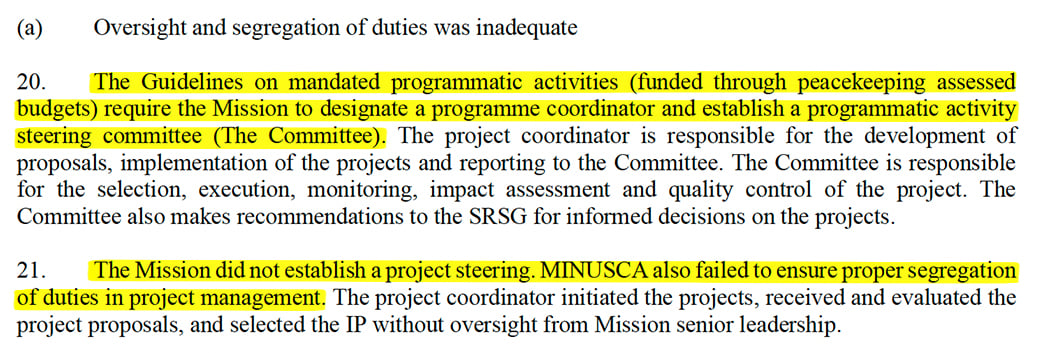
MINUSCA failed to establish a project steering committee – which is required by its own guidelines and which would have been responsible for monitoring, impact assessment, and quality control – and the requisite updates on projects were not provided.
The mission also failed to monitor the implementation of recommendations from project oversight entities, such as to address delays in the delivery of training materials, and to resolve unclear project timelines, a lack of startup kits, and the exclusion of food and transport costs for those travelling to training centres.
Post-project evaluations, follow-up reviews, and assessments of the overall impact and functioning of the trainings were not conducted as required, leaving the mission bereft of “critical information for improving the overall programme management”, the audit stated.
The audit did not examine other forms of support that are supposed to be provided by the UN once an individual comes forward, including safety measures, and medical, psychological, and legal assistance, which survivors and local organisations say are often lacking.
Senior UN officials have told The New Humanitarian that the organisation is unable to provide the level of assistance to survivors that it wants to because of inadequate funding from member states.
Edited by Andrew Gully.


