


I’m writing this now from Marseille, in the south of France. It’s been three months since my family – my mother, my father, my sister, and I – were able to evacuate from the Gaza Strip after surviving nearly 570 days of genocide.
The last time I wrote, it was about how the final weeks I spent in Gaza were the hardest of the entire war – yet I didn’t want to leave. The last night, on 22 April, as relatives and friends gathered to say goodbye in the house where we had sought refuge in Deir al-Balah, I stood outside under the familiar sky, and broke down. The guilt, the sadness, it was all too much.
I had been waiting for months for this moment – suspended between rumors and silence, between hope and dread. In the weeks leading up to it, I was told again and again: “It might happen. It might not.” I packed and unpacked my bag so many times, I lost count. And now that the moment was here, I felt crushed by the weight of it all.
Eventually, I went back into the house. When it was time to sleep, because we needed some rest before the journey, everyone began hugging each other. I stood in the corner. I didn’t want to hug anyone. I didn’t want to say goodbye.
I didn’t sleep that night. There was a tightness in my chest, a heaviness. Time moved slowly, painfully. We were supposed to leave for the gathering point at 4am.
When the clock struck 3am, I looked at my father and said, “I don’t want to go. That’s my decision.”
A violent argument erupted, not just between me and him but between me and the whole world. That night I cursed everything. I cursed this genocide. I cursed everything that had led us to this moment. I cursed those who scattered us, who destroyed our homes, our relationships, our dreams.
Why did I have to say goodbye? Why did I have to leave? Why must I bear what I never chose in the first place? To hell with it all. I kept repeating it, as if trying to release the fire inside me, as if cursing was the only weapon I had left.
Deep down inside, I knew my father would never allow me to stay. That was the hardest thought to accept. Gradually, the fight drained out of me, and I agreed to go.
The journey out
The gathering point was in an area near the Deir al-Balah market – a place once full of noise, smells, and life. That morning, before dawn, it was stripped of all of that. It had become a space of waiting, fear, and silent calculation. The other people we were being evacuated with arrived in the dark, clutching papers and small bags. We didn’t know any of them. There were 115 of us in total. No one spoke unless necessary. It felt like we were all standing on the edge of something irreversible.
The French consulate told us that we weren’t allowed to carry anything with us. Only our papers. But I hid my notebook and two pens in the pocket of my pants, clinging to the last things that felt like they connected me to myself. Even taking photos was forbidden until we reached the Kerem Shalom border crossing, where we would transit across Israel to Jordan.
I boarded the bus, arranged by the consulate, at the meeting point, tears burning my face. We started driving south, and the ruins spread out before us, in every direction. Everywhere. The houses were no longer houses. The roads, no longer roads. Everything around me was destroyed, erased, stripped of meaning. I wept. And I was afraid. Fear crept into my chest like invisible smoke.
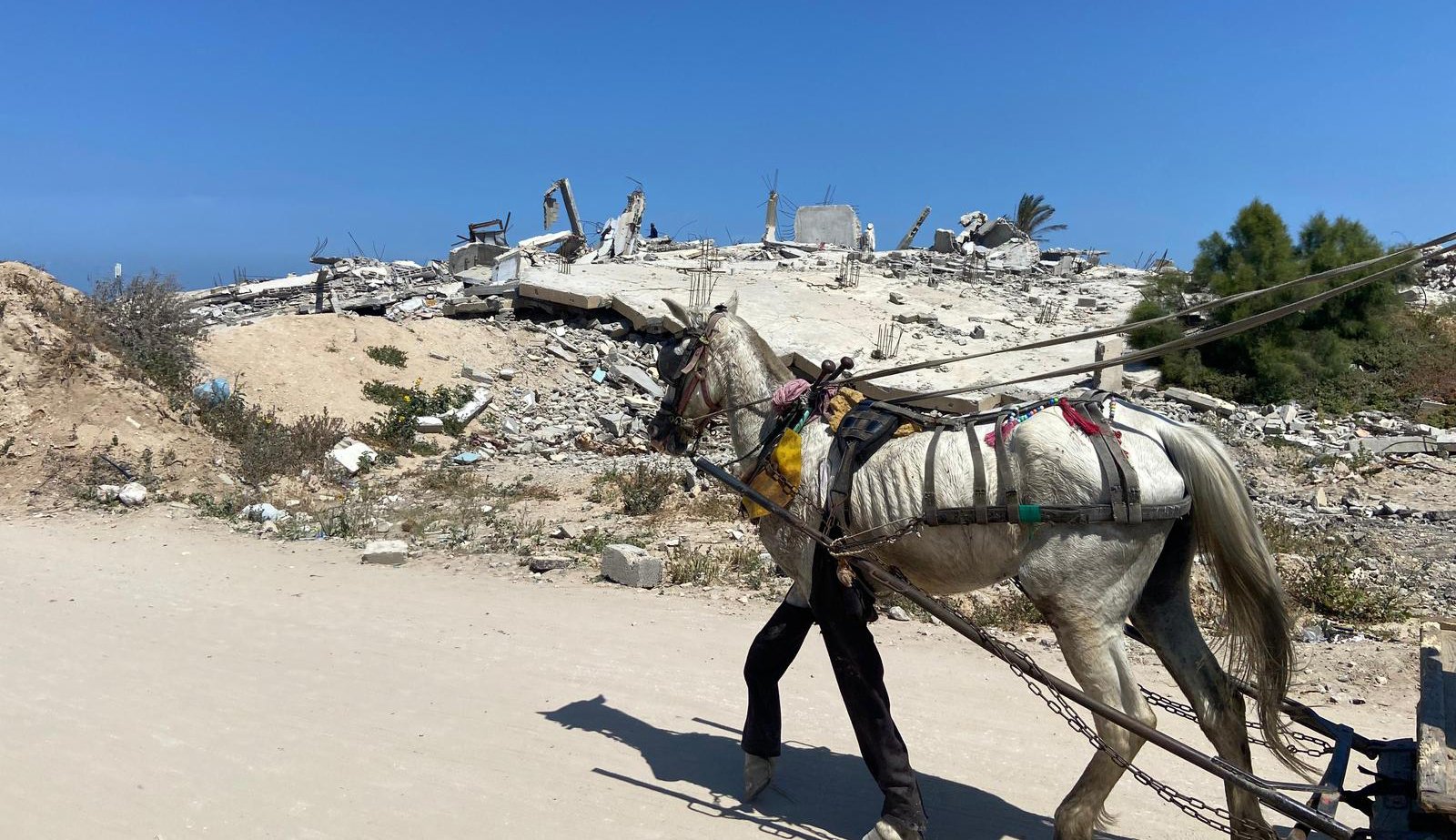
We passed through Khan Younis then Rafah. The last time I had seen Rafah was on 7 May last year. Like so many others in Gaza, my family fled there after our home in Gaza City was destroyed at the beginning of the war. We stayed in Rafah for six months, and were forcibly displaced four more times before the final Israeli invasion. During that time, I learned Rafah’s streets and corners – the neighbourhoods and houses where we took refuge. Even the sounds that filled the night became familiar.
When I saw it again, nothing remained but ash and rubble. Israel had turned it into a ghost town, stripped of everything. Rafah, which had once been a place of shelter, had now become a crushed memory. Stray dogs were everywhere, as if guarding the ruins, or as if they too were lost like us, with no direction, no home.
And the migrating birds – I don’t know if it was a coincidence that they flew above us, if they were saying goodbye in their own way, or maybe they were just carrying the weight of my emotions with them into the sky.
As we approached the Kerem Shalom crossing, it felt like a final test. There were tanks filling the area. Soldiers, fully armed, showed off their weapons as if we were the enemy, as if we were leaving with dignity and they had to crush whatever sense of ourselves still remained.
I saw Israeli flags fluttering everywhere in Rafah. Nothing screamed at me like those flags – as if they were saying: “This is not your land”.
The rubble surrounded us from all sides. Everywhere – collapsed homes, torn roads, the shadow of death never leaving. I held on to my notebook tightly, writing down everything my eyes saw, everything my confused heart felt, recording it so that memory would not betray me, so that the truth would not be forgotten.
I saw Israeli flags fluttering everywhere in Rafah. Nothing screamed at me like those flags – as if they were saying: “This is not your land”.
I swallowed my anger in silence, feeling like even the air itself was occupied.
The cold, iron gate
Finally, we approached the cold, iron gate. This entire time, this is what had separated us from the rest of the world – the world outside where people don’t live in fear of death falling from the sky as they slowly starve from deliberately imposed hunger. A cold, iron gate, heavy with fear. Behind it stood soldiers, armed to the teeth, as if they weren’t guarding an entrance but standing over the corpse of a city, preventing it from rising.
The surrounding area was terrifying. There were no buildings and no signs of life. Just soldiers, armoured green and black jeeps, and tanks lined up in every direction, like beasts on display. The air was thick and tense. The soldiers were alert, their fingers near the triggers of their weapons, scanning every movement. They moved with the confidence of the victor – intimidating, reminding us who held the power.
I looked at them through the bus window while everything inside me screamed. How can a single gate separate me from my life? How can one symbol erase me?
As I got off the bus, the ground beneath my feet felt cold. Exile was just steps ahead of me.
The soldiers were there, the procedures, the searches, the heavy stares. Everything was designed to strip us of whatever remained of our senses of self, of dignity.
I kept my notebook and pen hidden. They felt like the last parts of myself that I still owned, that I still had control over. It was as if the ink inside them was a crime and words, a weapon that were not allowed to be carried. My hand stayed inside my pocket the entire time, feeling the slightly torn cover of the notebook. I whispered to myself: “Don’t let it fall. Don’t let it be confiscated. This is your memory.”
The soldiers searched us as if we weren’t humans but some temporary thing passing by, but they weren’t thorough. I pretended to be calm.
Thank God we survived
When we finally crossed through, when we passed the soldiers and their cold stares, when the gate closed behind us and we weren’t called back, I felt something break inside me again and then something else slowly begin to heal.
On the faces of the other people on the bus, signs of relief began to appear. Eyes that had been vacant began to well with tears. Some cried out loud, some covered their faces with their hands, as if they couldn’t believe it.
Only in that moment did I realise that we had been prisoners and that what had just happened was a release – even if temporary – from the grip of death. But freedom, which had come so late, arrived exhausted, unable to heal everything that had been broken inside.
On the other side, staff from the French embassy were waiting for us with smiles, greetings, and boxes of food. They were kind, but I looked at them with disoriented eyes, as if I had come out of a dark cave and no longer recognised the shape of light. Only in that moment did I realise that we had been prisoners and that what had just happened was a release – even if temporary – from the grip of death. But freedom, which had come so late, arrived exhausted, unable to heal everything that had been broken inside.
Nothing about the moment felt permanent – not the safety, not the freedom, not even the ground beneath our feet. We had been released, but the war was still inside us. Our families were still trapped. The siege hadn’t ended. I felt as if we were only being loaned this breath of air, this space, this brief distance from death – and at any moment it could all be taken back.
I sat watching everyone as they ate as if the food wasn’t just food but a return to life, to the body, to something resembling normalcy. People’s faces were exhausted, but slowly colour began to return to them, as if a single bite was enough to remind us that we were still human.
What truly comforted me was the children. Faint laughter and tiny voices asking for more bread or juice. They were mending the atmosphere, letting light seep into the room. I saw their parents watching them silently, with eyes full of wonder and gratitude. Their gaze said it all: Thank God we survived.
It wasn’t victory. It wasn’t joy. It was just survival. But that was enough to make my heart believe, if only for a moment, that I was alive.
The first night
After leaving Kerem Shalom, we headed on a bus toward the Jordanian border. The journey was long and heavy. We were all worn out, our bodies tired, our souls too drained to express anything. Silence had become the only language we could speak.
We reached the Jordan River Crossing, just north of the West Bank, at the break of dawn and continued on to Amman, the capital. As we approached, signs of relief began to appear on our faces. The realisation that we had truly survived was slowly sinking in, even if only partially, even if only for now.
The French embassy had arranged a hotel for us to stay in for just one night because our flights were the following day. But that night, despite how short it was, was the first time we slept without the sound of explosions, without sirens, without fearing that soldiers could knock on the door or that someone would arrive bearing news of a new evacuation order, that a relative had been killed, or that a friend had been buried beneath the rubble. There was nobody desperately begging for food, for shelter, for help I couldn’t provide.
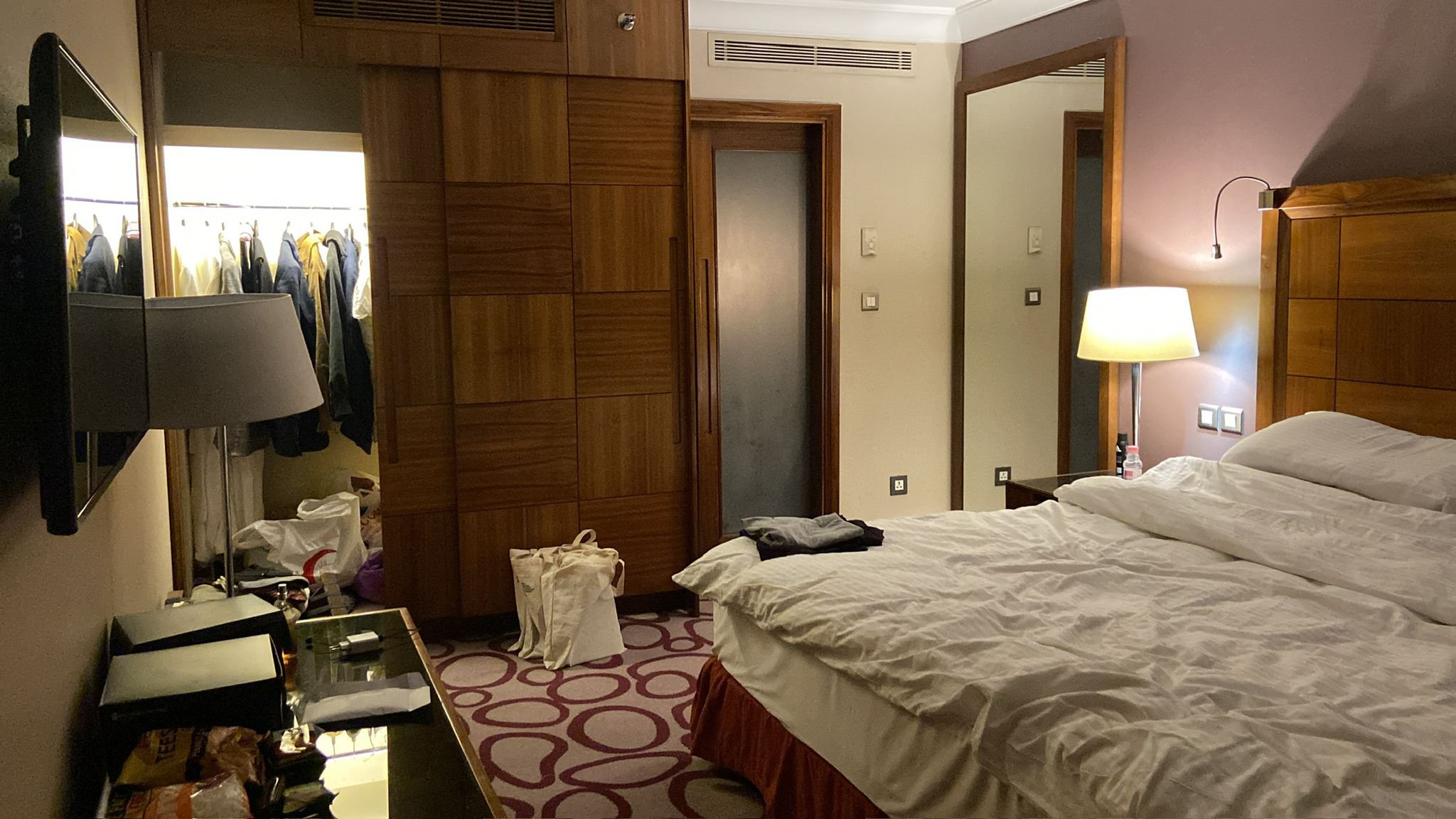
In Gaza, any sound could be the beginning of an ending. So, we looked forward to sleep that night as if it would help us to reclaim our bodies, to retrieve some fragments of the humanity we had lost along the way.
Yet despite everything, I wasn’t at ease. I sat in the air-conditioned hotel room, guilt silently gnawing at me. I couldn’t process anything. The room didn’t resemble my room in our now-destroyed home. The silence wasn’t Gaza’s silence, and the night was nothing like the nights of war I had grown used to.
All I knew was that I had left. Yes, I had left, but carrying deep wounds, and I would remain this way for a time I couldn’t define. And it wasn’t just me. Everyone who left with me felt the same. We were 115 people, each one carrying a city of pain inside – a demolished home in their heart, an incomplete goodbye, a quiet voice whispering, “I want to go back”.
Gaza didn’t leave me
In Gaza, I dreamed of being able to shower like a normal person. Being forced to go for days without bathing because the water supply had been cut off unsettled me.
Now, I was in a hotel room with hot, running water. I decided to take a shower. I thought it would be refreshing – that I would feel relieved and comforted. But the moment I turned on the faucet, I cried. I cried hard, as if everything I had buried inside me spilled out with the first drop of warm water.
I realised the wound wasn’t just in my memory, it was in my body as well, in the habits we were forced to develop, in the smallest details, in the water that was once unreachable, in tears that don’t stop even after the bombing does.
I hadn’t been able to use a proper shower in almost 570 days. I had bathed with cold water, sometimes using plastic bottles, sometimes under the open sky. The cold would pierce me to the bone.
And now, suddenly, I held a faucet in my hand, the water warm. I could control the temperature. It was something so ordinary but that I had been deprived of throughout the entire war.
In that moment, I realised the wound wasn’t just in my memory, it was in my body as well, in the habits we were forced to develop, in the smallest details, in the water that was once unreachable, in tears that don’t stop even after the bombing does.
As much as I longed for it, I couldn’t sleep that night, despite the clean bed, the soft pillows, the safe walls. I was crying and working at the same time. Writing, publishing, documenting. Because Gaza was present in my heart, in my body, in my fingers that wouldn’t stop tapping the keys.
Gaza didn’t leave me, and I never truly left it. Physically, yes, but it was with me in the small bag with my identity papers and some money that I brought with me, in my notebook that I managed to keep hidden, in every line I wrote – as if each one was a form of resistance.
Survival feels like a wound, not a gift
The next day we flew to France. When we arrived, I knew I would see familiar faces. Friends from Gaza who had left before October 2023 and who I hadn’t met in years. Only they could understand the grief and the silence I carried in my chest.
When I saw them, I hugged them and wept again, like a small child. That embrace was the first time I felt I wasn’t alone – that someone understood without explanation that survival feels like a wound, not a gift.
In the weeks leading up to our departure, it wasn’t just the fear of the bombs and the hunger that gnawed at me – it was the uncertainty surrounding exile and what it truly means. I had left Gaza before to go to the West Bank, Jordan, and Egypt. But this time, rumours spread like wildfire: that those who leave might never be allowed to return.
This war isn’t only about destruction, but also about erasure – making Gaza unlivable and pushing us out with no way back. It is a slow, deliberate ethnic cleansing.
Now I know, returning is nearly impossible. Those who leave don’t come back, because Israel simply doesn’t allow it. This war isn’t only about destruction, but also about erasure – making Gaza unlivable and pushing us out with no way back. It is a slow, deliberate ethnic cleansing. And for many, staying – even if it means dying – is the only way to insist: We are still here, on our land. That is why I didn’t want to leave.
But here I am now, in Marseille, writing. I’m still unable to believe it. I still cry deeply. Every scene I witnessed is etched inside me. I relive moments over and over again. I am here in France, but my heart is still in Gaza. My mind is still in Gaza. It’s as if I’m still on the road, holding my notebook, hiding from soldiers. I still hear the sounds of shelling, smell the dust of ruins, see the migrating birds in the sky.
Gaza is not a memory. It is a pulse inside me that will not stop. I feel like I am still there, caught between the rubble and the fire. I work, I write, I document. I cling to life through words. But I’m depressed, broken, carrying Gaza inside me like an open wound that won’t heal.
I speak to those who remain there. We cry together over the lack of food. I feel guilty when I eat, so I stop eating. I left Gaza to face another kind of death – a quiet, unseen death that eats away at me from within. I write because writing is the only thing I have left. The only thing no one can confiscate. Everything inside me is stained with despair, with questions.
Maybe I survived Gaza, but Gaza has not survived. Since arriving in Marseille, all I’ve felt is guilt. The guilt of staying alive, the guilt of leaving. The painful privilege of survival. I feel a powerful desire to return. I miss Gaza in a way that cannot be described, as if part of my soul is still there, waiting for me among the ruins.
I go to the port here in Marseille, the only place that reminds me of Gaza. I stand there before the sea, staring into the water, searching for a familiar shadow, and I cry, bitterly. No one calls this survival, because I know, as all who have seen what I’ve seen know, that this is not survival but another kind of death.
Edited by Eric Reidy.


