

Share & more
Seconds before the two earthquakes that would forever change her life hit Venezuela at about 6pm on 24 June, Jenny Mosquera heard an alarm beep on her smartphone. Like many, she didn’t have time to figure out it was a natural disaster alert before her building started shaking.
“Everything happened in a matter of seconds. The alarm went off three times, but I didn’t understand what it was. We just felt the shaking and fell [to the ground],” Mosquera said, standing near the rubble of her home in a coastal residential area of La Guaira, the worst-hit state north of Caracas.
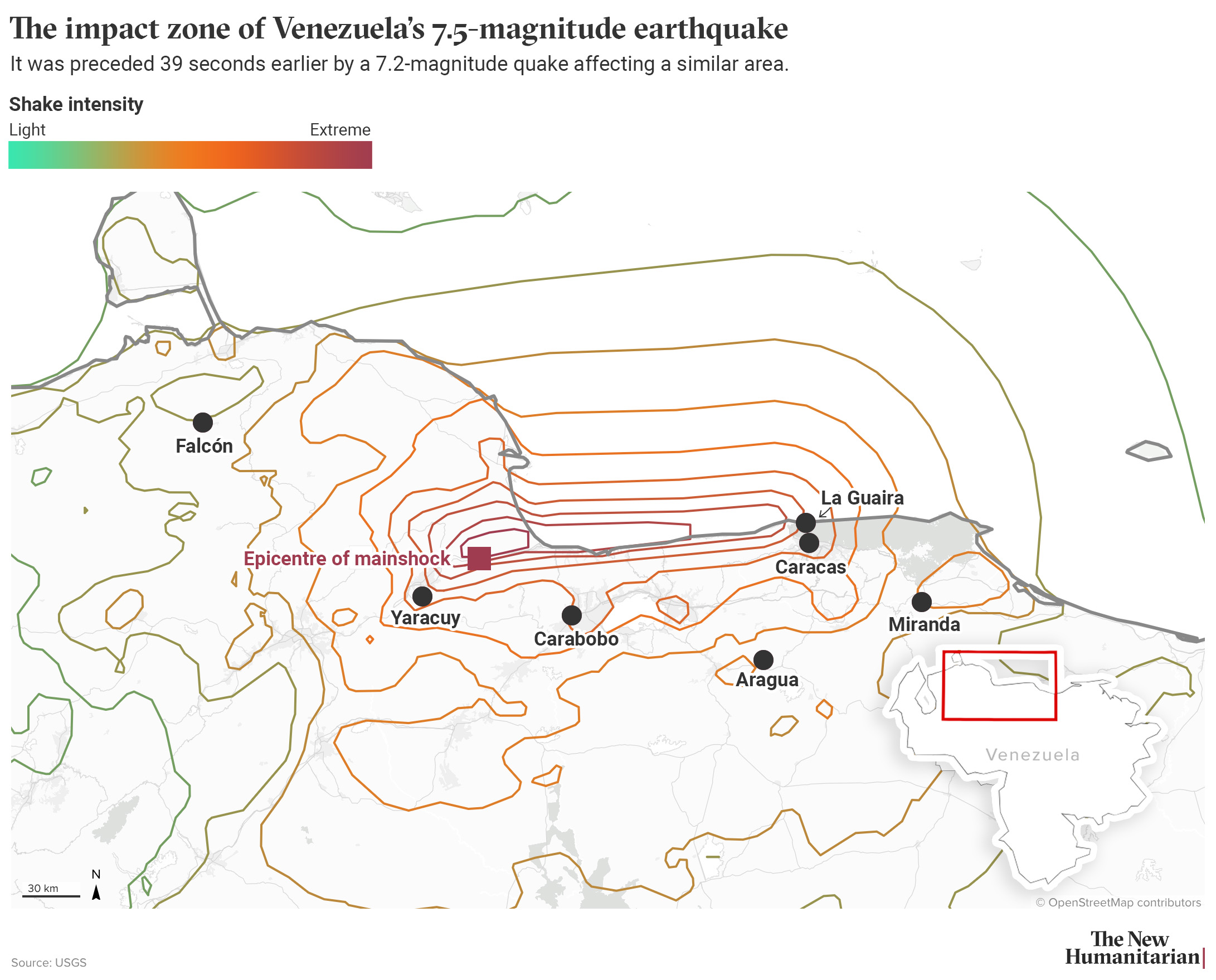
When The New Humanitarian met her, nearly 48 hours had passed since two quakes measuring 7.2 and 7.5 in magnitude – the most powerful to hit Venezuela in more than a century – shook the country, leaving behind a trail of death and devastation.
By 29 June, official data already registered 1,719 people dead, more than 5,000 injured, and nearly 16,000 people displaced. But the number of casualties is expected to continue soaring, as tens of thousands remain listed as missing and the window to find survivors is closing fast.
Hardest hit areas include La Guaira; the country’s capital, Caracas; and states on the northern coast, such as Carabobo, Falcón, and Miranda.
“The situation is catastrophic. It’s something never seen before, devastating,” César Jiménez, projects and grants manager for US-based global health and aid group Project Hope, told The New Humanitarian. “No country is prepared for a catastrophe of this magnitude.”
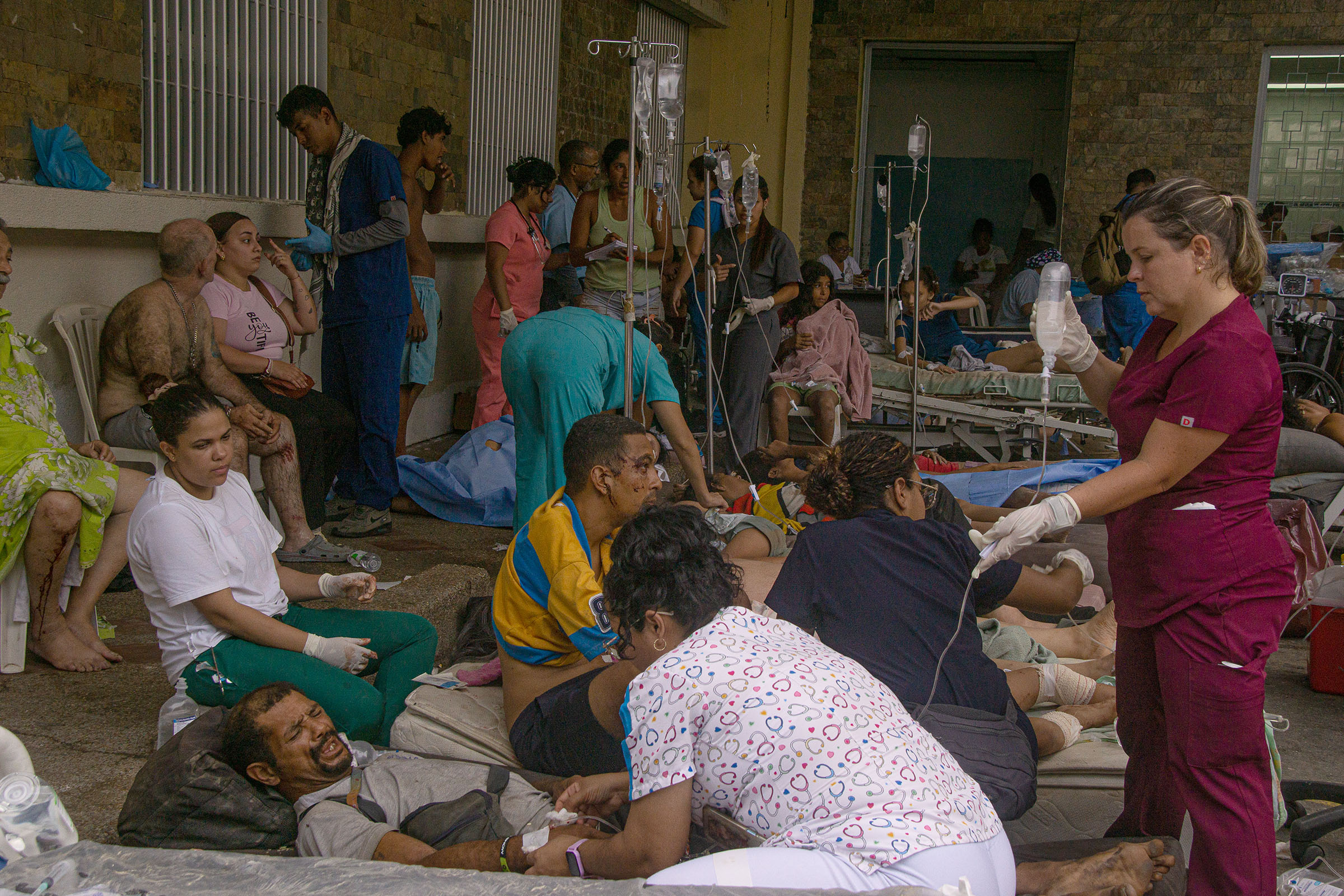
Jiménez, who has been assessing needs in La Guaira with his team, said videos being posted on social media don’t reflect the scale of the disaster. He said the electricity grid still hadn’t been reestablished in many areas, complicating rescue efforts at night. He said hospitals were completely overwhelmed, with the smell of decomposing bodies beneath the debris becoming more pronounced with each passing day.
Mosquera, 44, was in her sixth-floor apartment with her husband Roberto and their 13-year-old daughter Andrea when the quakes struck. They were all in a bedroom, but the shaking was so intense it threw her family into the living room, while she remained stuck under the door frame.
“The last thing I heard my daughter say was, ’Mom, what is this?’”, she said. “Then I saw a slab of plaster falling from the wall onto them. They died in each other’s arms.”
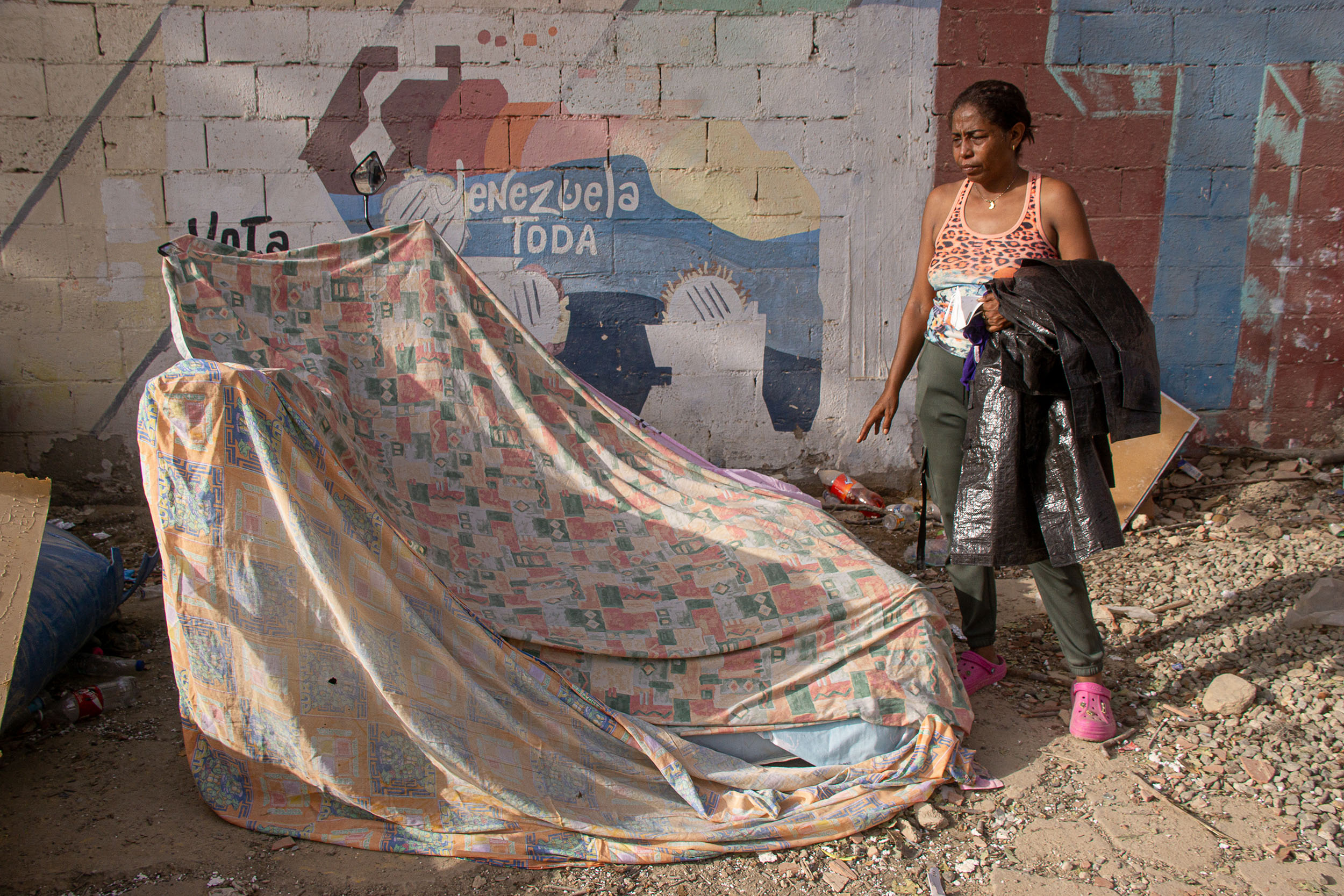
Mosquera managed to survive without serious injuries, crawling through the rubble towards an opening near her. Nearly 48 hours later, she was still at the site waiting for her family’s bodies to be recovered. She said she received food, water, and medical care for her wounds from volunteers, but that the arrival of the machinery and rescue tools had been slow.
“This has been a disaster,” said Mosquera. “It is the people who have been very humanitarian, because it is those [volunteer rescuers] arriving from other areas who have helped us.”
Once her husband and daughter had finally been recovered by surviving residents and volunteer rescue workers, she sheltered their bodies from the sun under an improvised tent she fashioned by tying a sheet to a motorcycle.
There was no forensic protocol; no one to take them to a morgue.
“I don’t even have the breath left to cry,” she said. “My heart is broken.”
Dozens of countries – from those nearby like the United States, Mexico, and Colombia to those far away such as France, Switzerland, and Qatar – have deployed rescue teams and sent aid. According to official figures, this international assistance amounts to 2,624 specialists in search, rescue, and humanitarian support.
But given the magnitude of the devastation in a country that was already battered by a decade-long humanitarian and political crisis, many worry it isn’t enough.
The 24 June natural disaster dealt yet another blow to Venezuelans. Earlier this year, many hoped for a change after the US military attack and kidnapping of authoritarian president Nicolás Maduro in January. But despite President Donald Trump’s promises, the US intervention has failed to bring prosperity, Maduro’s closest allies remain in power, and there are no elections in sight.
Inflation continues to be one of the highest in the world, while the monthly minimum wage of $240 – composed mostly of state bonuses – is dwarfed by the $770 cost of a basic monthly food basket. According to the National Survey on Living Conditions (ENCOVI), only 29% of households had access to running water on a daily basis in 2025, while 39% of them had no power for several hours a day.
“We are living a serious crisis within a major crisis,” said Claudia González, institutional relations and external engagement manager at World Vision Latin America. “For us to be hit by two earthquakes is the icing on the cake that was missing to create total chaos and a bleak outlook for the country.”
Community members as first responders
As soon as the quakes occurred, a vast array of Venezuelans started mobilising, organising volunteer aid efforts in La Guaira, Caracas, and other parts of the country’s interior.
Everyone from private businesspeople to the diaspora, from local officials in unaffected Venezuelan states to random citizens, began raising donations or participating directly in rescue tasks and body recoveries. They have set up fundraising efforts, relief collection centres, and shelters. They have supplied and delivered basic items such as food and water to those in need. They have created search pages for missing persons and even a platform to monitor supply and medicine requests across hospitals.
Motorbike, car, and truck owners have volunteered to transport goods and scout around parts of Caracas to identify people in need, including those who may not have lost their homes but have been left without electricity, gas, or stores to purchase food or medicine.
“Right from the start, before any delegation or [official] civil protection team reached La Guaira, there were people with gloves or their bare hands removing debris, and they are still there,” said Project Hope’s Jiménez, underlining the civilian response effort’s high level of coordination. “Everything has been organised, and the collection centres have worked very well. It’s happening spontaneously, and it includes volunteers from the general public.”
It does, however, highlight a painful reality: the state response is viewed by many as a total failure. Many Venezuelans have taken to social media to strongly criticise acting President Delcy Rodríguez and her government for the lack of machinery and rescuers to find survivors in the most crucial hours after disaster struck.
“In the absence of government, we have the people", has become a widely repeated refrain among volunteers looking for survivors. One Venezuelan humanitarian worker said it took two whole days for state assistance to get into gear, with international rescue teams arriving on the ground sooner than the country’s own official responders.
Anaís, whose last name is being withheld to avoid government reprisals, said she was unsettled by what she saw when she reached La Guaira 36 hours after the quakes with the brigade of 50 volunteer rescuers she leads from a training academy in the northwestern city of Barquisimeto.
“Most of the extractions were done by people searching for their relatives, neighbours, and volunteers coming in from other states across the country,” she said. “Too much time had already been lost, and a delayed response means it’s no longer about rescues, but body recovery.”
Her brigade, Anaís added, has to rely on donated medical supplies and other tools. But as days go by even international rescuers have run out of equipment. On 28 June, a Mexican rescuer went on camera saying they needed more body bags, ropes, harnesses, and key clips to be able to continue working.
On 26 June, after a rush of motorbikers carrying aid blocked the path of ambulances taking the injured to hospitals, the government deployed the military in La Guaira and restricted access, making volunteers secure a permit from an office in Caracas before entering the state.
For many of those racing to find survivors, this extra bureaucracy has sparked anger and desperation.
“The government doesn’t want to help us. On the contrary, it’s putting up obstacles to prevent the machinery we need to clear the debris from getting in. We keep working with picks and shovels, but it’s not enough,” Wilmer, whose family members were still trapped under the rubble of a building in the town of Caraballeda, told The New Humanitarian in clear distress.
Speaking on 29 June, he said a French rescue team had managed to pull out 12 people alive, and that survivors and volunteers wanted to continue searching.
“We know there are still people there because last night we heard cries for help,” he said. “But without the necessary tools, we can’t do it. There are private citizens who have offered to help us with machinery, but the government won’t let them go through without the permit.”
The New Humanitarian tried to talk with a civil protection officer at the site, but he said he was not authorised to speak with the press.
The government hasn’t so far directly responded to accusations it has been slow to respond other than by posting videos of machinery being sent to La Guaira and Rodríguez visiting affected areas. To justify access restrictions to La Guaira, the acting president stated that the decision responded to preventive health measures.
“The system has completely collapsed”
Away from the rescue sites, the situation for many is also difficult and distressing.
González, from World Vision, said she has been hosting family members who lost their homes in La Guaira, and that many others are doing the same.
But thousands of Venezuelans still have no safe place to stay. In Caracas alone, there are at least a dozen shelters, many of them improvised in parks and squares giving basic refuge to residents who have lost homes in La Guaira and other areas.
At Alí Primera West Park in Caracas, there’s no registry of those staying. Some people have tents, while others – including women, children, and the elderly – sleep outdoors on sheets they lay on the ground. The shelter is protected by gates. Anyone who wants to pass in or out has to go through a checkpoint, which is dissuading some citizens fearful of security forces from bringing donations, amid a lack of trust in the authorities to distribute aid properly.
“The first two days we received a tremendous amount of help from volunteers, but now we’re only able to get one meal per person per day, and the lines are incredibly long,” said one displaced woman who asked to speak anonymously. “Now, they’re restricting access, and people aren’t coming to donate like they used to. Some prefer to hand over aid through the park’s fences to avoid the entry checks. Everything has slowed down considerably.”
“The system has completely collapsed. The number of people currently in need of care far exceeds the capacity of these healthcare facilities, and despite the presence of many volunteers and doctors – and the arrival of full or partial shipments of supplies at the facilities – it is impossible to provide care for everyone, no matter how much we would like to.”
In the hospitals, meanwhile, chaos reigns.
The Venezuelan health system has long suffered from severe medical supply and medicine shortages, and has struggled with power outages that can put patients’ lives at risk. Jiménez from Project Hope said three of the 16 health centres his team assessed in the states of La Guaira and Miranda had to be immediately evacuated due to structural damage and many others have also been affected and can’t operate at full capacity.
“The system has completely collapsed. The number of people currently in need of care far exceeds the capacity of these healthcare facilities, and despite the presence of many volunteers and doctors – and the arrival of full or partial shipments of supplies at the facilities – it is impossible to provide care for everyone, no matter how much we would like to,” he said.
Ciarán Donnelly, senior vice president of international programs at the International Rescue Committee (IRC), stressed that the number of people with mental health needs is also huge. “There is the terrifying impact of the earthquake itself, the trauma of people who have missing family members, the grief of those who left their homes with only their clothes on their back, the continual fear of aftershocks, and the uncertainty of what comes next,” he said.
Funding cuts and reconstruction
The initial international response has been quick to materialise. In addition to sending rescue teams, many countries have provided equipment, medicines, and medical supplies.
The European Union, for instance, delivered five million euros of humanitarian aid and China is providing nearly $15 million of relief items.
The United States, whose future plans for Venezuelan oil could be derailed by this crisis, pledged $300 million for “life-saving assistance” to Venezuela and lifted some sanctions to allow “all transactions related to earthquake relief efforts in Venezuela that would otherwise be prohibited by the Venezuela Sanctions Regulations”.
International organisations with a presence in the country have also responded rapidly.
World Vision has put in place water, sanitation, and hygiene (WASH) programmes, provided emergency psychological support, and is setting up soup kitchens and temporary shelters, relying on the churches and faith-based organisations they work with to reach communities that have received little assistance.
In addition to procuring medical supplies and equipment, and maintaining water trucking for communities and health centres, Project Hope is planning to have mobile clinics deployed for the next six months near collection centres and shelters to alleviate the strain on the hospital and primary care system.
Médecins Sans Frontières (MSF) is also planning to provide medical and psychological care through mobile clinics, while the IRC is focusing on healthcare, WASH, and psychological support.
But what comes next is the question that really worries aid groups working in Venezuela. A lot more than this will be needed in the longer term.
In a country where shrinking civic space coupled with funding cuts has made providing humanitarian aid difficult for years, meeting the vast needs in the aftermath of a disaster of this magnitude is likely an impossible challenge.
Only 26% of the over $630 million required for Venezuela’s Humanitarian Response Plan had been funded by June, and that was before the current disaster. Additionally, economic losses from the quakes could range from $10-100 billion, or between 2% and 10% of the country’s GDP, according to a preliminary estimate by the United States Geological Survey (USGS).
“I worry that the reconstruction effort is going to take years ahead and that it won’t receive the level of dedicated funding that it needs,” said IRC’s Donnelly, adding that 20 international and local organisations in Venezuela had been forced to either significantly downsize or close operations entirely as a result of global aid funding cuts over the past year.
There’s also a risk that what resources are available will be concentrated in the earthquake’s impact zones, leaving needs in other areas of Venezuela unattended, Donnelly warned. Finding a way to both continue getting critical funding to stabilise the population of survivors and plan a recovery is another challenge, he added.
For Mosquera in La Guaira, there are no hopes for the future, just one simple expectation: “I have been left without my daughter and my husband. Now, I just expect the state to resolve my housing situation, because I don’t have any resources.”
Additional reporting and editing by Daniela Mohor in Santiago, Chile. Edited by Andrew Gully.


