


Share & more
When Mahmoud al-Mohammed found what he calls a “disaster” in the fields of rural Homs, he knew he had to act fast.
Having spent more than 10 years displaced in northwest Syria, he returned earlier this year to check on his home and his family’s farmlands, in the town of al-Jabrieh. That’s where he found around eight cluster munitions, spread around a field. Some were worryingly close to a heavily used main road, and close to where children play.
Al-Mohammed, who was a soldier in the Syrian army before defecting early in Syria’s 14-year civil war, was scared, but he didn’t want people to panic. So he called a hotline set up by the Syria Civil Defence, better known as the White Helmets. Within a few days, he was accompanying a White Helmets team to the site.
“We believe these cluster bombs are remnants of the bombardment that happened right before the regime fell, during the last battles here,” he says, referring to bombs dropped by the forces of former President Bashar al-Assad on rebels as they advanced south towards Damascus, eventually taking control of the country.
“We have to protect ourselves and our children,” al-Mohammed says, explaining why he called for help so quickly. “The munitions are so dangerous, especially for kids who think they can play with them.”
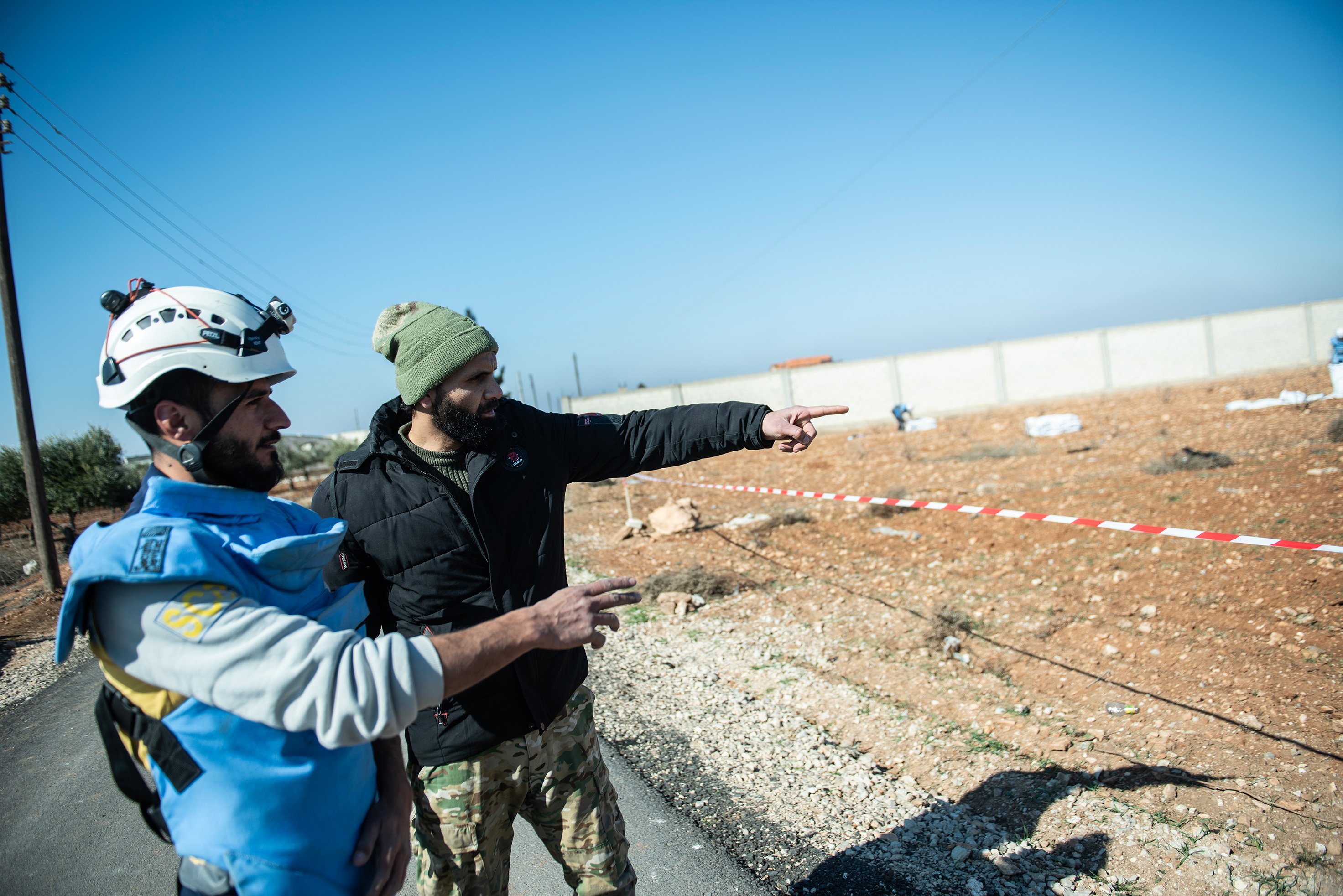
He had heard of a bomb exploding in the hands of a child, killing him, and was hoping to avoid anything like that happening in his village.
While the White Helmets work, passersby stop to look and ask questions. Several report suspicious objects of their own, and the team takes note of the locations for future inspection. One person says they have heard of a junk collector who is carrying around dozens of munitions, hoping to sell them for scrap metal.
“We should protect ourselves and our children. These munitions are so dangerous, especially for kids who think they can play with them,” says al-Mohammed, who is in his thirties.
Al-Mohammed stays as close as he is allowed to the clearance team until they finish. He wants to see for himself that the area is safe for his family and neighbours. “This is our responsibility now,” he says.
Edited by Annie Slemrod.


