

Share & more
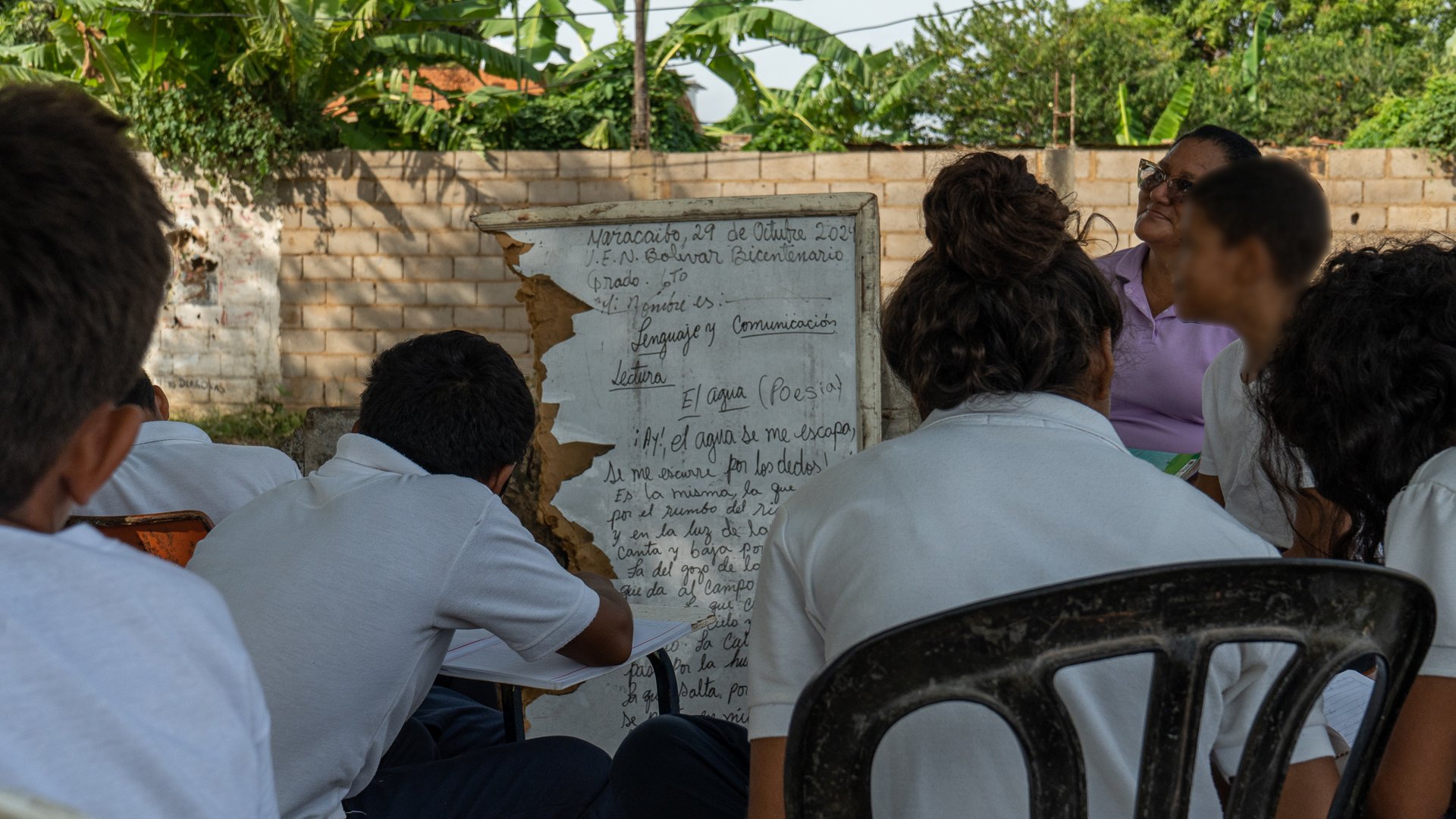
Standing under the canopy of a tree to shelter from the scorching sun in Maracaibo, Venezuela’s second city, a woman in her late 50s writes with a black marker pen on a cracked whiteboard. Ten children, uniformed in white, sit on plastic chairs – some attentive, others lost in the urban bustle.
Such unconventional schooling has become the new normal – not just in Maracaibo but in communities across Venezuela – as a lack of basic state support and infrastructure forces teachers to leave their dilapidated classrooms behind and improvise outdoors.
Venezuela once pioneered access to education in Latin America, registering notable achievements under former President Hugo Chávez, who implemented a series of successful reforms – including a mass literacy campaign and meal programmes for students.
Between 1999 and the mid-2000s, enrolment reportedly rose from 85% to 95% in primary education and from 40% to 70% in secondary. In 2005, after Chávez stated that 1.5 million Venezuelans had learned to read and write in just two years, UNESCO, the UN’s educational and cultural agency, awarded him a major international prize.
But years of mismanagement under his successor, President Nicolás Maduro, has led to a severe decline in the quality of education and unprecedented levels of absenteeism. This has come amid an all-encompassing and relentless humanitarian crisis that has marked Maduro’s increasingly authoritarian 12-year rule – pushing nearly eight million Venezuelans to migrate.
By 2023, 40% of Venezuelan students aged three to 17 went to school irregularly. Last year, a staggering 34% of children and young adults between the age of three and 24 – three million people – did not attend any educational institution.
After a period of relative stability, the wobbling economy is at risk from new storms – rising inflation, currency depreciation, and renewed US oil sanctions. Repression has also been ramped up since the July 2024 presidential election, which was decried internationally as fraudulent. All this threatens not only to deepen Venezuela’s humanitarian crisis but to also accelerate the collapse of the education system.
“Education is the main structural problem in the country,” said Fernando Pereira, a teacher and founding member of children’s rights NGO CECODAP. “In addition to the impact it has on the present, and on the quality of life of the population, it compromises the possibilities of future generations and the development of the country.”
For this special report, The New Humanitarian travelled to public schools in three different areas of historical and social relevance in Venezuela: the western oil city of Maracaibo; Ciudad Guayana, in the southeastern state of Bolívar; and Margarita Island, up in the north. We spoke with students, parents, grandparents, teachers, and principals to find out how they’re coping with the dramatic decline of the education system. We heard a long laundry list of concerns, but also found slivers of hope.
Teachers battle to get by
If Venezuela's imploding economy already had the public education system on life support, then the COVID-19 pandemic dealt it a near-final blow in mid-2020. After months without schooling – or a few weeks of online classes for those who had access to the internet – in-person teaching finally resumed in September 2022.
Amid a slight economic recovery, Maduro’s government promoted the message that “Venezuela was fixed”. However, the poorest didn’t benefit from any rebound, and neither did the country’s battered education system.
During the pandemic, sustained outward migration caused a shortage of teachers and an uptick in children dropping out of classes. Even the educators who stayed in the country lacked the money for transportation and couldn't get to school every day.
Despite the rampant inflation, the minimum wage in Venezuela has been frozen since 2022. This means the average monthly salary of a teacher is about $14.50, but it can be as low as $4. With government grants, monthly income can reach $50, but those bonuses don’t come every month, and when they do, they are still far from enough to meet household needs. Last December, the cost of the basic monthly basket reached nearly $500.
To address the situation, the government has established the “mosaic schedule” – allowing teachers to resort to other economic activities to increase their income. Teachers have started selling cakes, candies, or ice creams, and taking care of children in their spare time. In theory, they have to teach four days a week, instead of five. However, most public schools are only open two or three days a week because teachers don’t have the means to manage more than that.
In the beach town of Manzanillo on Margarita Island, Luisana Figuera works in fishing when she’s not giving lessons – a common second activity for teachers in the coastal area desperate to put something on their families’ table.
“The money is not enough,” she told The New Humanitarian. “We have to go scavenging for sustenance for our daily life at home.”
By 2024, the growing economic challenges had led to a 72% teachers’ attrition rate, according to a report by the human rights NGO FundaRedes. This prompted Maduro to ask more than 200,000 teachers who were out of the education system to return to teaching, offering incentives that never arrived.
Teachers on the island face other challenges too, enduring constant intimidation by school authorities and representatives of the Ministry of Education.
“They threaten us in different ways. They tell us that if we don’t go to classes one day to work elsewhere [to cover our needs], they will stop paying our salary or take away some bonuses,” said Johanna Quijada, who has been teaching for 19 years. “We receive threats almost daily.”
“Teachers should have a statue of them made in their workplace considering all the problems that there are,” said Fermín Rivero, who coordinates the Nueva Esparta chapter of the Teachers’ Inter-Union in Margarita. “They do their job, but the authorities take it upon themselves to humiliate and mistreat them when they can’t go to class one day because they don’t have enough money for the bus fare, for example.”
Teachers have been calling for more support for years.
Many have taken to the streets despite the risk of repression: Between 2022 and 2023, nearly 3,200 teacher protests were registered. Their demands are always the same: decent salaries, better pensions and retirements, and an end to persecution for protesting. But nothing has changed.
Last October, the education minister, Héctor Rodríguez, launched a six-month plan to address the crisis. It included the voluntary reinstatement of retired teachers, year-round enrolment to allow children returning to Venezuela to go to school, and the end of the mosaic schedule. However, there was no mention of additional resources for public education, nor were educators’ salaries increased, and, in practice, a full schedule remains unattainable.
Norelys Figueroa, principal of Batalla Naval de Puerto Cabello high school in Ciudad Guayana, has seen first-hand the golden years of Venezuelan education vanish.
“Most of the teachers we have are non-specialist,” she said. “We don’t have enough teachers in areas such as science, maths, physics, and languages.”
Figueroa has postgraduate diplomas and a specialty in natural sciences. She would like to pursue additional training but earns only about $15 a month, which doesn’t allow her to study.
“I lived in the era when teachers earned well. I have had to adapt to the current situation,” she told The New Humanitarian. “I would like things to improve so that the teachers who left can return.”
Schools with no services
In Maracaibo, the capital of the state of Zulia, known as “the land of the beloved sun” among Venezuelans, it is hot all year round. The average temperature in the city of more than three million ranges between 28 and 35 degrees Celsius.
The most important economic hub in the west of the country, Maracaibo was also the centre of Venezuela's oil bonanza in the 1970s. Its boom to bust story over the past decade has been particularly dramatic: Even gasoline is now a luxury here.
Maracaibo experienced the worst of the crisis between 2018 and 2021 and has not recovered. Long queues for fuel and frequent power cuts are still commonplace, and piped water is only available for five days once a month.
Nancy Ferrer, director of Aristóbulo Istúriz public school in Idelfonso Vásquez, north of Maracaibo, said the educational facilities in the area are unsuitable for proper teaching and learning. Her school has no piped water nor drinking water. Its electrical installations were set up by parents and provide paltry power to a few computers and fans.
Further north in the city, about 20 minutes from downtown, is one of the schools where classrooms have been moved outdoors. Students sit in a space on the school ground – a roof made of zinc sheets supported by precarious wooden poles and propped up by a single brick wall – divided into three classrooms.

Nearly 200 children from pre-school to sixth grade (11-12 years old) study in shifts here. Most are Wayuu, an Indigenous ethnic group, and many have been displaced from the border area with Colombia due to violence and poor living conditions.
While they are in class, cattle pass through the schoolyard, but the children don’t get distracted. They concentrate on the voices of their teachers and stare at the broken blackboards hanging on the walls. In their interviews with The New Humanitarian, the teachers praised the children for their efforts but said they desperately needed more assistance from the authorities to improve the facilities. They asked to speak anonymously, fearful that their comments could make obtaining any government support even harder.
“The conditions here are as you see them,” one teacher said. “The children need the construction of the school, but we still give classes here every day.”
The situation was no better in the other parts of Venezuela The New Humanitarian visited.
Bolívar, which borders Brazil and Guyana, is Venezuela’s largest state. It is crossed by two major rivers: the Orinoco and the Caroní – crucial for the development of Ciudad Guayana. The irony is that several times a week the city’s residents have no water.
The city used to be a centre for the mining industry that exploited the state’s abundant minerals – gold, bauxite, iron, and alumina – experiencing a decades-long economic boom until 2015. Now, fuel and gas are even more scarce than piped water, and the area’s schools are run-down and crying out for support.
Aida González, general secretary of the state’s teachers association, said schools in Bolívar can’t even withstand light rain and listed at least 10 in Ciudad Guayana with serious infrastructure issues. “The teachers want to teach, the kids want to go to school, but the situation in the institutions is critical,” said González, who is also chair of the state’s Education Commission and a local councillor.
Figueroa was proud that her students have the privilege to be given lunch daily, but she described a similar situation in her school.
She explained that the more than 500 students at Batalla Naval de Puerto Cabello struggle in such a precarious environment. “What can a student learn in a classroom that is too hot?” she asked. “We have managed to reactivate laboratory spaces thanks to donations. The kids are happy with that, but the situation with the bathrooms is bad. There is no drinking water: The children have to bring water from home.”
Neither the Fuerza Indígena school of Maracaibo (left) nor the Rafael Salazar Brito school in Margarita (right) have piped water.
Hungry children
School meals are not a luxury that all children in Venezuela have.
Figuera, the teacher on Margarita Island who fishes to complement her salary, said students in her classroom often stop paying attention quickly because they are hungry or tell her they don’t feel well because they haven’t eaten.
Margarita is one of three islands in the middle of the Caribbean Sea that make up the state of Nueva Esparta. Once Venezuela’s main tourism hotspot, it attracted high numbers of foreigners, but tourism declined as the complex humanitarian emergency settled in, and locals rapidly lost their main source of income.
Despite having sunlight for 12 hours a day and strong sea breezes, the island still depends on energy generated on the mainland and suffers frequent power outages that can last for weeks. Water, fuel, and domestic gas also have to be shipped from the mainland, which is now pulling more and more young people away from the island.
University careers in Margarita are almost exclusively linked to the tourism sector. With its downturn, the few who do still manage to graduate from high school are now preferring to leave the island to pursue other careers elsewhere. Migration abroad is also an option that Margaritans have increasingly chosen in recent years.
Sitting with one of her three daughters in a boat once used for fishing or for tourism trips at Manzanillo beach, 50-year old Yeritza María González said she has seven grandchildren, five of whom are in her care because their mother works all day and their father doesn’t provide for the family. It’s 5pm on a Saturday and there are barely three Venezuelan tourists on the beach.
Three of González’ grandchildren walk along the shore and approach them to offer them empanadas. “Two for a dollar,” they say.
“Since this Mr Maduro has been in charge, everything went downhill,” said González, lowering her voice. “This government ended everything.”
For survival, she barters with the fishermen – empanadas in exchange for fish. Part of what she gets is used to feed herself and her family. The rest she sells to buy the ingredients for her empanadas and to purchase whatever her grandchildren might need. In a bad week, she makes less than $50. When that happens, she doesn't send the children to school.
“It pains me to think that one of my grandchildren has to watch another child be able to bring something to eat [at school]. I’d rather have them stay at home, even if we have nothing to give them,” she said.
Historically, children going to public schools were guaranteed breakfast, lunch, and an afternoon snack, but this isn’t the case anymore. According to the National Living Conditions Survey (ENCOVI), in 2024, only 21% of the beneficiaries received meals every day, while a recent report by HumVenezuela – a platform that monitors and provides data on the humanitarian emergency – shows that 70% of children between three and 17 years of age received no food at all at school last year.
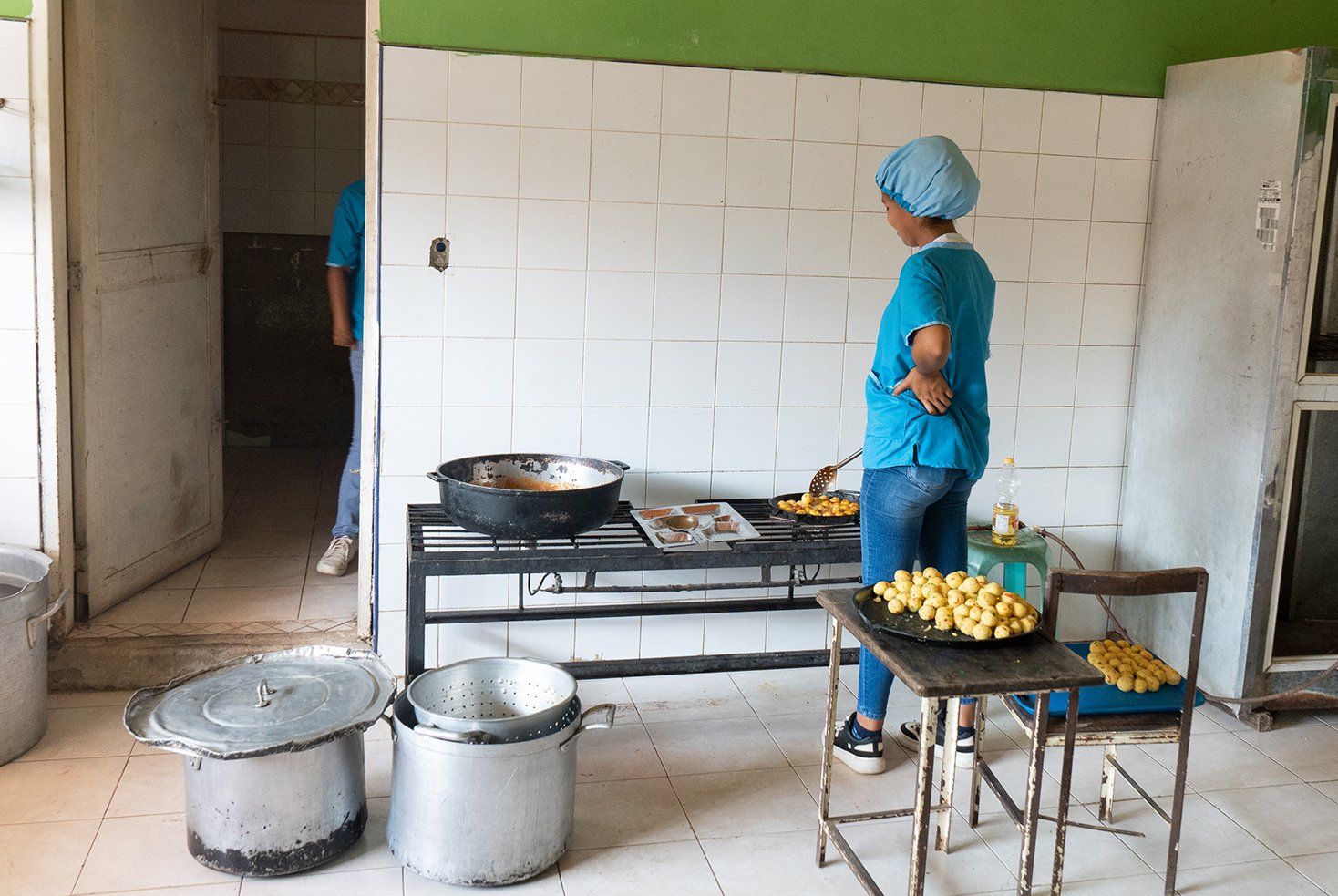
“The schools here are useless,” González said. “When they give out food, there's only beans and pasta, and when it runs out, if you don’t give the child something at home, they have no way to feed themselves.”
Everywhere, parents expressed concern about the future of their children and the conditions they face in their places of learning.
Fabiana Briceño, a 30-year-old mother of three in Maracaibo, said she has seen her son come home “red from the heat”, because he had no clean water to drink or to refresh himself at school.
Still, she is determined to make sure her children get some education.
It is a determination many parents shared. Teachers also insisted on working, despite the adversity, for the sake of the children and said the reciprocal support they get from the students' families has been vital to keep them going.
“We are giving education to the children, which is the most important thing – as teachers and as families – because the parents are always supportive,” said one teacher in Maracaibo, who asked to speak anonymously.
“The teachers do everything they can, and one helps as much as one can, but there are other people who do not have the means to do it,” said Yoselin Gutiérrez, a mother-of-two in Maracaibo. “School should be normal. It should have a playground, electricity, and so on. Like every mother, I’m worried about finding a good future for my children.”
Learning deficiencies and increased inequality
To better understand the impact of this crisis, The New Humanitarian asked some children to draw their school. In most cases, they said they felt good at school and loved their teachers. They drew their houses, families, and teachers, mostly using warm colours, and said they felt loved at school. But they were also aware of the shortcomings.
The fallout for young Venezuelans has been felt for several years already.
A recent report published by the Andrés Bello Catholic University shows that students in the Venezuelan education system have serious learning deficiencies. For instance, around 71% of students in the third year of primary school (eight to nine years old) and nearly 99% of those in the final year (11-12 years old) were at the lowest performance level in mathematics in 2024. For writing and reading comprehension, it was about 84% of them.
Experts have highlighted that results have been dropping steadily in recent years, that students’ motivation is lower, and that the gap between children in the private system (15% of students) and the vast majority who are in public schools is widening.
In Ciudad Guayana, a group of teen girls said that, due to the lack of teachers, they hadn’t had classes in some key disciplines since the beginning of the school year, and they described the discomfort caused by the dilapidated facilities and lack of water at school. Still, they said they planned to continue attending classes to be able to study abroad once they graduate.
Local initiatives tackle government neglect
As the crisis has deepened, educators, families, and local organisations have lost hope in the possibility of government support and have come up with their own ways to keep children on track with their education or to provide them with training opportunities.
Read more: In Maracaibo, a former gang leader takes children under her wing
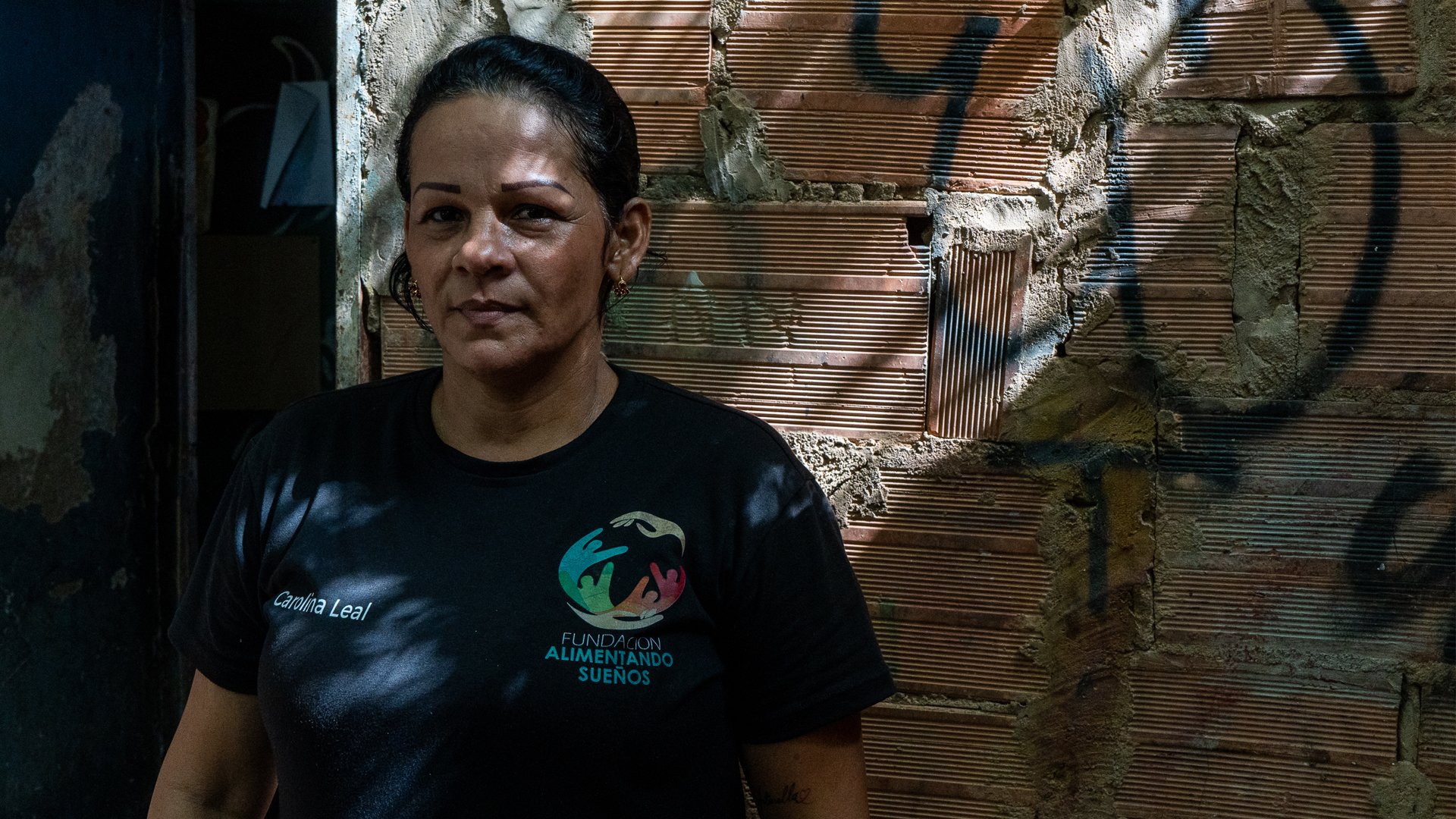
At first glance, Carolina Leal looks like a rather serious woman. Her frown is furrowed and her lips are tight. She has a loud voice and walks fast, with determination. She is 47 years old, has four children, and once led a criminal gang in Maracaibo.
“Before, people were afraid of me, and rightly so. Now, they love me because I help the community,” she told The New Humanitarian.
Her life of crime, drugs, theft, and murder changed drastically when she was 33 years old. She was told she had lung cancer and little chance of surviving if she didn’t change her ways. At that moment, Leal claims to have found God and realised that her life had another purpose. In 2022, she decided to create the organisation Alimentando Sueños (Feeding Dreams) with the help of donations from the community. Initially intended to help fight malnutrition in Maracaibo, over time the organisation has evolved into something more.
“We had a lunchroom, and we realised that the children who came had difficulties communicating. We went to their homes and found out that they weren't going to school,” she said. “So, with some colleagues, we taught them how to read and write.”
Now, Leal works with six other volunteers – including one of her own daughters.
The children are clearly fond of Leal. When she speaks, they regularly go and hug her or ask for help with their homework. Over the years, Leal has adopted nine children that she has raised along with her biological ones, in order to protect them.
Currently, Alimentando Sueños gives classes to more than 50 children, many of whom are abused in their homes.
“Their rights are violated in many ways – physically, psychologically, financially, in health and education,” said Leal.
The activities Alimentando Sueños carries out include talks with experts in education who serve as guides and help the children learn to take care of themselves and to see the value that education can have in their lives.
The older children are given learning opportunities in styling, hairdressing, cooking, and craftsmanship so they can work and earn a living.
One of the most visible initiatives is Fe y Alegría, a network of low-cost private schools scattered throughout the country that focuses on providing education to children and teenagers in poverty.
Founded in 1955 by the Chilean priest José María Vélaz, it is now an international movement working in several countries in Latin America and Africa. In Venezuela, it runs 177 schools, which, according to the organisation, serve nearly 95,000 students.
In Ciudad Guayana, there are 16 Fe y Alegría schools, mostly in lower-income and densely populated areas. Monthly fees vary to adjust to the reality of the communities where the schools are located. Teachers' salaries are no higher than in the public system, but the organisation offers greater incentives for educators through extra bonuses and benefits.
Children attend one of the low-cost private schools run by the organisation Fe y Alegría in Ciudad Guayana.
Nataly Martínez, whose three children go to one of these schools in the Santa Joaquina neighbourhood, said she has noticed the difference in their learning curve since they left the public school system.
“I can see that they have made a lot of progress,” she said. “My son has a learning disability, but he has managed to learn to read and he communicates well.”
On Margarita Island, Christian Maestre, a 29-year-old man from the Pampatar salt flats area of the island, has developed an innovative programme to give young people a better outlook and motivate them to study.
Noticing how many young people in his community were turning to crime to get by, he started a business in 2021 that brings tourists to visit the salt flats and uses most of the income to encourage children to seek alternative paths. He provides them with training in craftsmanship, social media management, photography, and tourist hospitality, as well as sex education. The programme directly benefits 150 children up to 13 years of age.
Maestre provides their families with money to buy food and food supplements, as well as personal hygiene items, to help them take care of the youngest or send their children to school. Sixty of them are now studying. “[We invest] in training the kids in order for them to stay motivated,” he said. ”We have to offer them new things so that they keep learning.”
Edited by Daniela Mohor.


