


Share & more
This is Inklings, where we explore how aid works in the wilds of humanitarian hubs, on the front lines of emergency response, or in the dark corners of aid punditry.
It’s also available as an email newsletter. Subscribe here.
Today: Questions and (one or two) answers about the US-OCHA funding deal, more awkward tech partnerships, and Israel’s new Google keywords target.
On the radar |
The US announced $2 billion in emergency response spending a month ago, and humanitarians are still parsing out the details and ramifications.
The range of reactions can be neatly charted on a scatterplot. On one axis: How much US humanitarian cash were you really expecting this year ($0 to $17 billion)? On the other: How much reform do you want to see (“just a bit off the top” to “burn it all down”)?
If it sticks – and that’s still a big if – the US plan to steer all its humanitarian cash through UN pooled funds could reshape the funding landscape. And that has some other agencies in a fix. Here are a few more notes and lingering questions:
- Why did the US do it? The deal negotiated by UN relief chief Tom Fletcher surprised other aid leaders (more on that below). Fletcher can count two billion reasons to sign on. But what motivates the Trump administration – led here by Jeremy Lewin, a former DOGE official who helped swing the axe over 2025’s deadly aid cuts?
- Buying the reset: Fletcher has sold the Trump administration his so-called humanitarian reset as a “new model” for aid delivery. The State Department has co-opted much of Fletcher’s reset jargon, from efficiency and hyper-prioritisation, to a conspicuous love of pooled funds or the reset label itself.
- Buying the relationship: Fletcher has sold himself and the UN’s humanitarian coordination arm, OCHA, as a trusted US partner – somehow separate from the behemoth UN system the Americans say they detest, and with shared interests in efficiency and shedding waste. Fletcher has built a level of rapport with Lewin and other (currently) influential figures in the Trump administration that other agencies and NGOs have not – despite months of DC hallway tea-leaf reading.
- The timing: It’s not something the US was eager to publicise. Who plans a funding announcement between Christmas and New Year’s Eve? The US-led rollout happened at the US mission in Geneva during a publicity deadzone on 29 December. From a US audience perspective, it seems timed to fly under the radar. In January, meanwhile, the US Congress agreed on a foreign aid spending bill for 2026 (including some $5.4 billion for humanitarian aid) that counters some of the Trump administration’s planned cuts.
- Conditions, caveats, and clauses: OCHA says there are no conditions restricting how the money is used (beyond the rules of existing OCHA pooled funds, or the US selection of 17 countries it wants the money targeted towards). Our review of the Memorandum of Understanding signed between the US and OCHA doesn’t show any explicit clauses on gender, diversity, or climate, for example. (Devex first reported details on the MoU).
- But: There are other ways in which funding could be influenced. A State Department official may sit on existing pooled fund advisory boards. This doesn’t let members “hold back or decide quantity of funds”, the MoU notes. But one aid official we spoke to questioned how well the firewall would hold if an outspoken MAGA-type served on a fund dominated by US cash: $2 billion would roughly double what all the OCHA-run funds processed in 2025.
- The big secret and the subtle fallout: The US deal surprised even senior leaders at other agencies. Some learned about it as it was being announced. Some understand the need for discretion, but an apparent lack of any consultation whatsoever seems to have rankled. Fletcher has previously mused about how quickly closed-door discussions seem to leak (one solution: just open the door). He’s evidently pretty good at keeping a secret, but that has its costs.
- Take it or leave it: Fletcher frames it as “this or nothing”: There were no other scenarios for US money including direct funding to UN agencies, he told aid leaders at a January meeting. But some other agencies still believed they could have struck better deals one-on-one, we’re told.
- Pooled funds: It’s easy to see why ex-DOGE Lewin might be intrigued by Fletcher’s efficiency reset narrative. It’s harder to imagine any Trump official embracing the minutiae of pooled funds without a hefty sales push. The MoU explicitly includes an entire section on promoting pooled funds (and implicitly, OCHA-run ones in particular) to other donors, and the US says it plans to eventually steer all of its humanitarian funding through OCHA. During “reset” discussions last year, Fletcher couldn’t find the backing for his call to send half of donor funding through pooled funds (some saw it as a “cash grab”). In this case, money speaks more loudly than consensus.
- Trust: This leaves Fletcher in a position of mending fences. He has signed a pact that could re-orient funding for the wider humanitarian system, with little input and buy-in from other players. One aid official described it as a trust problem. “We have to make it work, definitely,” said the official. “But it’s a massive power shift. You’ve got to take people with you on this.”
- This could all fall apart: The MoU is signed until 31 December 2027, and there are mutual out-clauses with suggestions of three-month notice periods. Nothing is guaranteed, regardless of what the fine print says.
- Country deals: Separate deals for country-based pooled funds must be signed one-by-one. There is plenty of opportunity for hangups, hitches, and last-minute hurdles.
- US backlash: Whether intended or not, the US has now bought in to Fletcher’s reset and put its money behind a version of UN-coordinated humanitarian aid. It’s now at least partially on the hook for any domestic backlash.
- Trump volatility: The biggest variable may be the leadership of the world’s most volatile nation: the United States. At least in part, the US-OCHA deal rests on Fletcher’s relationship with Lewin. But two Trump administrations show how the machinery eats its own, and it’s hard to plan for policy sketched out on Truth Social.
- Risk: The deal is filled with risk on multiple fronts, from frontline groups to Fletcher himself. A few elements:
- To OCHA: The agency Fletcher leads, OCHA, will process sums that dwarf its own budget. It takes on accountability and monitoring roles it may not be able to deliver on. The deal pushes it towards being a US fund manager, rather than the system coordinator it was designed to be.
- To reform: Fletcher’s reset isn’t a reform agenda, but a patchwork emergency plan with hard-won tweaks and marginal buy-in. Will the US settle for its narrative of change, instead of the real thing? If not, there’s a risk of over-promising what today’s system can actually deliver.
- To the system itself: $2 billion is substantial. But it’s also a single-digit percentage of what humanitarian needs will cost this year, and a shadow of what the US used to give. The humanitarian system is shifting and bending for a single donor that is now a minority funder and a growing contributor to global instability.
Tech trends |
Speaking of awkward collaborations: Weird partnerships are a humanitarian trend for 2026. Cuts, the belief in AI efficiency, and Big Tech’s growing moral ambiguity point to increasingly odd collabs. Do we have another example on the horizon?
- Hoot: Social media management tool Hootsuite is chasing deals with US Immigration and Customs Enforcement (ICE), The Globe and Mail newspaper reported. The company is pitching its services to monitor online conversations and public sentiment for an agency responsible for killing Renee Nicole Good in Minneapolis. In particular, it’s upping a “social listening” subsidiary called Talkwalker.
- WHO: UNICEF used Talkwalker as part of a COVID-19 information tracking project promoted by both UNICEF and Talkwalker as a case study. A 2023 UNICEF briefing noted that the agency had a global “long-term agreement” with Talkwalker “to produce weekly and monthly social listening reports”. The World Health Organization also announced a misinformation collab with Hootsuite back in 2022. World Vision is also listed on Hootsuite’s non-profit partner page, Hootgiving. World Central Kitchen participated in a Hootsuite-organised how-to webinar.
Data points |
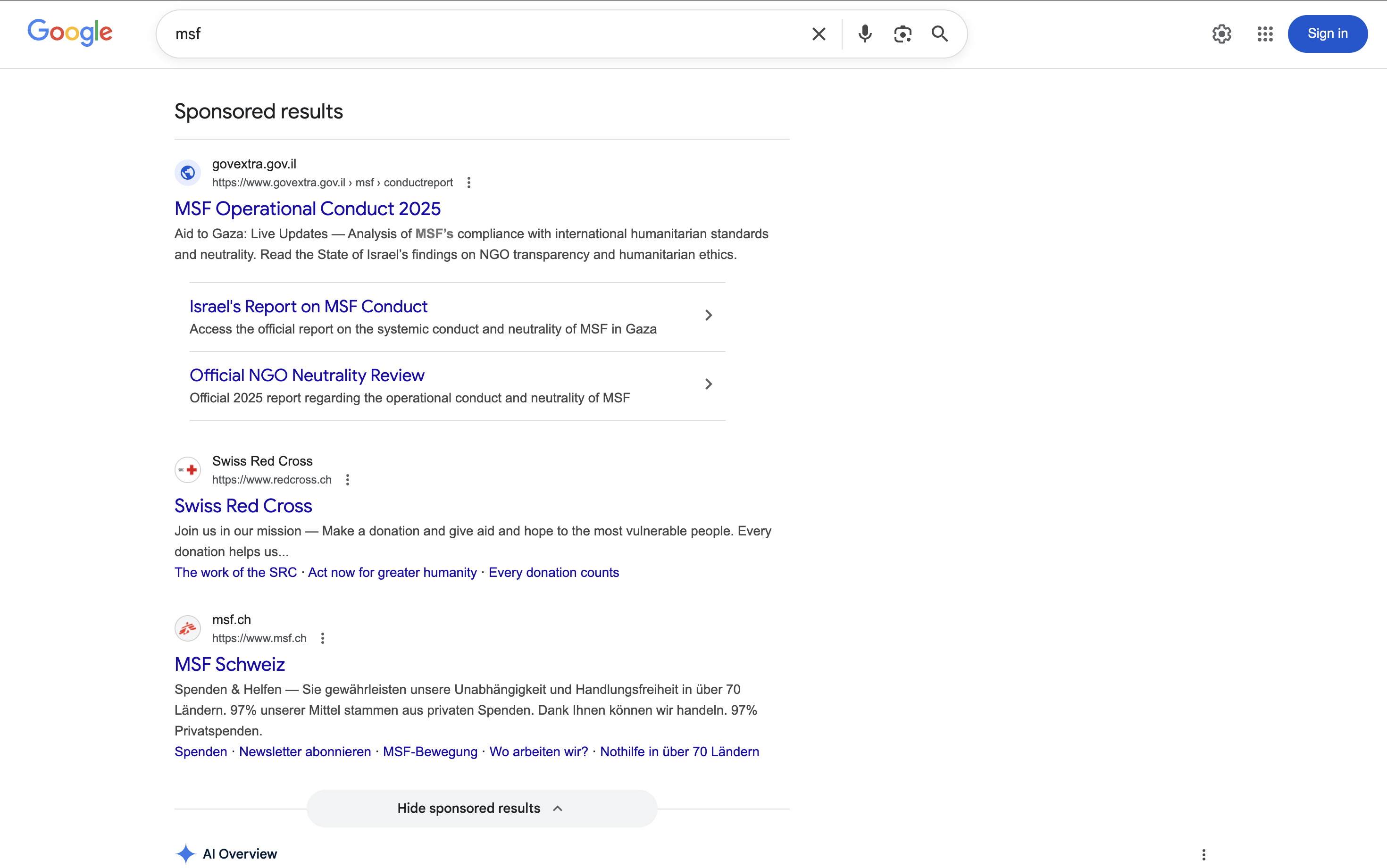
Israel seems to have a new aid target for its long-standing digital harassment campaign. It’s sponsoring Google search results trolling Médecins Sans Frontières – one of the dozens of NGOs it recently kicked out of Gaza (first noted here).
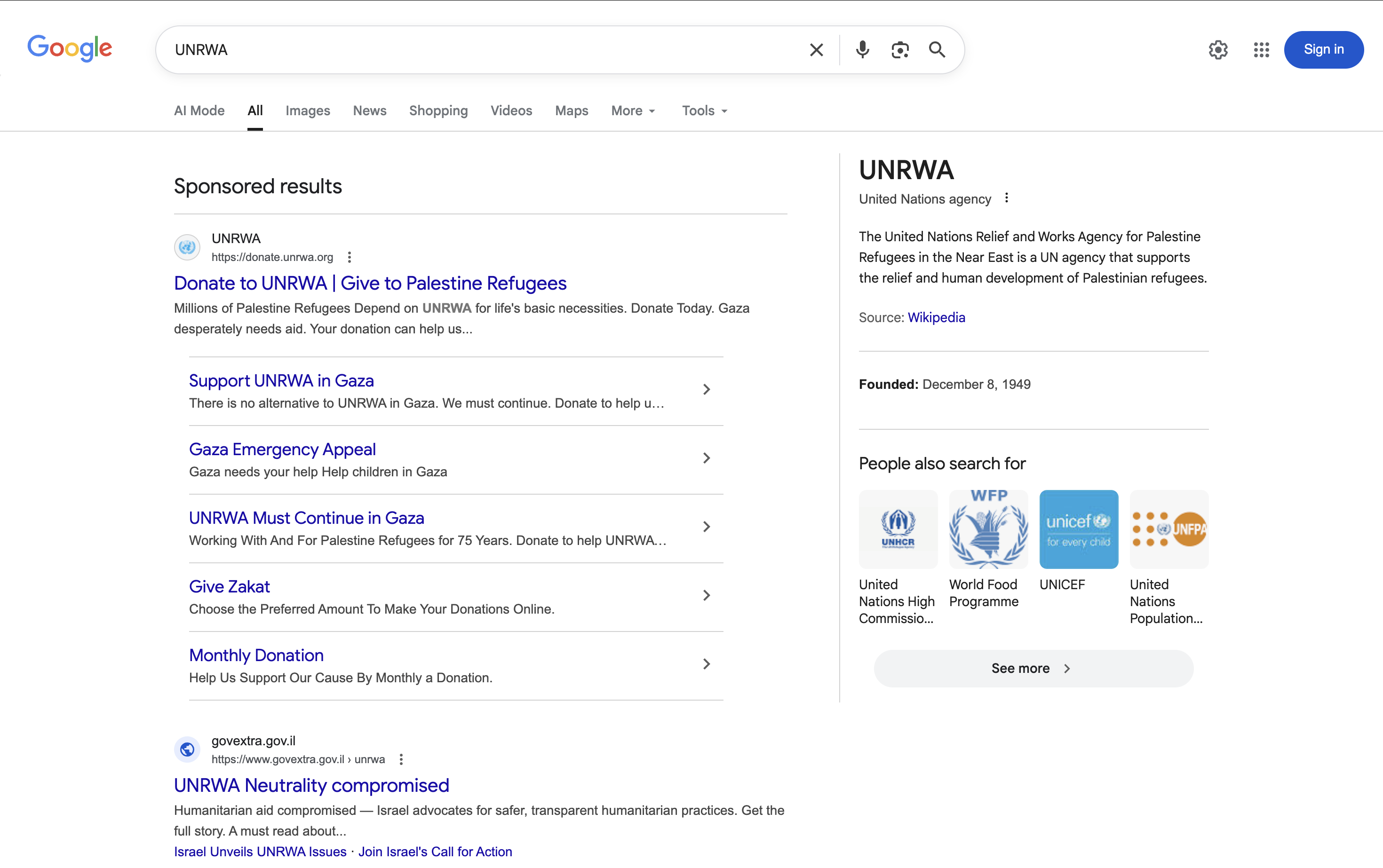
A previous target, the UN’s agency for Palestinian refugees, or UNRWA, has been more proactive. It’s bidding on its own name to get its donation page ranked higher on sponsored search results.
Have any tips, recommendations, or indecipherable acronyms to share with the Inklings newsletter? Get in touch: [email protected]


