


Share & more
Last month, I was part of the first audience to see The Lebanon Displacement Diaries on stage in Beirut. Watching a theatre production adapted from stories I had helped collect felt like many things at once: a shared act of mourning, a brief exhale in the aftermath of a war that hasn’t really ended, and a reminder that people from my country are humans even when political parties, armies, and news stories treat us as anything but.
The way Laban Theater adapted the stories of 10 people who were forced to flee their homes by Israel’s recent war in Lebanon from a participatory journalism project I coordinated with The New Humanitarian felt both painful and heartwarming. It also felt important.
But the truth is that up until the opening early in September, I wasn’t convinced a play would make much of a difference in the whole scheme of things.
That’s because even though Hezbollah and Israel reached a ceasefire late last November, life for many people, especially where I live in south Lebanon, has not gone back to normal. Israel still bombs regularly: There were airstrikes near my home of Nabatieh on the night we published the diaries, and less than a week before the first night of the play, which is called Al-Tamma, or catastrophe in Arabic.
The 10 people whose stories were in the diaries and the play are a tiny fraction of the around a million people – including my family – who were displaced at the height of Israel’s bombing and invasion of the south late last year.
While working with the project and meeting with many of the people whose stories we published, I felt it was a way to document what was happening in Lebanon, even when most media wasn’t paying attention. It also allowed me to express solidarity with others who had been displaced, often in much worse circumstances than me.
But, unlike the some 80,000 people in Lebanon who are still displaced, including many of those featured in the diaries – Abu Ali, Riham, Yasmina, Abbas, Hassan, Robert, Raghida, Nour, Leo, and Zahraa – I at least had a home to go back to after 66 days.
So as I watched the smoke from the latest airstrike rising from my home, I felt like life in Beirut had moved on, while people in the south were still living with destruction, bombing, and so much pain. I wasn’t sure about the impact one play on the Beirut stage could make.

The Lebanon Displacement Diaries
These are the stories of 10 people forced to flee their homes by war in Lebanon, told in their own words, photos, and videos.
A living conversation
One of the aims of The Lebanon Displacement Diaries was to show what displacement looks like, and feels like; to show that it is more than statistics or reports of how many homes were damaged. It’s a deeply personal experience, and people’s stories show how they lived through the chaos and fear, how they adapted, and what they remember.
Many of the 10 people who shared their stories come from places that are now just names on a map, everything completely reduced to rubble. As I spoke with them, the project became about more than journalism for me, it became about connection between people.
When The New Humanitarian decided to ask the Beirut-based Laban Theater to adapt the diaries into a play, my colleagues and I hoped it would give the stories a wider reach and a longer life. But I still didn’t know how it would feel to see these people on stage, portrayed by actors.
On the first night, 4 September, the Beirut rooftop that surrounds Laban’s theatre space was full with people from all walks of life; Lebanon is often seen as divided by religious sect as well as class, but this seemed like a true mix.
When the theatre doors closed with every chair full, a single light appeared on stage. I watched the stories come out through the actors in local Arabic dialects, starting with Nour’s wedding, which was on 8 October 2023, the day Lebanon was pulled into Israel’s war on Gaza, which turned into a genocide.
Woven throughout the scripted play written by Laban were stories from people in the audience. They used a technique called “playback” theatre, taking breaks throughout the production to ask the audience to share their experiences of the war and displacement. The actors then turned these into short improvised scenes of movement and sound.
One woman told of how she was pregnant during the war, and desperately didn’t want to give birth until a ceasefire was announced. She didn’t want her daughter to come into the world with the same fear she had grown up with.

Another young man said part of him wanted the war to continue, because he had already lost everything that mattered – his father and his home. If the war ended, he said, he might have to face the loss.
For me, the playback segments were the most powerful part of the play. They broke the barrier between audience and performer, just like sometimes the diaries broke the barrier between journalist and subject. In those moments, everyone became part of the story. That’s when The Lebanon Displacement Diaries stopped being a published piece, and became a living conversation about trauma and emotions that didn’t end with the ceasefire.
One of the Laban actresses, Ghaliya Saab, said the mix of traditional theatre and playback was what made this production stand out for her, too: “In the middle of the performance, you are listening to the stories of people who lived through the war, and then right away we reflect those stories back to the audience who are face to face with us,” she told the pan-Arab paper Annahar. “It’s a mix between stories that are told right now, and things that happened during the war, including some moments we all went through.”
Permission to pause
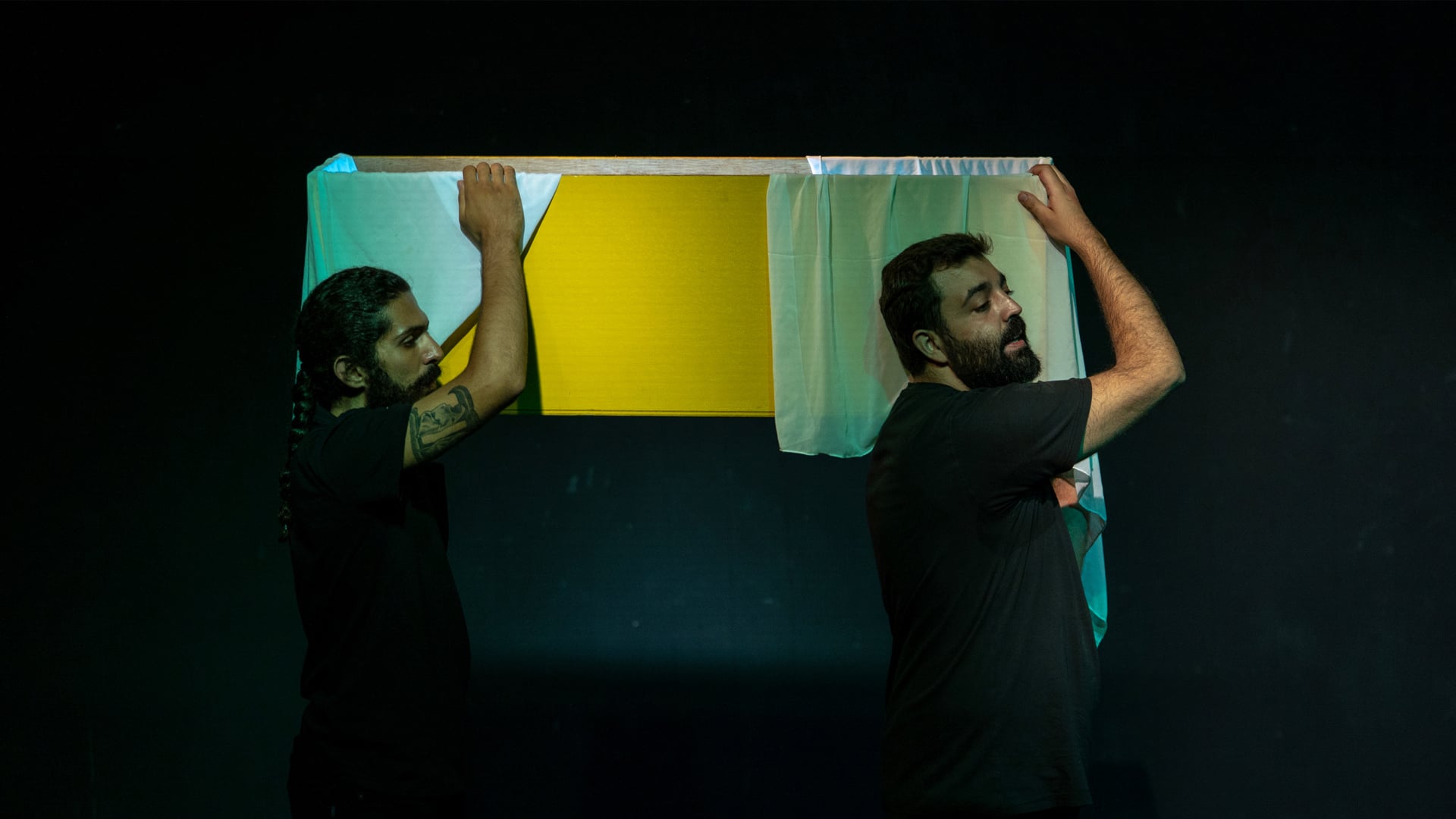
The play ended with a funeral, with the actors singing the same traditional wedding song that rang out during Nour’s wedding, but this time in a mournful tone. The actors took white roses from a wooden coffin, and slowly handed one to each person in the room. Someone next to me whispered, “I will keep this flower forever.” I understood what they meant. It wasn’t just a souvenir; it was a reminder that memories don’t fade just because the world moves on.
It felt like the funeral belonged to all of us. Almost everyone in the room was crying, maybe for Nour, maybe for Abu Ali, maybe for themselves.
In a country where people are told to be resilient, to keep going and act like everything is fine, it felt like permission to pause; to feel grief not as weakness, but as proof of our humanity.
It wasn’t just sadness though. The rooftop was buzzing after the show. As my friend Maya told me: “I saw people content, content with what they saw, and moved. It shows how important it is to do things like this… I can’t think of anything else that has showcased the stories of people who lived through this war,” she said. “The war ended, and we are still having internal debates about who won and who lost. But we have forgotten that there are stories of people who were displaced and lost their homes, their memories, their families. I was so moved, it’s hard to express everything I am feeling.”
On the second and final night of the show, Laban’s Beirut rooftop filled up again. People had told their families and friends. After each show, there was laughter, but also serious conversation about what they had seen and been a part of.
In a country where people are told to be resilient, to keep going and act like everything is fine, it felt like permission to pause; to feel grief not as weakness, but as proof of our humanity. One person told me they drove home in complete silence after watching the play. It wasn’t until watching these stories on stage, they said, that they truly realised what they, and Lebanon, had been through.
And despite my earlier doubts, that matters.
Why the rooftop mattered
It wasn’t easy for me to watch the stories I had recorded in shelters, rented rooms, and welcoming homes. Like most of the people in the room, I sat in the theatre in tears, thinking about the loss and guilt I carry from my own 66-day displacement: During that time, I was in a relatively safe part of Lebanon, but missed home. I missed my beloved cat, who I returned to find dead after the ceasefire.
I had a home to go back to, but others were not so lucky. Some are renting or staying with relatives. Others are trying to rebuild with whatever savings they have. Even for those who are “home”, it’s still hard. There is so much rebuilding to do, not just of homes and hospitals and shops, but also of things like a daily routine, a sense of safety, a view of the future.
Over so many years of war in Lebanon, many people feel pressured to act like they are fine, even when they are not. Not everyone wants to talk about what happened to them, or what is still happening. Israel is still bombing, its drones are still flying low, and it is still occupying part of the south.
But storytelling is a way to remind each other that we are human. We are not just targets or soldiers. Our stories are not static, and journalism done this way can adapt and resist the purposeful forgetting or rewriting of history that so often happens.
As Farah Wardini, Laban’s director, told the Lebanese media outlet Manateq: “There is no such thing as big loss or small loss, and war is only about what headlines limit us to: the rising number of martyrs, the destroyed houses, the school that is gone... The importance of this kind of theatre is that our stories remain alive, and that people feel safe enough to share and rebuild real spaces of connection in society.”
That’s why that rooftop mattered. For two nights, we broke the silence. We allowed ourselves to feel, to name, to remember. Through art, we created a brief – and real – ceasefire of our own.
The Lebanon Displacement Diaries is a reminder, even if the world’s attention shifts elsewhere, we are still here. Neither the play nor the project was about closure. It was about continuing the story, and reinforcing that telling our stories can hold us together even when everything else falls apart.
Edited by Annie Slemrod.


