


Share & more
After 28 years of struggle in Iran, Jaffar told his wife and adolescent son the risk had become too great and they had no choice but to finally pack up and return to their native Afghanistan, a country Jaffar hadn’t been to since he was a teenager himself.
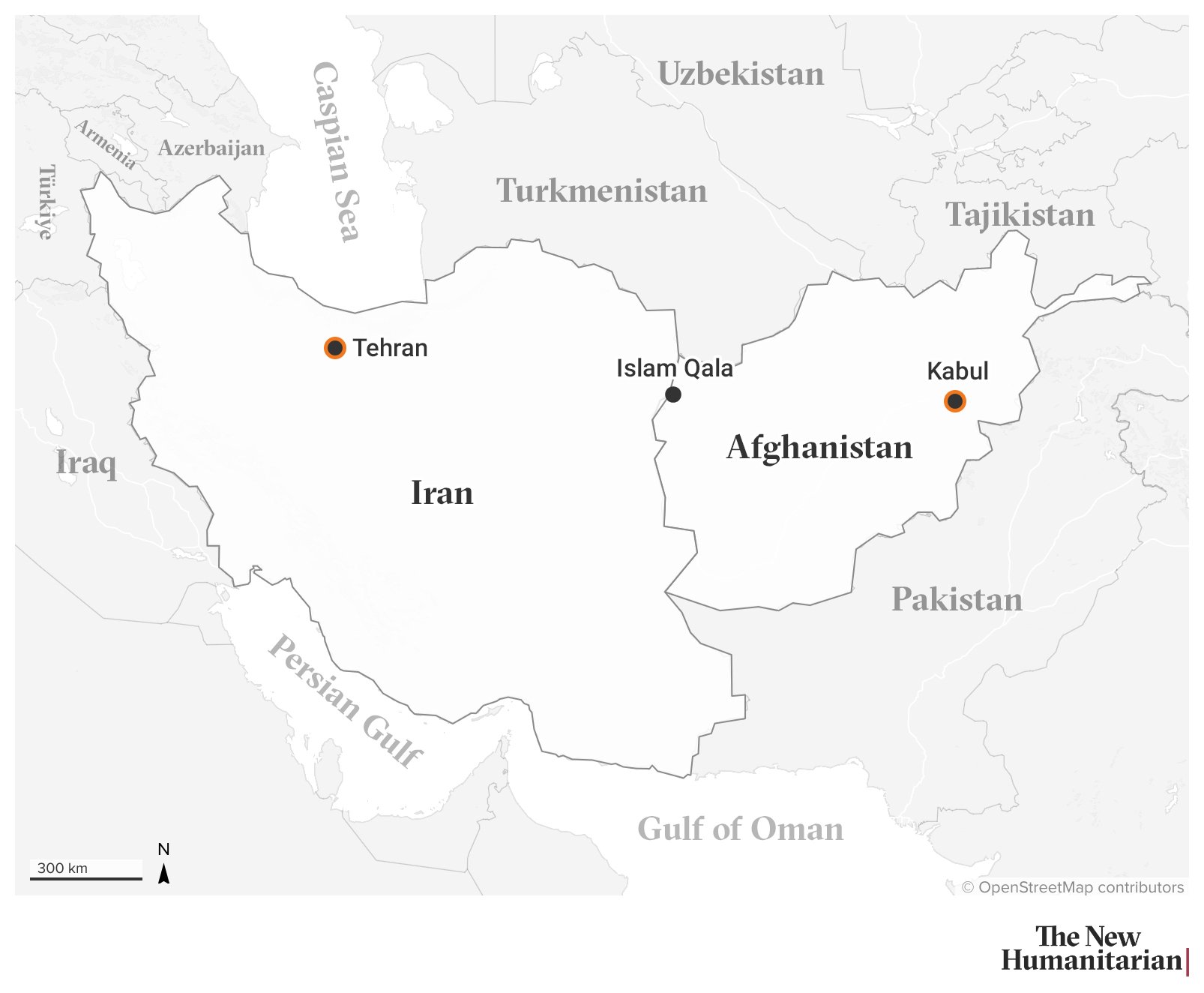
Since early June, tens of thousands of Afghans have left Iran and poured into Afghanistan’s western province of Herat. In May, Tehran set a 6 July deadline for all unregistered foreigners to leave the country, then came Israel’s bombardments of Iran.
The Iranian government and public have long been accused of abuse, violence, discrimination, and racism towards Afghans, but Israel’s 12-day bombing campaign only worsened the anti-Afghan sentiment. Tehran, which had already been deporting Afghans by the hundreds of thousands for years, began to accuse Afghans of spying for Israel.
Jaffar* and several other Afghan returnees in Islam Qala told The New Humanitarian that a combination of political and public hostility and suspicion led to mass round-ups, detentions, and eventual deportations. Though a ceasefire has taken hold after months of regional conflict, checkpoints remain in place across Tehran and other cities – ostensibly for security, but increasingly used to identify and detain Afghan nationals.
“Whatever you say, they show no mercy,” Jaffar said of the Iranian police. “From a work site, to a bakery, to the street, to a bus; wherever they can, they will come looking for Afghans.”
Jaffar said even if an Afghan does possess proper documents, authorities will tear them up or try to claim the documents contain an error that invalidates them.
“You would argue and beg, but it was futile,” he said. “They would find any way to threaten you with arrest and keep demanding larger and larger amounts of money.”
“A nothing document”
Jaffar said trying to navigate Iranian bureaucracy and keep within the ever-changing law is a tenuous prospect for Afghans.
“It’s a nothing document,” the 48-year-old said of the government-issued amayesh cards, which the UN says grant “holders temporary stay in the designated area for the period of their validity and enable the holders to apply for work permits”.
Jaffar’s statement about the arbitrary nature of such documents was laid bare in May when senior Iranian interior ministry official Nader Yar-Ahmadi used the new deadline announcement as an opportunity to also nullify the documents of millions of Afghans.
“Two million individuals whose census documents were valid until March 20 last year are now also considered undocumented. This has brought the total number of undocumented migrants in Iran to 4.1 million,” he said.
Additionally, legal hurdles mean that even registered Afghans are denied basic rights and services. Afghans have no pathways to citizenship, even if they are born in Iran. They are unable to open bank accounts. Many areas of the country are closed to Afghan renters. Some bakeries have started to refuse to sell bread to Afghans. In some cities, Afghans are not even allowed into public parks. Pharmacies have also started denying service to Afghan customers.
When they can work, Afghans are relegated to low-paying, dangerous jobs usually in the construction industry that often lead them to drug addiction due to the physical nature of the job.
Seeing his friends and neighbours disappear week after week left Jaffar with a fear like he had never felt before. Given Iran’s history of deporting tens of thousands of Afghans at a time, it was no mystery to Jaffar or other Afghans where all those people went or why they were disappearing.
That instinct is backed up by the statistics. The first day of July alone saw 43,000 Afghans arrive back inside Afghanistan at the border town of Islam Qala.
Finally, by the second week of July, Jaffar decided it was time to head back himself. When he and his family reached Herat – the main province in western Afghanistan near the Iranian border – on the morning of 12 July, they were among 600,000 Afghans who had left Iran over a single 40-day span.
Even though his family chose to return, before they could be deported, Jaffar said the Iranians did not make it easy.
Police have been using a 2021 declaration to seize and seal the homes of Afghan nationals, forcing them to leave in haste, and with almost nothing.
“We gathered everything in the house, but the fare to transport it all would be too much,” Jaffar said. “We sold some of it at a pittance, and now we’re here with nothing.”
Iranian landlords have also been accused of failing to return advance payments made by deported Afghan tenants.
“I no longer want to go outside”
All of the Afghans who spoke to The New Humanitarian in Islam Qala, including children, said their lives in Iran were full of abuse, taunting, and exclusion, leading them to believe that Israel’s bombardments were just an excuse to deport what Tehran claims is six million Afghans with or without documentation – the UN estimates the actual number to be about half that.
“The Iranians treated us terribly. Every day in Iran was awful,” Mohammad said of the five years his family spent in Tehran. At 13, Mohammad is among the many Afghan children who have been deported over the last year – children represent some 25% of the total number of deportees.
Like most other Afghan children, Mohammad was banned from public education in Iran simply for being Afghan. Private schools proved too costly and too far away for his family, so he spent the majority of his time in Iran without an education.
For Afghans still in Iran, fear continues to haunt them.
Bahar, a 24-year-old student, said anxiety has now become a part of her daily existence, even though she and her sister both live in Iran legally. Neither has left the house in weeks, except for the most essential tasks.
“I no longer want to go outside. I am deeply worried,” she told The New Humanitarian during a voice call via Signal, too afraid to meet in person. “You can see the fear in people's eyes.”
The government of Iranian President Masoud Pezeshkian, which came to power in 2024, has articulated an even more firm resolve to reduce the country's Afghan population. The Afghan question became a central issue during the 2024 election season. At the time, Eskandar Momeni, now Minister of Interior, told parliament: “First, the entry of foreign nationals must be halted.”
This is very similar in tone and action to what is happening in neighbouring Pakistan. In late 2023 Islamabad said it wanted “all illegal foreigners” out of the country. Since then, more than one million Afghans, including those with official registration, have returned to Afghanistan from Pakistan.
“Afghanistan is already facing the effects of climate change, deep poverty, and a stretched humanitarian system – it cannot meet these new needs without immediate international support.”
These public declarations by Afghanistan’s nearest neighbours have placed a great strain on the country’s Islamic Emirate government, which has been struggling to rally its economy under the weight of sanctions on top officials, asset seizures, international banking restrictions, and two years of global aid cutbacks.
So far, the annual humanitarian response budget for Afghanistan is only 22% funded. The Refugee Response Plan is even more underfunded, having reached only 19% of the $622 million requested.
“Afghanistan is already facing the effects of climate change, deep poverty, and a stretched humanitarian system – it cannot meet these new needs without immediate international support,” said Samira Sayed-Rahman, advocacy director for Save the Children Afghanistan.
But that international support is unlikely to arrive. Several EU officials have reportedly decided to resume their own deportations of Afghan nationals. Last week, Germany sent back 81 Afghan men Berlin accused of having “criminal records”, with the participation of the Islamic Emirate’s Foreign Ministry.
For its part, the United States, which had long been the source of the majority of foreign aid to Afghanistan, has made it very clear that Washington no longer believes in providing aid to the country.
“The existing approach to humanitarian assistance for the Afghan people is not sustainable and will continue to fail to yield the intended results,” Washington’s Acting Representative to the UN Economic and Social Council Jonathan Shrier said earlier this month.
This means Afghan families have to find a way to reach far-off provinces like Takhar, Kunduz, and Nangarhar – between 19 and 21 hours from the border by car – with a maximum of 10,000 afghanis ($145) in UN-provided cash assistance.
“Things fall apart”
“Parents are arriving anxious about how they will rebuild their lives, especially for their children,” said Sayed Rahman as she watched a group of refugee children drawing at a Save the Children-run learning and psychosocial support centre in Islam Qala.
Khyber Khan, an Afghan-British documentary filmmaker and photographer who has mobilised a team of volunteers in Islam Qala, said the real challenge begins once families have to leave the border town, usually within 24 to 72 hours of their initial arrival.
“That’s where things fall apart,” Khan told The New Humanitarian via telephone from Herat. “Many have nowhere to go, no relatives in Herat or Kabul, no jobs, no shelter. That’s the gap we’re trying to fill.”
To help fill that gap, Khan and his team – Emergency Relief Afghanistan – raised $11,000 online and have been giving $200 cash grants to the families they deem the most needy. “Even small cash grants can help them find temporary accommodation and buy some time to figure things out,’ Khan said.
As with past emergencies in the country, citizens, celebrities, and high-profile businesspeople are trying to fill the assistance gap. One of Afghanistan’s most famous cricketers, Rahmatullah Gurbaz, took to his X account to express solidarity with Afghans who have been expelled from Pakistan and Iran.
“To Afghans being forced back from Iran and Pakistan you are not alone. Welcome home. Let’s uplift and assist them with open hearts and a united spirit,” he posted.
Mirwais Azizi, a Dubai-based Afghan real estate magnate, recently committed nearly $15 million from his family’s private foundation to assist the returnees.
“The forced evictions of Afghan refugees from Iran and the entailing humanitarian crisis inside Afghanistan have gravely saddened me,” Azizi told The New Humanitarian via phone. “I have instructed our team on the ground to travel to Herat immediately to help deliver the assistance to those in need.”
Khan, the documentary maker, said he wants to reach other Afghans – both inside and outside the country – who may not have the kind of resources Azizi does but still want to help. He said he wants his 71,500 Instagram followers to follow his stories and see “what’s actually happening, what’s needed, and where help can be directed”.
This visibility has helped to mobilise support from Afghans abroad, who often want to help but aren’t sure where to start, he said: “By sharing data and personal stories, we’re encouraging people to contribute where it matters most.”
*All the names of the Afghan migrants interviewed have been changed for privacy and potential security reasons.
Ali M. Latifi reported from Islam Qala, Afghanistan. This piece was published in collaboration with Egab, which connects journalists from the Middle East and North Africa with news organisations worldwide. Edited by Andrew Gully.


